
Build your business website yourself when your offer is clear, the site is simple, and you can handle setup and maintenance without neglecting client work. Hire help when you need decisions about branding, content, structure, or technical connections—not just someone to arrange a template.
- DIY small business website design fits a clear offer, simple pages, and an owner willing to maintain the site.
- Hire a freelance designer for a defined task; consider a small agency when branding and website decisions belong together.
- MORSE LLC suits solo owners who want direct help with branding and websites.
- Compare the work included, your responsibilities, and the handoff—not just the finished appearance.
Why this matters: You are choosing who will make decisions, not simply who will build pages. For a 2026 launch or refresh, separate the work you understand from the work you need help defining. This guide to small business website design for solo service providers covers the needs of an owner-led service business.
Should you build your business website yourself or hire help?
Build it yourself if you know what the website needs to say and do. Hire help if deciding those things is the work you cannot finish alone. A simple website with clear content does not automatically require an agency. A confusing offer does not become clear because you buy a template.
Use this comparison to identify the kind of help you need. These are hiring categories, not guarantees about individual providers. Check each person's actual scope before choosing.
| Approach | Best for | Main advantage | Main limitation | Your responsibility |
|---|---|---|---|---|
| DIY website builder | Owners with a clear offer and straightforward pages | You control edits and work directly on the site | You remain responsible for content, layout, setup, and testing | Make the decisions and maintain the website |
| Freelance designer | Owners with a defined design or website assignment | You can hire around a specific skill or task | Writing, branding, development, and support are not automatically included | Confirm boundaries and supply anything excluded |
| Small branding or web agency | Owners who need connected branding and website decisions | Related work can sit within an agreed scope | You still need clear responsibilities, approvals, and a handoff | Explain the business and review decisions |
Choose the smallest arrangement that covers the work you cannot reasonably own. Do not hire a larger team just because your business is new. Do not choose DIY just because the first page looks easy to assemble.
When should you build the website yourself?
DIY is best for a clear, limited website that you are prepared to operate. You know your service, your intended customer, and the action a visitor should take. You can also make time to learn the builder and check your work.
A useful readiness test is to describe your main service in 1 sentence without relying on phrases such as quality solutions or personalized excellence. State what you do and who it helps. If that sentence is difficult, settle the offer before spending hours adjusting a homepage.
DIY makes sense when you can say yes to these points:
- You can write useful service descriptions without waiting for someone else.
- Your website needs familiar pages and a straightforward inquiry route.
- You are comfortable managing accounts and learning unfamiliar settings.
- You will check the site on a phone, not only on your computer.
- You accept responsibility for future updates and troubleshooting.
The benefit is control. The trade-off is that the unfinished work stays with you. Your 2026 website still needs accurate contact information, working forms, readable content, and someone responsible for keeping it useful.
Keep the first version focused. A smaller site you can finish and maintain is a better project choice than a large plan you have no capacity to complete.
When should you hire a freelance designer?
A freelance designer is best for a defined assignment with clear boundaries. You might have the service descriptions ready but need page layouts. Or you might know exactly which parts of an existing website need to change.
Hire against the task rather than the job title. A designer's agreement should tell you whether the work includes writing, development, form setup, mobile adjustments, and publication. Do not assume those tasks are included because they relate to the website.
Before hiring, prepare a short brief:
- What needs to be built or changed?
- What content and brand materials will you supply?
- What must work when the assignment is finished?
- Who approves the work?
- Who handles updates after the handoff?
The advantage is a focused working relationship around a specific need. The limitation is coordination: if you hire separate people for writing, branding, and development, decide who resolves conflicts between their work.
Ask for examples relevant to your assignment, then ask what the designer actually contributed. An attractive finished page does not establish who wrote the content, built the form, or managed the launch. Match the demonstrated work to the responsibility you are assigning.
When should you hire a small branding or web agency?
A small agency is best when your branding and website need to be worked out together. This applies when you are still deciding how to explain the business, which services to emphasize, or how the site should support inquiries.
The reason to hire is not the agency label. It is an agreed scope that connects the decisions you need help making. For a 2026 project, ask the provider to explain what happens before page design begins and what you must supply.
Look for a proposal that distinguishes:
- Business and audience decisions.
- Brand identity work.
- Website content responsibilities.
- Design and development work.
- Testing, account access, and handoff.
The benefit is having related work addressed within a shared plan. The limitation is that an agency relationship still requires your participation. You know your services, customers, and operating constraints; a provider needs that information to make useful recommendations.
Do not buy a broad scope to avoid making decisions. Ask which parts are necessary for your immediate goal and which can wait. If you only need a clearly defined page update, a focused freelance assignment or your own edits deserve consideration too.
Why the right website approach varies
Your choice depends on the work, your available attention, and who will own the result. Use these factors to judge the project rather than treating DIY and professional help as opposing camps.
- Offer clarity. If you cannot explain the service, start with messaging. Building pages is a separate task from deciding what they should say.
- Content readiness. Finished service descriptions and usable images create a different assignment from a project that also needs content planning.
- Website functions. List the forms, booking connections, payments, or other functions you actually need. Give each an owner and a test.
- Owner capacity. Decide where website work fits alongside paid work and business administration. Do not plan around time you have not set aside.
- Brand consistency. If your business materials describe different offers or use conflicting names, resolve that before repeating the confusion across new pages.
- Maintenance responsibility. Name the person who will update content and manage access after publication. The project does not end with an approved screenshot.
These factors also explain why two businesses with similar page counts can need different kinds of help. Page count alone does not describe the decisions, content, or connections involved.
How do you choose without overcomplicating the project?
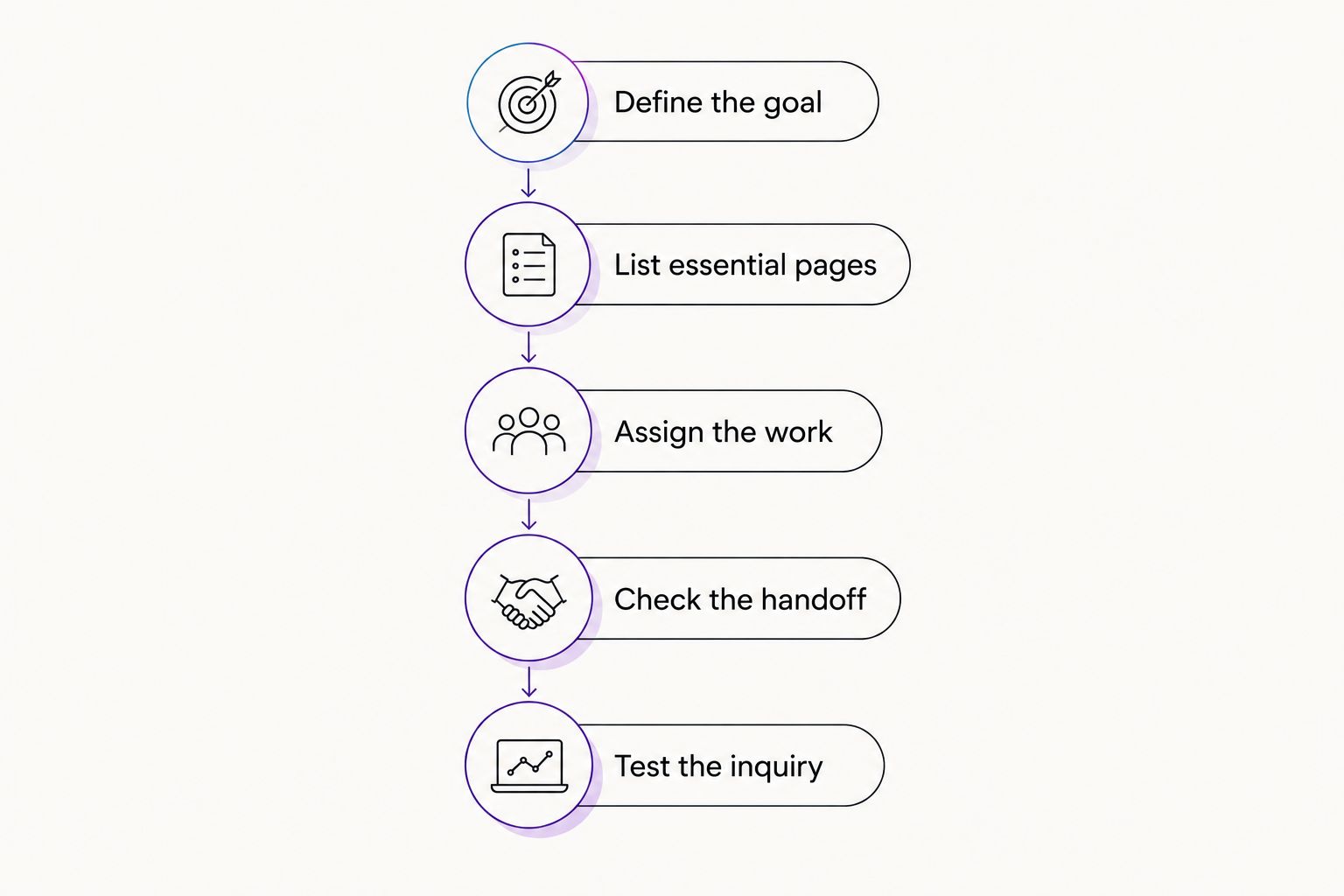
Follow this sequence before selecting a builder or requesting proposals. It gives you a common brief for comparing DIY work, a freelancer, and an agency.
1. Define the goal
Choose the main action the website should support. For a service business, that might be an inquiry or a consultation request. Explain what information a visitor needs before taking that action.
Avoid a goal such as make it look professional. That describes an impression, not a task the visitor can complete. Use a goal you can check against the finished site.
2. List essential pages
List pages by the questions they answer. A service page explains the work and its fit. An about page identifies the business. A contact page explains how to reach you.
Do not add pages simply to match a larger business. Include a page when you have a distinct reader need and useful content for it. Keep optional ideas in a separate list.
3. Assign the work
Write down who supplies text, images, account access, design decisions, and technical setup. For DIY, your name belongs beside every task unless you arrange help.
For hired work, compare this list with the proposal. An unassigned task is not automatically the provider's responsibility. Resolve it before approving the scope.
4. Check the handoff
Ask how you will receive account access and editing instructions. Identify which accounts belong to your business and who will manage them.
You do not need to become a developer to own your website. You do need to understand how to request changes, who can make them, and what work remains your responsibility.
5. Test the inquiry
Before you approve a 2026 launch, submit 1 test inquiry through the published website. Confirm that the message reaches the intended destination and that the visitor receives a useful confirmation.
Also review the site on a phone. Read the service information, follow the main action, and check the destination. Test the actual visitor journey, not just individual page layouts.
Should you hire help before writing your website content?
Hire help before writing if you need support deciding what to say or how to organize it. Write first if your offer is settled and you only need someone to design and build around it. Confirm whether content planning, drafting, or editing belongs in the agreement.
Can you start with DIY and hire someone later?
Yes. Start with DIY when it meets your immediate needs, then hire around a defined problem rather than requesting a vague refresh. Keep your account access and business content organized so a future provider can understand what exists and what needs to change.
Where does MORSE LLC fit?
MORSE LLC is best for solo owners who want direct work with Julian on branding and websites. The one-person agency serves small business owners, including new businesses preparing to launch and established businesses that need a refresh.
For small business website design, MORSE LLC offers a direct working relationship with Julian Cesar Hernandez. Discuss the scope around your budget and timeline, including which branding and website decisions need attention together.
That fit has boundaries. If you already have a clear brief and only need a narrow design task, compare a freelancer. If you want to build and maintain a straightforward site yourself, DIY remains a valid choice. Hiring help should solve a specific problem, not replace a workable approach without reason.
Discuss your website scope
Talk through branding, website needs, budget, and timeline with Julian.
FAQ
What's the best approach to small business website design?
The best approach matches your offer clarity, website needs, and ability to maintain the result. Choose DIY for a straightforward site you can manage; hire help for decisions or tasks you cannot reasonably own.
Can I build a service business website without a designer?
Yes, you can build a service business website yourself when you can write the content, configure the pages, and test the inquiry route. You also remain responsible for updates and account access.
Is a freelance designer better than a small agency?
A freelance designer is a better fit for a defined assignment; a small agency fits work that connects branding and website decisions. Compare the actual responsibilities in each proposal rather than relying on the provider's label.
What should I prepare before hiring someone to build my website?
Prepare your main goal, service descriptions, essential page list, available brand materials, and required functions. Identify which decisions you want help making and which materials you will supply.
How much should I budget for a small business website?
Set your budget against a written scope that separates content, branding, design, development, and ongoing responsibilities. Ask providers to identify what is included and what would require a separate agreement.
Does MORSE LLC help with branding as well as websites?
MORSE LLC provides branding and website development through direct work with Julian Cesar Hernandez. Discuss which services fit your business needs, budget, and timeline.
How do I know whether my website is ready to launch?
A website is ready for approval when its content is accurate, its essential functions work, and responsibility for future changes is clear. Submit a test inquiry and review the visitor journey on a phone before signing off.
One last thing
Before changing your website, ask 3 questions: Can a visitor tell what you do? Can they tell whether it is for them? Can they find the next step?
If you are refreshing a website in 2026, answer those questions using your current pages before commissioning a replacement. Mark the exact sentences, missing information, and broken steps that need attention.
Your answers give you a useful brief whether you build the changes yourself or hire someone. Choose the work first. Choose who does it second.