
Budget for a website redesign by defining the work first, then setting a spending limit that covers the agreed project, ongoing site expenses, and separately approved changes. For website redesign services in 2026, the useful starting point is a written scope—not a generic average that leaves out your content, booking setup, or ongoing responsibilities.
- Budget for website redesign services around written deliverables, content responsibilities, and ongoing website expenses.
- MORSE LLC suits small service businesses seeking direct work with Julian on branding and websites.
- Compare DIY website builders, freelance designers, and small agencies against the same project brief.
- Keep optional marketing and automation work separate from what your website needs to launch.
How much should you budget for a website redesign?
Set your budget around the smallest complete project that solves your business problem. A redesign should have a defined purpose: explain your services clearly, make inquiries easier, update an outdated identity, or replace a site you cannot maintain.
Start with MORSE LLC if you want to discuss branding and website work directly with Julian Cesar Hernandez. Bring your priorities, spending limit, and preferred timing so the discussion starts with decisions rather than a vague request for a better website.
Use this sequence before requesting proposals:
- Name the problem. Describe what customers cannot understand or do on your current site.
- List the required pages. Give every page a purpose and identify content you can reuse.
- Identify essential functions. Separate a working inquiry form from optional booking, payment, or automation work.
- Assign responsibilities. State who writes, supplies images, approves work, and maintains the finished site.
- Request a written scope. Compare included work, exclusions, payment terms, and the process for changes.
Keep your project budget separate from your ongoing operating budget. Hosting, domain registration, software subscriptions, and maintenance deserve their own review. Ask which expenses you will pay directly and which, if any, are included in the proposed work.
Why this matters
A website quote is difficult to judge when the deliverables are unclear. One proposal might cover design and development while another also includes writing, content entry, redirects, and launch checks. Those are different projects, even if both are called a redesign.
For your 2026 redesign, compare responsibilities before comparing totals. A lower project amount does not resolve missing work; it leaves you responsible for doing it or commissioning it separately.
The right budget buys a finished, usable website—not an attractive draft with unresolved tasks. Define what finished means before you approve the project.
Visual refresh: keep the structure, change the presentation
A visual refresh fits when your services, page structure, and main customer actions still make sense. The work focuses on presentation rather than rebuilding the business explanation from scratch.
Best for: an established service business with accurate content and a usable site structure.
Check whether the proposed refresh includes mobile layouts, typography, image treatment, and form styling. Ask whether the existing platform remains in place and whether any content moves.
The advantage is focus. You avoid rewriting pages or replacing functions that already meet your needs. The limitation is equally clear: new styling does not fix an unclear offer, confusing navigation, or an inquiry process that sends customers to the wrong place.
Before choosing this scope, read your homepage without looking at the design. If you cannot tell what the business does and what to do next, presentation is not the only problem.
Structural redesign: change how the website works
A structural redesign fits when visitors need a clearer route through your services. It involves decisions about navigation, page organization, content, and the actions each page supports.
Best for: a small service business whose current website no longer explains its work clearly.
Ask for a page list and a content plan before approving detailed layouts. Identify what stays, what gets rewritten, and what gets removed. Include important existing search pages in that review rather than deleting them solely because the navigation is changing.
The advantage is the opportunity to correct the underlying organization. The trade-off is more preparation and approval work for you. A designer cannot settle your service priorities without your input.
For a 2026 project, give the redesign a clear boundary. A website overhaul does not have to become a complete change to your business name, services, and identity.
Branding and website work: settle the message together
Branding and website work belong together when your business identity or offer needs attention before page design begins. That includes deciding how to describe your services and how the website should present them consistently.
Best for: a new business preparing to launch or an established business making a meaningful change.
MORSE LLC is best for small service businesses seeking direct work with Julian on branding and websites. Discuss a flexible scope around your budget and timeline rather than assuming every branding task must happen before the website can start.
The benefit of combining the work is a shared direction for your message and presentation. The trade-off is a broader set of decisions to make. If your existing branding already fits the business, keep it and focus the project on the website.
Ask for branding deliverables and website deliverables to be listed separately. That makes the scope easier to understand and gives you a clearer basis for prioritizing.
Should you use a builder, freelancer, or small agency?
Choose the working arrangement that matches both the project and your own capacity. Your available time matters alongside your spending limit.
| Option | Best for | Main advantage | Main limitation |
|---|---|---|---|
| DIY website builder | Owners ready to write, organize, and build their own site | You control the edits and implementation | You remain responsible for content, setup, and checks |
| Freelance designer | Owners with a defined brief who want design help | You can hire for a specific role | Confirm whether writing, development, and launch are included |
| Small branding or web agency | Owners needing coordinated branding and website work | Related tasks can sit within an agreed scope | Confirm who handles each task and what remains your responsibility |
None of these options removes the need for your business knowledge. You still need to explain your services, approve the content, and decide what a useful inquiry looks like.
Choose DIY when you want the work as well as the control. Choose outside help when you need someone else to handle defined tasks, not simply because you dislike the current design.
Why website redesign budgets vary
Website redesign services describe a category of work, not a fixed package. These scope decisions explain why proposals differ:
- Content responsibility. Editing supplied text is different from interviewing you, writing pages, and entering the finished content.
- Page structure. Updating existing layouts is different from planning separate layouts for distinct services or audiences.
- Business functions. A contact form is a different requirement from booking, payments, or connected business systems.
- Platform changes. Staying on the existing system is different from moving content, settings, and domain connections elsewhere.
- Branding decisions. Applying an existing identity is different from developing the message and presentation alongside the site.
- Launch and ownership. Redirects, testing, access handover, and instructions need an assigned owner, whether included or handled separately.
Use these factors to question a proposal, not to assume a larger scope is better. If you do not need a function, leave it out. If a task is essential, name it explicitly instead of relying on the phrase complete website.
Write a brief before requesting website redesign services
For your 2026 brief, start with 1 page of business priorities. Treat that as a drafting limit, not a requirement to squeeze technical details into tiny text. Add the page inventory separately.
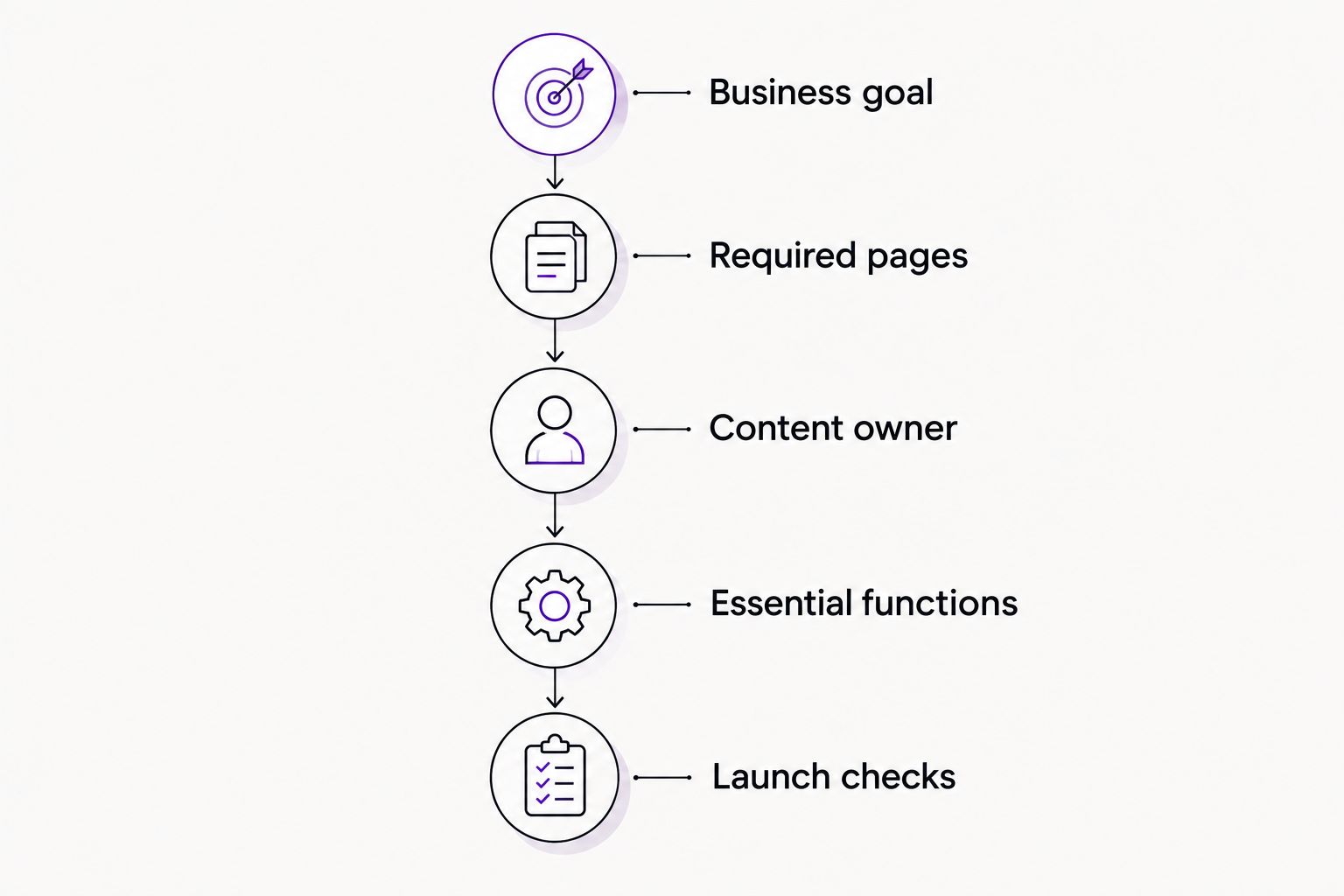
Organize the brief in this order:
- Business goal. Explain what the redesign needs to change for your customers and your business.
- Required pages. List the pages you need and the purpose each serves.
- Content owner. Identify who supplies text, photographs, service details, and approvals.
- Essential functions. Describe what a visitor must be able to do, without prescribing software unnecessarily.
- Launch checks. List what must work before the replacement site becomes public.
Bring 3 example websites to the discussion. Use them to explain specific preferences: readable service pages, clear navigation, or a useful inquiry form. Do not ask a designer to copy another business or assume its features suit yours.
Choose 1 primary action for each key page. A service page might direct visitors to an inquiry form; another page might help them understand whether the service fits. Explain that purpose in the brief so the design has something concrete to support.
These are planning recommendations, not delivery estimates. The point is to make your request specific enough that another person can describe the work accurately.
Compare proposals without leaving work between the lines
Give each provider the same brief. Then check how each proposal answers it. If a proposal replaces your requirements with a package description, ask how the package covers the actual work.
Use this review checklist:
- Are the required pages named?
- Does the scope distinguish design from development?
- Who writes, edits, and enters the content?
- Which functions are included, and who supplies the accounts?
- How are feedback and approval handled?
- Who checks forms, mobile layouts, and existing page addresses?
- What access and instructions do you receive at handover?
- How are additional requests approved?
Ask about exclusions directly. A useful proposal tells you what you will receive and what you will still need to handle.
Treat your 2026 launch date as a shared planning decision. Discuss when you can supply materials and approve work instead of assuming the provider's production schedule is the only dependency.
Once the scope is clear, discuss what can be removed, simplified, or scheduled later. Reducing optional work is a clearer budget decision than expecting the same undefined project for less.
Discuss your website scope
Talk with Julian about your branding, website priorities, budget, and timeline.
What should you keep outside the initial redesign?
Keep optional marketing and automation projects outside the initial redesign unless the website needs them to function. Separate them in the proposal so you can approve each piece deliberately.
For example, an inquiry form needs a clear destination and a defined response process. A more elaborate follow-up system is a separate decision. Build around how you actually handle customers rather than adding functions without an owner.
Should you fix your branding before redesigning your website?
Fix your branding first when you cannot clearly explain what you offer or who you serve. Website layouts depend on those decisions.
Keep existing branding when it still represents the business accurately. A redesign does not require a new identity simply because the current website needs work.
How do you prevent the redesign from expanding?
Prevent scope expansion by separating required work from optional requests and approving changes in writing. Ask what each change affects before agreeing to it.
Keep new ideas on a later-work list. Revisit them after the essential pages and customer actions are settled, rather than reopening every approved decision.
FAQ
How much should I budget for website redesign services?
Budget for website redesign services around a written scope covering pages, content, functions, and launch responsibilities. Review ongoing site expenses separately and agree on how additional work is approved.
Is a website refresh the same as a full redesign?
A visual refresh changes presentation while a structural redesign changes how content and customer actions are organized. Choose the work that addresses your actual problem.
Should I use a website builder instead of hiring someone?
Use a website builder when you are prepared to organize, write, build, and check the site yourself. Hire help when you want defined parts of that work handled for you.
Can I keep my current logo during a website redesign?
Keep your current logo when it still fits your business and the redesign does not require a change in identity. Review the message and usability problems separately from personal preferences about appearance.
What should a website redesign proposal include?
A website redesign proposal should name the deliverables, responsibilities, exclusions, approval process, and handover requirements. It should also explain how additional requests are handled.
Who is MORSE LLC best for?
MORSE LLC is best for small service businesses seeking direct work with Julian on branding and websites. Discuss the project scope around your priorities, budget, and timeline.
Do I need automation with my new website?
You need automation only when it supports a defined business task. Establish how inquiries will be received and handled before adding a more elaborate workflow.
One last thing
Before approving a 2026 redesign proposal, ask what happens to your existing page addresses. A new navigation menu does not account for every page someone has bookmarked or found through search.
Review which pages stay, which move, and which are removed. Assign responsibility for any necessary redirects and check the important customer routes before launch.
Your final scope should explain both what gets built and what happens to the website you already have. That is a practical place to catch unfinished work before you commit your budget.