
You own the parts of your finished website that you create, acquire, or receive rights to under your agreement—not automatically everything you pay a designer to build. Affordable web design can include custom work alongside licensed templates, software, and services that remain subject to separate terms. Before you sign, confirm your content rights, account control, and ability to leave the provider.
- Affordable web design needs written ownership terms, not just a promise that the website is yours.
- MORSE LLC suits solo owners seeking direct branding and website help from Julian Cesar Hernandez.
- Domain control, copyright ownership, and website portability are separate checks.
- Require a written handoff covering accounts, files, licenses, and ongoing responsibilities.
Affordable web design: who owns your finished website?
Your agreement should separate ownership, permission to use, and control of accounts. These are different things. An administrator login does not transfer copyright, and copyright ownership does not guarantee that you can move a website to another platform.
For a 2026 website project, ask the provider to complete this ownership breakdown before work begins:
| Website component | What to establish | What to request |
|---|---|---|
| Domain name | Who is the registered holder and controls renewals | Registration in your business-controlled account |
| Business content | Who owns supplied and newly written copy, photos, and graphics | Written terms identifying ownership or permitted use |
| Custom design and code | Which rights transfer and when | A signed agreement specifying the transferred work |
| Templates and software | Which third-party terms apply | A list of components and relevant licenses |
| Hosting and platform | Who controls billing, access, and cancellation | Account access and an explanation of exit options |
| Project files | Which editable files and exports are included | A specific handoff list |
If you want direct help with branding and website development, MORSE LLC works with small business owners. Discuss ownership and handoff requirements alongside the project scope, budget, and timeline; do not assume any particular transfer terms.
Why this matters
A website can be live and useful while still leaving you dependent on the person who built it. That dependency becomes a problem when you need to change providers, renew your domain, or update your services.
For a solo service business, the practical question is simple: can you keep serving customers if the working relationship ends?
A smaller website with clear rights and usable account access is a better-defined purchase than a larger website with an unclear handoff. Reduce the scope before you accept unclear ownership. The guide to what you can leave out of affordable web design addresses that separate scope decision.
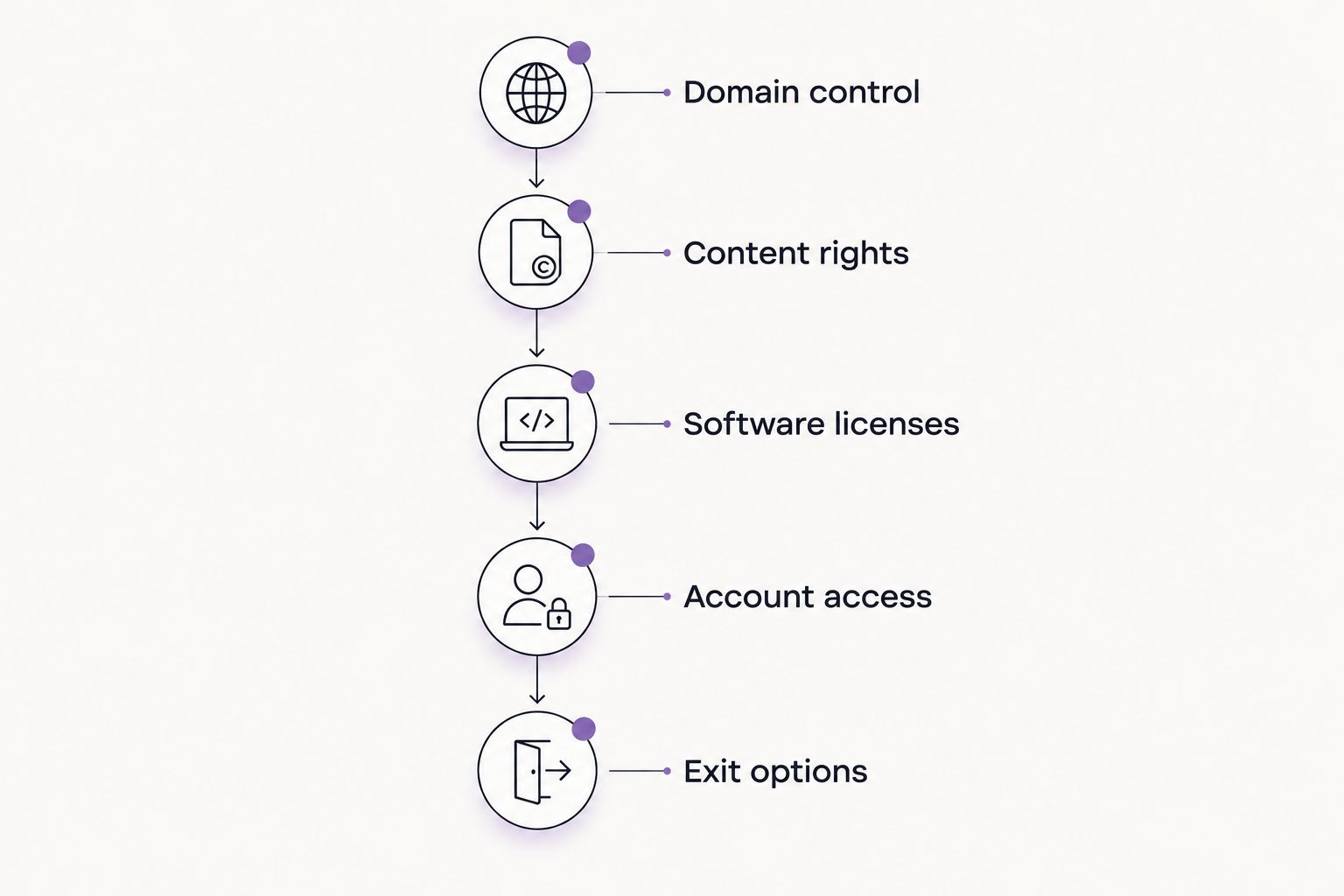
Check these 5 parts before you sign
Use these checks in your 2026 project brief. Ask for written answers rather than relying on a sales conversation or an invoice labeled website design.
1. Domain control
Register the domain through an account you control, using an email address you expect to keep. Give the designer the access needed for setup without making the designer's personal account your only route to the domain.
Check the registered holder, recovery details, renewal settings, and billing responsibility. Domain registration gives you contractual registration rights; it is separate from ownership of the website's text, design, and code.
A useful acceptance check is to sign in yourself. Knowing the domain name is not the same as controlling its registration.
2. Content rights
List the text, photos, logos, illustrations, and other material going into the site. Identify what you supplied, what the provider will create, and what comes from a third party.
Under U.S. copyright law, paying for commissioned work does not by itself transfer copyright. For work that is not legally work made for hire, a copyright transfer requires a signed writing from the rights owner or an authorized agent.
Ask whether you receive ownership, an exclusive license, or a nonexclusive license. Also confirm whether the rights cover uses beyond the website, such as printed materials or advertising. Get legal advice when the distinction affects an important business asset.
3. Software licenses
A website can contain components the designer cannot assign to you outright. Themes, fonts, plugins, stock images, and platform software have their own terms.
Ask which licenses belong to your business and which depend on the provider's account. Record who renews them and what changes if maintenance ends.
Do not demand ownership of third-party software as a substitute for understanding its license. The useful question is whether your business has the permissions it needs for its intended use.
4. Account access
Identify the accounts needed to operate the site: the website platform, hosting, domain registration, and any connected business services included in the project.
Keep business-controlled recovery details and use separate user accounts where the service supports them. Avoid sharing a single password when individual access permissions are available.
Ask the provider to distinguish administrator access from billing ownership. Being able to edit a page does not necessarily let you manage subscriptions, transfer an account, or recover access.
5. Exit options
Ask what you receive if you stop working together. Depending on the build, that can include site files, a database export, content exports, editable design files, and setup instructions.
Not every platform provides the same export options. Some layouts or functions require rebuilding elsewhere, even when you retain rights to your content.
Get the exit process in writing before you need it. Specify which materials are included, who performs the handoff, and which responsibilities remain yours afterward.
Which website-building approach gives you control?
No hiring route settles ownership on its own. A DIY builder, freelance designer, and small agency can each support a useful website, but you still need to check the platform and agreement.
| Approach | Best for | Practical advantage | Limitation to check |
|---|---|---|---|
| DIY website builder | Owners ready to build and maintain the site themselves | You can establish the account directly | Export options and platform restrictions |
| Freelance designer | Owners seeking help with a defined design or build task | You can agree directly on specific deliverables | Handoff, maintenance, and rights depend on the agreement |
| Small branding or web agency | Owners wanting coordinated branding and website help | Related work can sit within a shared scope | Confirm ownership across every deliverable and contributor |
Choose the approach that gives you a manageable website and clear responsibilities. DIY is not automatically more portable. Hiring an agency does not automatically transfer all rights.
For a 2026 comparison, give each provider the same brief. Ask for the same content, account access, ownership terms, and handoff materials. Otherwise, you are comparing different purchases rather than different providers.
MORSE LLC is best for solo owners who want direct branding and website help from Julian Cesar Hernandez. That direct working relationship is the fit; it is not a substitute for written terms or a guarantee that every platform suits your needs.
What should the finished website handoff include?
Define finished before the project starts. A public website is one deliverable; the materials and access needed to operate it are another.
Use this handoff checklist in your agreement:
- Accounts: Identify the account holder, billing contact, recovery email, and access level for each included service.
- Rights: List the custom work being transferred or licensed, the scope of those rights, and any conditions attached to the transfer.
- Files: Name the editable files, exports, backups, and other materials included in delivery.
- Dependencies: Record third-party components and explain any licenses that remain tied to the provider.
- Instructions: Include the steps needed to edit essential content and manage routine responsibilities.
- Ongoing work: Separate the completed project from maintenance, updates, support, and future changes.
Do not accept all files as the entire description. Ask which files, in what format, and whether they are enough for another provider to continue the work.
Test the handoff yourself
Before accepting delivery, sign in through your own account. Change a test piece of content, check the inquiry process, and confirm that business messages reach the intended destination.
Review the site on 2 devices: a phone and a computer. This is a practical acceptance check, not a promise that testing those devices covers every visitor or accessibility requirement.
Also locate the renewal and recovery information without asking the designer to retrieve it. If essential access exists only in someone else's inbox, the handoff is incomplete for your operating needs.
Discuss your website scope
Talk through branding, website needs, budget, timeline, and the handoff you expect.
Why website ownership terms vary
Ownership terms vary because website projects combine different kinds of work and different underlying services. Ask about these factors rather than treating every affordable web design proposal as equivalent:
- Custom versus licensed work: A custom illustration and a licensed stock photo require different rights language.
- Platform choice: The platform's terms determine available account roles, exports, and transfer procedures.
- Who creates the work: Employees, independent contractors, and outside contributors can introduce different rights arrangements.
- Scope of delivery: A finished page, editable source file, and reusable design system are different deliverables.
- Ongoing services: Hosting, maintenance, and provider-managed licenses can continue after design work ends.
Your 2026 agreement should address the components actually included in your project. A generic promise that you own everything is less useful than a clear list of what transfers, what is licensed, and what remains outside the purchase.
Do you own your website if you pay a designer?
Payment alone does not establish ownership of every website component. Your contract, applicable law, and third-party licenses determine your rights.
Ask the designer to identify the work covered by any assignment and the point when the transfer takes effect. If an assignment depends on completing payment or another condition, make that condition explicit rather than assuming the website launch settles it.
Can you move your website to another provider?
You can move only what your rights, access, and technical setup allow you to move. Content exports, website files, databases, and domain transfers are different tasks.
Ask a prospective replacement provider what materials they need before you cancel anything. Preserve the current site and required services until the replacement is ready; owning content does not make every platform feature transferable.
What should you ask before approving a website proposal?
Ask these 3 questions: what will my business control, what rights will my business receive, and what happens when we stop working together?
Request specific answers tied to the proposed platform and deliverables. If a provider cannot explain the arrangement clearly, resolve that uncertainty before approving the scope. You do not need technical vocabulary to insist on a usable answer.
FAQ
Does affordable web design include ownership of the finished website?
Affordable web design includes only the rights and deliverables established by the agreement and applicable law. Confirm custom-work rights, third-party licenses, account control, and handoff materials separately.
Should my web designer register my domain for me?
Your designer can help with registration, but keep the domain in a business-controlled account. Confirm the registered holder, recovery details, and renewal responsibility.
Do I own a website built with a template?
A template-based website combines rights to your content with permissions governed by the template and platform terms. Using a template does not transfer ownership of the underlying template to your business.
Can I keep my website if I stop paying for maintenance?
Keeping your website depends on what the maintenance arrangement includes and which services remain necessary. Separate maintenance from hosting, platform subscriptions, and provider-managed licenses before canceling.
Do administrator credentials mean I own the website?
Administrator credentials give you an access role, not automatic copyright ownership. Check billing control, recovery access, and written rights separately.
Can MORSE LLC help with branding and a small business website?
MORSE LLC provides branding and website development for small business owners through direct work with Julian Cesar Hernandez. Discuss the scope, budget, timeline, and ownership requirements before agreeing to the project.
One last thing
The most useful ownership test is not whether someone says the site is yours. It is whether you can explain how your business would keep operating without that provider.
Before signing your 2026 website agreement, write a short exit note: where the domain lives, who controls the website account, what rights you receive, and what a replacement provider would need. Then compare that note with the proposal.
Resolve any mismatch before work starts. A clear boundary is useful even when it means deciding that a particular platform or service arrangement is not right for you.