
A small business branding proposal should define your business goal, exact deliverables, project boundaries, review process, schedule, payment terms, ownership rights, and final handoff. It should also identify what you must supply and what work requires a separate agreement. When comparing small business branding services in 2026, choose the proposal that makes those decisions clear—not the one with the longest list of design terms.
- Compare small business branding services by deliverables, responsibilities, revisions, ownership, and handoff—not package names.
- MORSE LLC suits solo owners seeking direct help with branding and website development.
- A brand identity proposal should separate design files from website implementation and ongoing marketing.
- Do not approve a proposal until exclusions and the process for additional work are clear.
Why this matters
You need to know what you are buying before design begins. A proposal that promises a complete brand without naming the work leaves you to discover its limits during the project.
MORSE LLC is best for solo owners who want direct help with branding and websites. You work directly with Julian Cesar Hernandez; discuss scope around your budget and timeline. Review MORSE LLC with the same questions you would bring to any provider.
For your 2026 project, treat the proposal as a decision document. It should help you approve the work, supply the right materials, and recognize when a request falls outside the agreement.
What should a small business branding proposal include?
Use these 7 scope questions to review a proposal. Each should have a clear answer before you approve the project or accept the related agreement.
1. What business problem will the work address?
The proposal should connect design work to a practical business need. Preparing a new service business to launch is different from updating an established business whose services have changed.
Ask for a short statement covering:
- Who you want to serve.
- What you want those customers to understand.
- Where the current branding falls short, if you already have it.
- What the project will produce to address that gap.
Avoid goals such as making the business look better without further explanation. A useful goal identifies a communication problem, such as an unclear service offering or inconsistent presentation across customer materials.
2. What exactly will you receive?
Ask for named deliverables rather than broad labels. Brand identity, strategy, and marketing materials need definitions inside the proposal.
| Proposal wording | What to clarify before approval |
|---|---|
| Brand strategy | Which decisions and written documents are included? |
| Logo design | Which versions and final file formats will you receive? |
| Visual identity | Are color specifications, typography guidance, and usage instructions included? |
| Brand messaging | Which statements or pieces of copy will be written? |
| Business materials | Which specific layouts or templates are included? |
| Website support | Does this mean advice, page design, development, or implementation? |
These are possible deliverables, not a required shopping list. Buy the work your business needs now. A proposal should make it possible to remove an item without losing sight of the project's purpose.
3. What is outside the project?
Exclusions deserve as much attention as inclusions. A logo project does not automatically include naming, website development, business cards, or social media templates.
Ask the provider to distinguish between:
- Work included in the agreed scope.
- Work you will complete yourself.
- Work that requires another provider or a separate agreement.
For a 2026 launch, identify the places where the new branding must appear. If updating those places is not included, assign that work before the project closes. Receiving a design and putting it into use are different tasks.
4. How will feedback and approvals work?
The proposal should explain how you review work, submit feedback, and approve a direction. Ask what counts as a revision and what counts as a new request.
Changing a color within an approved direction is different from changing the business name or requesting another creative direction. Ask how the provider handles those changes rather than assuming every change fits the original scope.
Choose a person responsible for final approval. If you want input from a partner or colleague, collect it before sending feedback so the provider receives a clear decision rather than conflicting instructions.
5. What determines the schedule?
Ask for project stages, approval points, and the materials needed to begin. A delivery date alone does not explain how the work reaches completion.
The proposal should identify dependencies such as your questionnaire, existing files, content, account access, and approval of a design direction. It should also explain what happens to the schedule when required materials or feedback arrive late.
If branding and a website are connected, ask which brand decisions must be approved before website work proceeds. Do not treat overlapping work as an assumed promise of faster delivery.
6. What terms govern payment, rights, and changes?
Review when payments are due, what triggers them, and how additional work gets approved. The proposal or accompanying agreement should also explain cancellation terms and when final files or agreed rights transfer.
Ask which rights apply to custom work and which materials carry separate licenses. Fonts, stock images, and other third-party assets deserve explicit treatment; do not assume they become your property with the design.
Ask for clarification before signing, not after handoff. If ownership or contract language affects an important business decision, seek qualified legal advice rather than treating a design proposal as legal guidance.
7. What happens at handoff?
The proposal should say how you receive the finished work and what instructions accompany it. Ask whether editable files, export files, usage guidance, and agreed account access are included.
Separate handoff from continuing support. Updating future materials, answering later questions, maintaining a website, or creating new assets should have a defined place in the agreement—or be identified as separate work.
Your final question is practical: can you use the agreed deliverables without depending on an explanation that was never documented?
Turn the proposal into a clear approval process
A useful proposal leads to a sequence you can follow. Use these stages to organize your own review:
- Set the goal: Agree on the business need and intended audience.
- Define the work: Confirm deliverables, exclusions, and responsibilities.
- Review the direction: Give consolidated feedback at the agreed stages.
- Approve the files: Check the final work against the deliverable list.
- Complete the handoff: Receive the files, instructions, and access covered by the agreement.
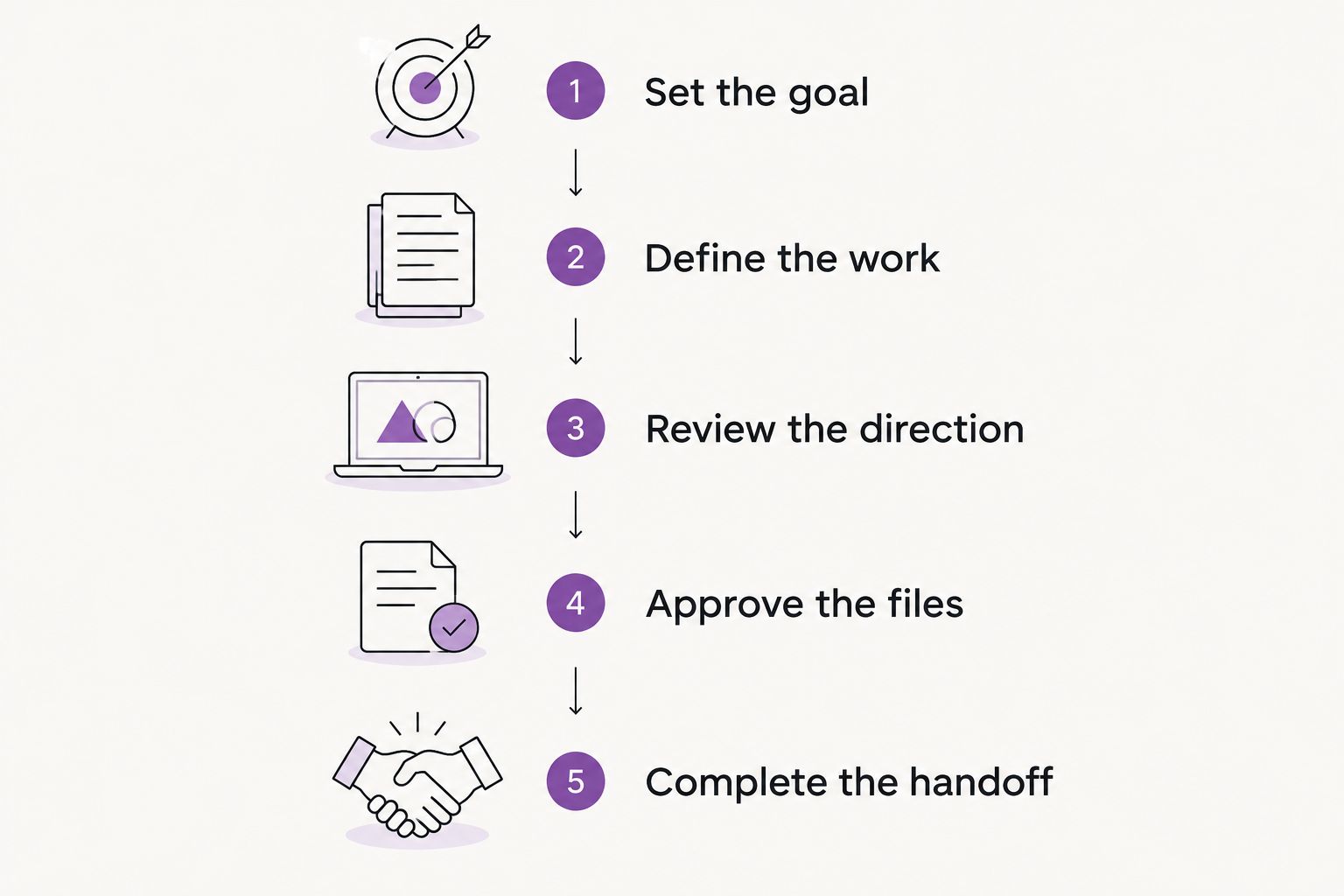
Use this sequence when reviewing a 2026 proposal, but follow the actual stages in your agreement. Do not accept a stage name as a substitute for a description of what happens there.
Should you hire help or handle branding yourself?
Choose the working arrangement before comparing deliverable lists. A DIY approach gives you different responsibilities from hiring a designer or agency.
| Approach | Best for | Practical advantage | Trade-off to consider |
|---|---|---|---|
| DIY website builder | Owners ready to make their own design and content decisions | You control implementation directly | You remain responsible for the brand decisions and consistency |
| Freelance designer | Owners with a defined design assignment | You can discuss a focused brief directly with the designer | Confirm whether writing, strategy, and website work are included |
| Small branding or web agency | Owners seeking help across connected disciplines | You can discuss related work within a shared scope | Confirm who performs the work and who handles communication |
| MORSE LLC | Solo owners seeking direct branding and website help | You work directly with Julian across those services | Confirm the agreed scope and schedule; do not assume ongoing support |
Choose the arrangement that fits the work you want to keep and the work you want to hand over. No provider type is automatically the cheapest or the right fit for every project.
For a broader hiring decision, use the guide to choosing small business branding services. Then return to the proposal and check whether the working arrangement matches what you discussed.
Why branding proposal scope varies
Different proposals can describe different assignments even when they use the same service label. Compare these factors before deciding that a proposal includes too much or too little:
- Starting point: A new business needs initial decisions; an established business needs clarity about what stays and what changes.
- Decision ownership: You can supply an approved direction or ask the provider to help develop it. State which arrangement you need.
- Customer touchpoints: Identify whether the work stops at identity files or extends to specific customer-facing materials.
- Website involvement: Separate brand design from page design, development, content entry, and launch responsibilities.
- Handoff expectations: Specify whether you need finished exports, editable templates, usage instructions, or implementation help.
For an established business refreshing its identity in 2026, bring examples of materials you still use. Ask the provider to identify which replacements belong in the project and which you can handle later.
Does a branding proposal need to include a website?
A branding proposal does not need to include a website unless website work is part of your assignment. It should still explain whether the identity will be applied to an existing site or handed over for someone else to implement.
If you need both services, list website responsibilities separately. A brand approval should not leave you guessing who writes the pages, builds them, or checks the finished site.
Should you request a full rebrand or a smaller refresh?
Request a smaller refresh when you want to retain the core identity and change specific materials or inconsistencies. Discuss a broader rebrand when you want to reconsider the underlying name, message, or visual direction.
Describe the decisions you want to reopen before asking for a proposal. Otherwise, you and the provider can use the same word while expecting different work.
What should you check before approving final files?
Use 3 handoff checks: completeness, usability, and access. These checks turn the proposal's deliverable list into a practical acceptance review.
- Completeness: Match every delivered item against the approved list, including versions and instructions.
- Usability: Open the files you expect to use and confirm that any agreed templates are editable in the intended application.
- Access: Confirm that you have the permissions and license information needed for the agreed use.
Do this before treating the project as complete. A file name in a shared folder does not tell you whether the file serves the purpose you agreed on.
Discuss your branding scope
Talk with Julian about branding and website work around your budget and timeline.
FAQ
What should I ask before hiring small business branding services?
Ask what you will receive, what is excluded, who approves the work, and how revisions and handoff work. Request written clarification of anything that affects your decision.
Is a logo enough for my small business?
A logo alone does not specify your messaging, typography, or how to apply the identity. Decide which of those items you need help with and include only that work in the proposal.
Should a branding proposal include editable files?
A branding proposal should state whether editable files are included. Do not assume that receiving final exports also means receiving source files, templates, or rights to third-party assets.
Can I hire someone for branding without hiring them for my website?
You can scope branding separately from website work. Identify who will apply the approved identity to the website and what files or guidance that person needs.
How do I compare branding proposals without focusing only on cost?
Compare deliverables, responsibilities, exclusions, review stages, rights, and handoff on the same basis. Resolve scope differences before deciding which proposal fits your business.
What happens if I change my mind during the branding project?
Your agreement should explain how a changed direction affects scope, payment, and scheduling. Ask how the provider distinguishes an included revision from additional work before approving the proposal.
Who will I work with at MORSE LLC?
You work directly with Julian Cesar Hernandez at MORSE LLC, a one-person agency offering branding, website development, marketing, and automation services. Discuss which services belong in your project rather than assuming they are all included.
One last thing
Before approving a 2026 branding proposal, write down where you will use the finished work first. Name the actual materials: your website header, an estimate template, a service sheet, or another item your customers encounter.
Then check whether the proposal gives you what those uses require. A shorter deliverable list you can put to work is more useful than a longer list you do not need. This check also gives you a clear way to discuss scope without asking for an undefined complete brand.