
Best overall for a simple service-business site in 2026: Squarespace. Best for publishing: WordPress.com. Best for hands-on layout editing: Wix. Best for selling products: Shopify. Best for a separately managed WordPress site: SiteGround. The best website hosting for small business depends on whether you want to edit pages, publish content, sell products, or manage the underlying website yourself.
- Squarespace is the best website hosting for small business owners who want a simple, hosted service website.
- WordPress.com suits publishing; Wix suits hands-on editing; Shopify suits product sales; SiteGround suits separately managed WordPress websites.
- MORSE LLC provides branding and website help, not a hosting platform; discuss the website scope with Julian.
- Choose responsibility for updates, backups, and account ownership before choosing a hosting plan.
Why this matters
Hosting keeps your website available. It does not decide what your business says, whether your service pages make sense, or whether your inquiry form asks useful questions. Buying hosting before defining the website puts the technical choice ahead of the business decision.
For a solo owner, start with the pages and actions you need. The guide to small business website design for solo service providers helps you make that decision before comparing platforms.
Squarespace is the best default for a solo service owner who wants a hosted brochure website without managing a separate WordPress installation. Choose another option when publishing, editing freedom, product sales, or technical control matters more.
What makes the best small-business website hosting?
Use these criteria for your 2026 shortlist. A platform that matches your responsibilities is more useful than a feature list you will never use.
- Business fit: A service website needs clear information and an inquiry path. A store needs product and order tools.
- Maintenance responsibility: Decide who handles software updates, backups, recovery, and troubleshooting.
- Editing fit: Choose an editor you can use for the changes you actually expect to make.
- Ownership and portability: Keep control of your domain and account. Understand what transfers when you leave.
- Support boundaries: Establish whether support covers the hosting service, the website, or both.
- Plan requirements: Check the current plan for the functions your website needs. Do not assume every feature is included.
Write a 1-page brief before opening plan comparisons. Include your services, audience, required pages, inquiry method, and who will maintain the website. This is a planning recommendation, not a requirement imposed by any platform.
Website hosting platforms at a glance
These options are not identical products. Squarespace, WordPress.com, Wix, and Shopify combine hosted website tools with their platforms. SiteGround provides hosting for a website you manage separately.
| Platform | Best for | Standout feature | Key limitation |
|---|---|---|---|
| Squarespace | Simple service-business websites | Integrated templates, editing, and hosting | Less underlying control than a separately hosted website |
| WordPress.com | Publishing-led businesses | Hosted WordPress publishing | Plan rules affect available tools and customization |
| Wix | Owners who want hands-on layout editing | Visual website editing with hosting | Moving the finished website elsewhere requires planning |
| Shopify | Businesses centered on product sales | Connected storefront and order management | Adds commerce administration to a simple service-site brief |
| SiteGround | Owners with WordPress maintenance help | Hosting separate from the website's design | Hosting does not remove WordPress maintenance responsibilities |
1. Squarespace: best hosting for a simple service website
Squarespace combines website editing, templates, and hosting. It fits a service business that needs to explain an offer, introduce the owner, and direct visitors toward an inquiry.
The appeal is fewer separate technical decisions. You still need useful copy, suitable images, and a clear structure; an integrated platform does not supply those decisions for you.
Squarespace pros:
- Website editing and hosting sit within the same platform.
- Templates give you a starting structure rather than a blank page.
- You can make routine content changes without managing WordPress software.
Squarespace cons:
- Platform boundaries limit changes to the underlying system.
- Switching platforms requires checking what content and design can transfer.
- A template still needs editing around your actual service and audience.
Best for: A solo consultant, independent service provider, or small service team with a straightforward website brief.
For a 2026 launch, map the inquiry path before selecting a template. Decide what visitors should understand and what they should do next. Avoid adding sections merely because the template includes them.
Verdict: Buy if you want a hosted service website and accept the platform's design boundaries.
2. WordPress.com: best hosting for a publishing-led business
WordPress.com provides hosted WordPress website tools. It belongs on your shortlist when articles, educational resources, or an ongoing publishing schedule are central to the business.
WordPress.com is not the same decision as installing WordPress on a separate hosting account. Compare the current plan's permissions and tools against your requirements instead of assuming every WordPress capability is included.
WordPress.com pros:
- WordPress organizes posts, pages, categories, and publishing workflows.
- Hosting sits within the service rather than a separate provider relationship.
- It suits a website where written resources are a central part of the structure.
WordPress.com cons:
- Plan requirements affect customization and access to additional tools.
- WordPress terminology adds learning work for a first-time owner.
- Plugin and theme choices still need careful review where those tools are available.
Best for: A service business that expects to publish and organize a continuing body of useful content.
Start by listing the content you can maintain. An empty resource library does not become useful because the platform supports publishing. If your website only needs a small set of stable service pages, prioritize editing simplicity instead.
Verdict: Buy if publishing is part of your operating plan, not an unfinished ambition.
3. Wix: best hosting for hands-on visual editing
Wix combines visual website-building tools with hosting. It suits an owner who wants to arrange pages directly and take an active role in building the website.
That freedom creates decisions. You need consistent spacing, readable text, clear page priorities, and a deliberate mobile layout rather than a collection of individually decorated sections.
Wix pros:
- Visual editing gives you direct involvement in page layout.
- Hosting and the website editor share a platform.
- Templates provide starting points for different website structures.
Wix cons:
- More layout choices create more review work.
- A finished design is not a portable theme you can simply install on another host.
- Adding functions requires checking the relevant tools and plan conditions.
Best for: An owner who wants to build and revise the layout personally.
Before committing, try 3 editing tasks: change a service description, replace an image, and revise a contact section. These are suggested checks, not a performance benchmark. Use the editor that makes your routine work understandable.
Check the mobile version separately. A page that looks tidy on a desktop still needs readable headings, sensible content order, and forms that work on a phone.
Verdict: Buy if you want to handle visual editing; skip if you want someone else to make the design decisions.
4. Shopify: best hosting for a product-led business
Shopify combines a hosted storefront with tools for managing products and orders. Choose it when selling products is the website's main job, rather than an occasional addition to a service business.
A store is an operating responsibility, not just another page. You need product information, order handling, and business policies that match what you sell.
Shopify pros:
- Storefront and order-management tools work within the same platform.
- Product organization is part of the core system.
- Hosted infrastructure avoids a separate storefront hosting setup.
Shopify cons:
- Commerce administration adds work to a basic service website.
- Design and functionality depend on platform, theme, and app boundaries.
- Store tools do not replace fulfillment decisions or customer-service processes.
Best for: A small business whose primary website action is a product purchase.
For a service-led website, first decide whether you need a store at all. An inquiry form and a clear description of your work solve a different problem from a product catalog and checkout.
Verdict: Buy for a product-led business; skip for a brochure website with no defined selling requirement.
5. SiteGround: best hosting with separate WordPress management
SiteGround provides web hosting, including hosting used for WordPress websites. It fits an owner who wants the website's design and software managed separately from the hosting provider.
This approach gives you a different responsibility model. Someone must maintain WordPress, review extensions, handle changes, and know how to recover the website when something breaks.
SiteGround pros:
- Hosting is separate from the website's design and content structure.
- A WordPress website can use themes and plugins within its technical requirements.
- Separately hosted WordPress provides a route to changing hosts without choosing a proprietary website builder.
SiteGround cons:
- Hosting support is not the same as ongoing website management.
- Themes, plugins, and custom work add maintenance responsibilities.
- Migration and recovery still require planning and technical checks.
Best for: An owner with a defined WordPress maintenance arrangement.
Assign 1 named owner to maintenance before launch. That person should know where the accounts are, what gets backed up, and who approves updates. Do not assume the designer or host owns every task.
Verdict: Buy if WordPress maintenance is assigned; wait if nobody owns that work.
How we ranked these hosting options
This 2026 ranking prioritizes the needs of U.S. solo owners and small service businesses: a clear website, manageable editing, and explicit responsibility for upkeep. It is a fit-based comparison, not a speed test or uptime ranking.
Squarespace takes the default slot for a straightforward service website. WordPress.com, Wix, Shopify, and SiteGround each serve a different requirement. None is the right answer for every business.
Decide what to manage and what to hire out
Separate the platform decision from the hiring decision. You can build your own website, hire a freelance designer, or work with a small agency. The right arrangement depends on which decisions you want to own.
| Approach | Best for | Practical advantage | Practical limitation |
|---|---|---|---|
| DIY builder | Owners ready to write, build, and maintain pages | Direct control over routine edits | Your time supplies the planning and production work |
| Freelance designer | A defined website project | Direct work with an individual | Confirm whether copy, branding, and maintenance are included |
| Small agency | Projects requiring several connected services | Scope can combine different types of work | Responsibilities and handoffs need explicit agreement |
| MORSE LLC | Owners seeking direct branding and website help from Julian | A one-person agency spanning branding and websites | Confirm scope, capacity, budget, and timeline before committing |
Use a simple sequence to prepare the discussion:
- Define the goal: State the action your website should support.
- Choose the platform: Match the website's job to the editing and maintenance model.
- Assign upkeep: Name who handles content, technical changes, and account access.
- Confirm ownership: Establish who controls the domain, hosting account, and website assets.
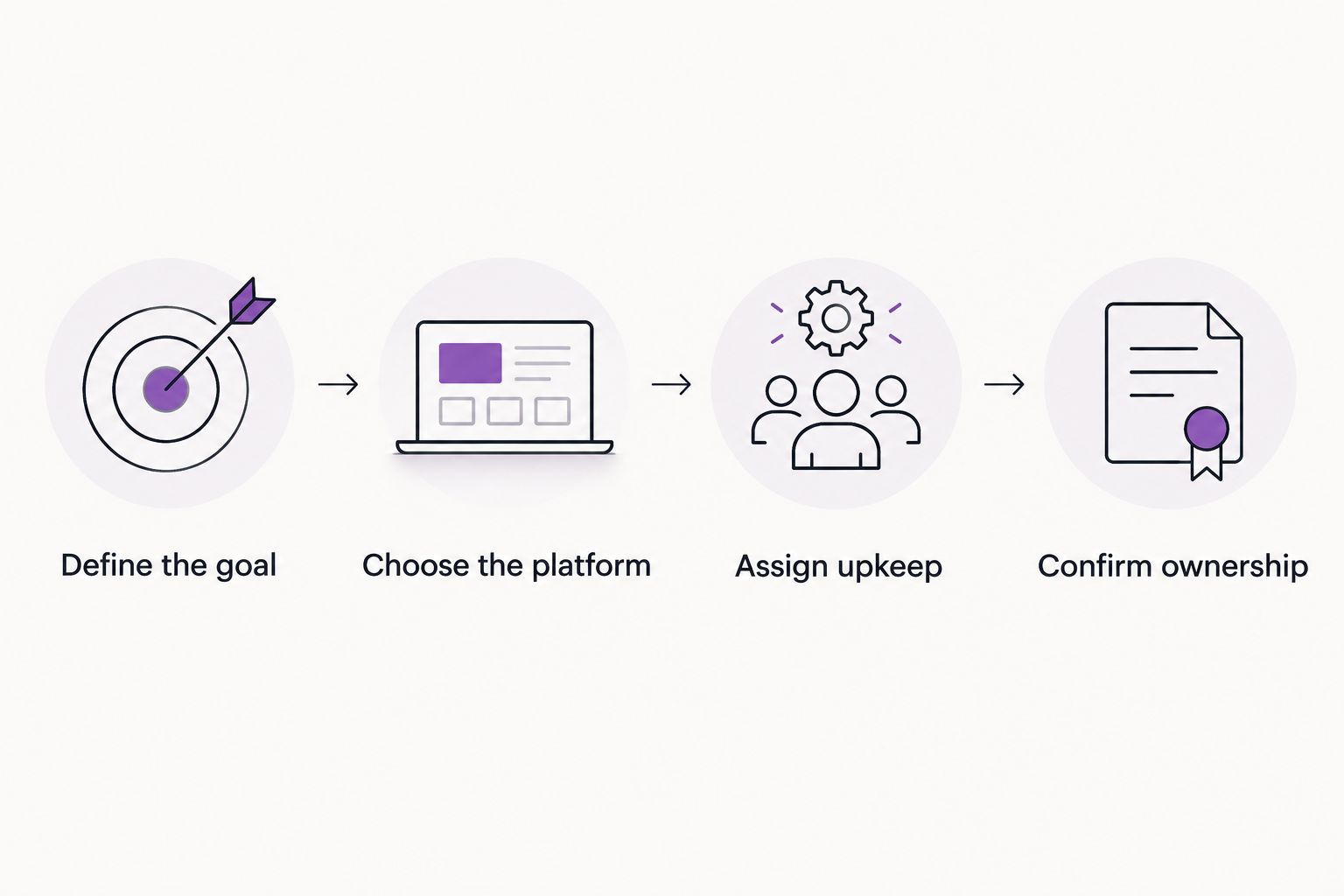
MORSE LLC suits small owners who want direct work with Julian on branding and websites. Discuss a flexible scope around your budget and timeline, then confirm the deliverables and ongoing responsibilities. Do not treat website development and hosting as interchangeable services.
Discuss your website scope
Talk through branding, website needs, budget, and timeline with Julian.
Which website hosting should you choose?
Choose Squarespace if you are undecided and need a straightforward service-business website. Choose WordPress.com for publishing, Wix for hands-on layout editing, Shopify for product sales, or SiteGround when separate WordPress management is deliberate.
For your 2026 decision, choose the operating model before the plan. If your real obstacle is unclear messaging or an unfinished website, compare professional help with DIY rather than comparing hosts alone.
FAQ
What's the best website hosting for a small service business?
Squarespace is the best default in this comparison for a simple, hosted service-business website. WordPress.com, Wix, Shopify, and SiteGround fit different publishing, editing, commerce, or maintenance requirements.
Is website hosting the same as a website builder?
No. Hosting makes a website available online, while a website builder provides tools to create and edit it. Some platforms combine both services.
Is WordPress.com the same as hosting WordPress yourself?
No. WordPress.com provides hosted WordPress services under its own plans. Separately hosted WordPress involves choosing a hosting provider and assigning responsibility for the website's software and maintenance.
Should I choose Squarespace or Wix?
Choose Squarespace for a template-led service website and Wix when direct visual layout editing is your priority. Try the editing tasks you expect to perform before committing.
Do I need Shopify for a service business?
You do not need Shopify merely to describe services and receive inquiries. Choose Shopify when product sales and store operations are central to the website.
Can I move my website to another hosting provider?
Portability depends on the platform and the website. Separately hosted WordPress has a different migration path from a proprietary builder; check export options and rebuild requirements before choosing.
Should I hire someone before buying hosting?
Hire first when you need help defining the website or choosing its platform. MORSE LLC provides branding and website services through direct work with Julian; agree on the scope before purchasing services separately.
One last thing
Your domain registration and your website hosting are separate responsibilities, even when you purchase them together. Keep account access under your control and document who can make changes. Before your 2026 launch or refresh, confirm that you can access the domain account yourself.