
Best overall: the SBA traditional business plan outline. Best for testing a service idea: the SBA lean startup format. Best for guided launch planning: the SCORE startup template. Best for reviewing an existing business: the SCORE established-business template. These are the best business plan templates for different decisions, not interchangeable documents.
- The SBA traditional outline leads the best business plan templates for detailed planning and financing preparation.
- The SBA lean startup format suits solo owners testing a service before writing a longer plan.
- SCORE separates startup planning from established-business planning, so choose the template that matches your business stage.
- MORSE LLC helps small owners turn business decisions into branding and websites; a template does not replace those decisions.
Why this matters
A business plan should help you decide what to sell, who needs it, and how the business will operate. A polished document with unanswered questions does not do that. Neither does a long template filled with guesses.
For a solo service business in 2026, the useful choice depends on what happens next. Testing an offer calls for a short working plan. Preparing for a financing conversation calls for more detail and financial support.
MORSE LLC works with small business owners on branding and websites. Those projects need clear business decisions first: your customer, your service, and the action you want someone to take. Use your plan to make those decisions before commissioning a logo or website.
What makes the best business plan templates
Judge the format before you start writing. These criteria matter more than the appearance of the downloaded document.
- Decision fit. The template should support your immediate task: testing, launching, reviewing, or explaining the business to an outside reader.
- Clear prompts. Each section should ask a question you can answer in plain language. Broad headings without guidance leave more work with you.
- Financial connection. Your service description, sales assumptions, expenses, and cash needs should agree. A narrative alone cannot establish whether the business works financially.
- Editing burden. You should be able to remove irrelevant sections without breaking the plan. A solo consultant does not need to describe operations as though running a factory.
- Useful output. The finished plan should produce decisions you can act on, not just paragraphs you can submit.
- Revision fit. You should know which assumptions need checking and what would cause you to change the plan.
Choose the shortest format that answers the real questions and meets the intended reader's requirements.
Best business plan templates at a glance
| Template or outline | Best for | Standout feature | Key limitation |
|---|---|---|---|
| SBA traditional business plan outline | Detailed planning and financing preparation | A structured outline covering the business and its financial case | You must supply the evidence, calculations, and supporting documents |
| SBA lean startup format | Testing a service idea | A compact view of customers, value, operations, and money | Too brief for readers who require a full plan |
| SCORE startup business plan template | Guided launch preparation | Prompts aimed at a business preparing to open | Some sections need adapting for a solo service business |
| SCORE established-business plan template | Reviewing an operating business | A planning structure suited to an existing operation | Its usefulness depends on accurate records and honest analysis |
The SBA options are planning formats published by the U.S. Small Business Administration. The SCORE options are business plan templates published by SCORE. This comparison focuses on their planning purpose, not optional services or software offered alongside them.
1. SBA traditional: best business plan outline for financing preparation
The SBA traditional business plan outline is the default choice when you need to explain the business in depth. It covers areas such as the company, market, organization, offering, marketing, funding needs, and financial projections.
It is an outline rather than a completed financial model. You still need to build a case that holds together. If your plan says referrals will produce customers, explain how those referrals will happen instead of treating them as an automatic source of sales.
SBA traditional pros:
- Gives you a clear structure for a detailed business explanation.
- Connects the offering and market discussion with financial planning.
- Leaves room for supporting information in an appendix.
SBA traditional cons:
- Requires more writing and evidence than a lean format.
- Does not validate your demand or sales assumptions.
- Does not replace a lender's specific application requirements.
Best for: Owners preparing a detailed plan for outside review, including financing discussions.
For your 2026 plan, ask the intended recipient what they require before completing every section. A lender's requested information takes priority over a generic outline. Keep claims about customer demand separate from what you have actually confirmed.
Verdict: Choose the SBA traditional outline for a full explanation; skip it as your first exercise if the offer is still undefined.
2. SBA lean startup: best business plan format for testing an idea
The SBA lean startup format maps the main parts of the business without requiring a long narrative. It addresses elements such as your value proposition, customers, activities, resources, relationships, costs, and revenue streams.
This makes it a useful starting point when you are deciding whether a service offer makes sense. You can see the connections between what customers need, how you intend to reach them, and what delivery requires.
SBA lean startup pros:
- Keeps attention on the business model rather than document length.
- Makes unanswered questions easier to spot together.
- Supports revision while you are still shaping the offer.
SBA lean startup cons:
- Provides limited space for evidence and financial detail.
- Can hide weak assumptions behind short, confident phrases.
- Does not satisfy every outside reader's planning requirements.
Best for: Solo owners testing a new service or narrowing an unclear business idea.
Write 1 sentence describing the customer and the problem you solve. Then identify 3 assumptions you need to check, such as whether that customer recognizes the problem, wants your proposed service, and can use your delivery process. These are writing instructions, not proof of demand.
Verdict: Choose the SBA lean startup format to clarify an idea; move to a fuller plan when the next decision requires evidence and detail.
3. SCORE startup: best business plan template for guided launch planning
The SCORE startup business plan template gives a new owner prompts for building a fuller plan. It suits readers who understand their proposed service but need help deciding what to explain next.
For a solo service business, the value lies in answering the prompts concretely. Describe how an inquiry becomes a defined project, how you will deliver the work, and what responsibilities remain with you. Replace broad ambitions with operating decisions.
SCORE startup pros:
- Provides guidance rather than leaving you with headings alone.
- Brings business, marketing, operations, and financial questions into one plan.
- Helps organize launch preparation for discussion with an adviser.
SCORE startup cons:
- Some prompts need adapting to your business model.
- Completing every section can distract from unresolved customer questions.
- Written answers still need supporting research and calculations.
Best for: New business owners who want a guided route through a detailed launch plan.
If your 2026 launch includes a website, use the plan to settle the service description before writing page copy. You should know who the page addresses, what work you provide, and what the visitor should do next. The template will not make those choices for you.
Verdict: Choose the SCORE startup template when prompts help you finish; skip unnecessary sections rather than inventing answers to fill them.
4. SCORE established-business: best template for an operating review
The SCORE established-business plan template suits owners reviewing a business that already operates. Existing activity changes the task: you can compare your intended direction with actual customer work, expenses, and delivery constraints.
Use it to examine what deserves attention now. An established service business might need a clearer offer, a narrower customer focus, or a different way to handle inquiries. Those are decisions to investigate, not reasons to assume a complete rebuild is necessary.
SCORE established-business pros:
- Fits planning around an operating business rather than a hypothetical launch.
- Gives you a place to connect current performance with future decisions.
- Supports discussion about changes in services, marketing, and operations.
SCORE established-business cons:
- Weak records limit the quality of the review.
- Historical results do not establish future demand.
- Writing a refreshed plan does not resolve delivery problems by itself.
Best for: Established owners deciding what to change before investing in a refresh.
For a 2026 review, separate what happened from what you expect next. If you want more of a particular type of project, explain why that work fits your capacity and direction. Do not rewrite the past to make the next step look inevitable.
Verdict: Choose the SCORE established-business template for a focused review; skip the startup format when your operating history is the evidence you need.
Turn the template into decisions you can use
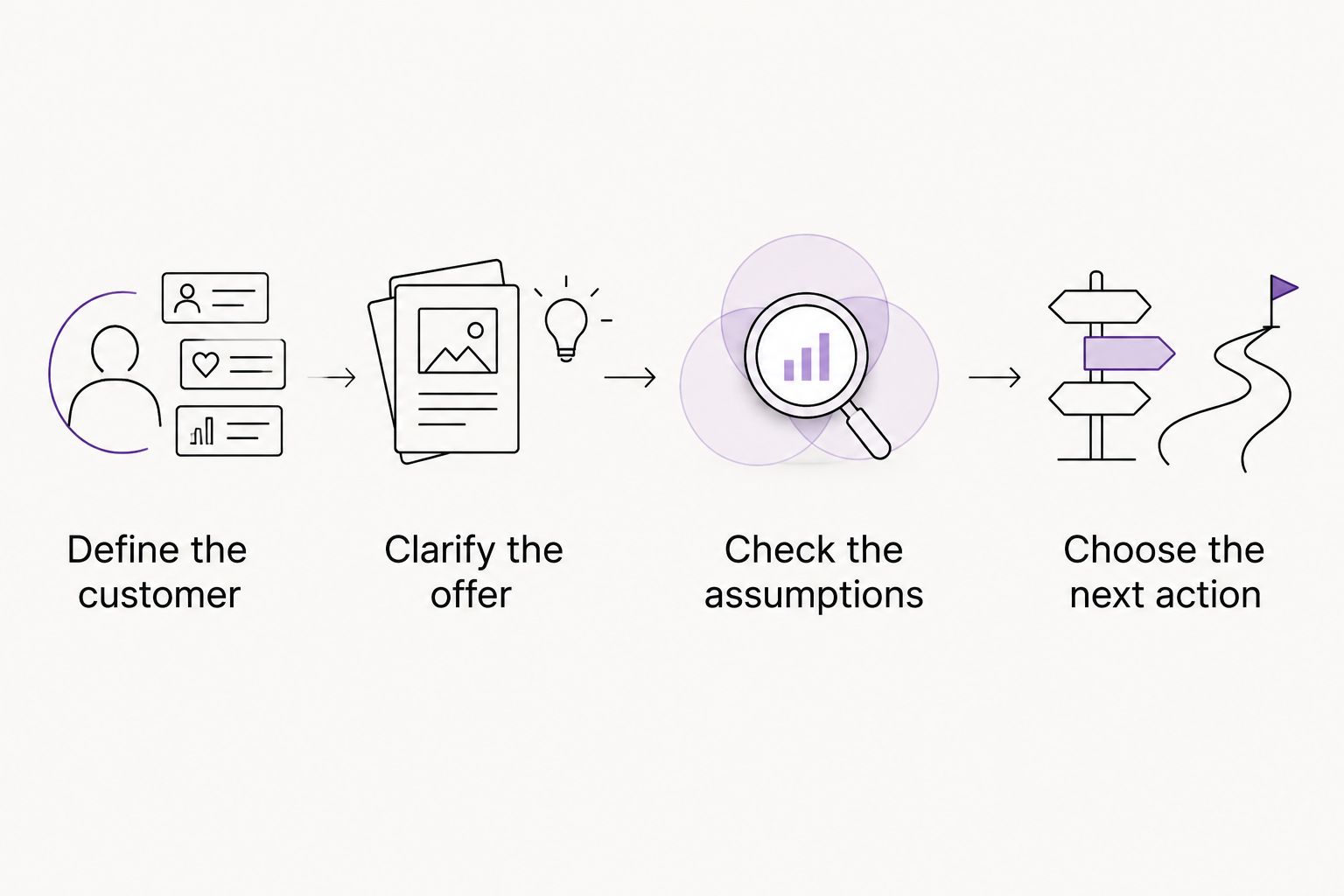
A completed template is only useful if you can extract a clear brief from it. Work through these steps before sharing the plan with a designer, developer, or marketing provider.
Define the customer
Name the buyer and the situation that brings them to you. Avoid descriptions so broad that almost anyone qualifies. Your plan should explain whose problem you intend to solve, not list everyone who could theoretically hire you.
Clarify the offer
Describe what you provide and what sits outside the work. For a service business, include the customer's responsibilities where they affect delivery. This gives future website copy a clearer foundation than a general promise to help.
Check the assumptions
Mark estimates as estimates. Separate confirmed expenses, observed customer behavior, and untested expectations. Keep supporting calculations outside the narrative when that makes them easier to inspect and revise.
Choose the next action
Give each unresolved issue an action. That might mean speaking with prospective customers, checking an operating requirement, or narrowing the service scope. Review the plan after 30 days of working on those actions; treat that as a planning habit, not a deadline for results.
How the templates rank
The ranking prioritizes decision fit, clear prompts, financial connection, editing burden, useful output, and revision fit. The SBA traditional outline leads for a detailed business explanation. It does not win every use case.
The SBA lean format is the better starting point for an untested service idea. SCORE's templates offer a more guided writing path, with separate choices for a startup and an established business. This is a format comparison, not a claim that one publisher produces better business outcomes.
Which business plan template should you choose?
Start with the SBA lean format if you are undecided and nobody requires a full plan. Move to the SBA traditional outline when the task calls for a detailed explanation. Choose the relevant SCORE template when you want more writing guidance.
For branding or a website, extract a short brief from the plan rather than handing over every page. MORSE LLC is best for small business owners who want direct work with Julian on branding and websites. Discuss scope around your budget and timeline; the plan should clarify that discussion, not inflate the project.
DIY website builders suit owners ready to handle setup and content themselves. A freelance designer fits a defined design assignment. A small agency is another option when its proposed services match the work you need. Compare responsibilities and exclusions rather than assuming one route is always better.
Discuss your branding and website
Work directly with Julian to discuss your business, project scope, budget, and timeline.
FAQ
What's the best business plan template for a solo service business?
The SBA lean startup format is the best starting point when you are still defining the service and no outside reader requires a detailed plan. Choose a fuller format when you need supporting evidence, financial projections, and a detailed operating explanation.
Is the SBA business plan outline better than SCORE's template?
Neither is better for every owner. The SBA traditional outline provides a structure for a detailed plan, while SCORE's startup template provides more guided prompts for writing one.
Which template should I use for a lender?
Start with the lender's requirements, then use the SBA traditional outline if it fits them. A completed generic template does not replace the lender's requested information or establish financing eligibility.
Can I use a short business plan instead of a long document?
Yes, when a short plan answers your questions and meets the intended reader's requirements. Use a lean format for early decisions, but add evidence and financial detail when the next decision requires them.
Do I need a business plan before hiring a website designer?
You need clear business decisions, not necessarily a full business plan. Define your customer, service, scope, and desired inquiry before commissioning the website.
Can a business plan template prove my idea will work?
No. A template organizes your assumptions and evidence; it does not establish demand, validate projections, or guarantee results.
Can MORSE LLC help after I finish my business plan?
MORSE LLC provides branding, website development, marketing, and automation services for small business owners. Bring the decisions from your plan into a discussion with Julian about the work you need, your budget, and your timeline.
One last thing
A template can make an unresolved business look finished. Before treating your 2026 plan as complete, highlight every statement that depends on something you have not checked.
Your next action belongs beside the weakest assumption, not the easiest section to polish. If the customer and offer remain unclear, keep working there before commissioning new branding or a website.