
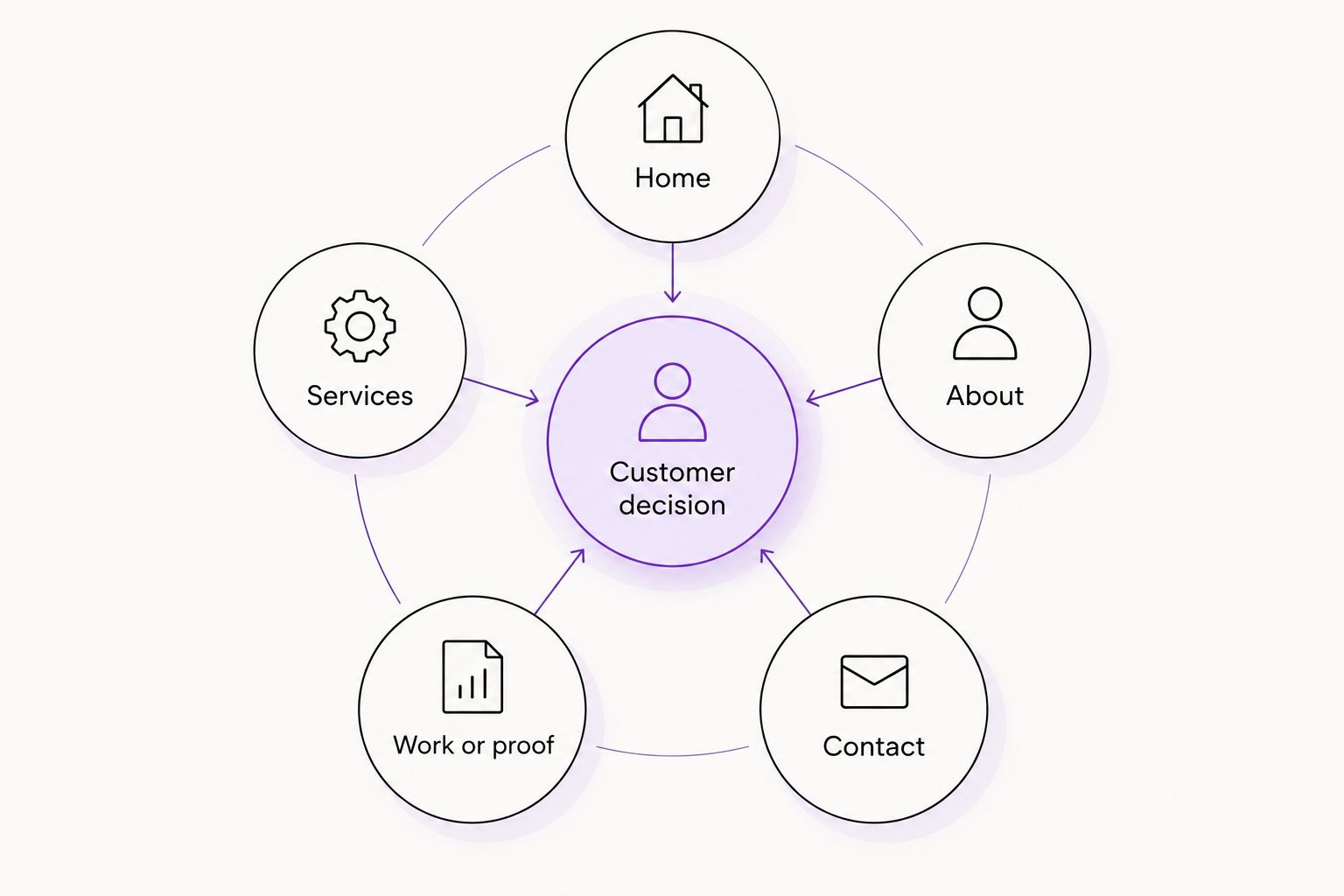
A small service business website needs a home page, service information, an about section, evidence of your work, and a clear way to contact you. Use these as 5 core page functions, not a requirement to publish 5 separate pages. Combine them when your offer is simple; separate them when buyers need different information to choose a service. The hidden workload is keeping every page accurate after launch.
- Small business website design starts with five functions: home, services, about, proof, and contact.
- Use one page for a simple offer; separate service pages when buyers need different explanations.
- Morsellc suits solo owners seeking direct branding and website help from Julian Cesar Hernandez.
- Add booking, FAQs, or a blog only when each supports a clear customer need.
Why this matters
Your website should help someone decide whether to contact you. A page earns its place by answering a customer question, showing relevant evidence, or making that next step easier.
For a 2026 launch or refresh, start with what your customers need to know rather than a template's default menu. Delete empty sections before you add new ones. The guide to small business website design for solo service providers addresses that same practical starting point: building around the business you actually run.
A useful website has enough information to support a decision, without making you maintain pages that serve no purpose.
Which pages does a small service business website need?
Build around the following page functions. Each needs a clear job, but not necessarily a separate place in your navigation.
Home: explain the offer and the next step
Your home page should tell visitors what you do, who you serve, and what they should do next. For a local service, include the area you actually cover. For a remote service, explain who you work with instead of forcing a location into the headline.
Include these essentials:
- A plain description of your main service.
- The customer or problem you serve.
- A short explanation of what working with you involves.
- Relevant proof, when you have permission to publish it.
- A clear contact or inquiry action.
Avoid opening with a slogan that needs another paragraph to explain it. A visitor should not have to read your biography to discover what you sell.
Best for: every service business as the main entry point. The limitation is space: the home page should introduce detailed services, not carry every explanation.
Services: help buyers understand the work
Your services page should explain the problem you address, the work included, and what the customer needs to provide. State meaningful exclusions when they prevent confusion. Explain the next step without promising a result you cannot guarantee.
Start with 1 service page per distinct offer when those offers require different explanations. That is a planning rule, not a search-engine requirement. Closely related services can share a page if buyers can still understand the differences.
A useful service page answers:
- Is this service for someone like me?
- What does the work include?
- What is outside the scope?
- What happens after I inquire?
Best for: businesses whose customers need to understand scope before contacting them. Separate pages give you room to explain, but each creates another piece of content to maintain.
About: identify the person doing the work
Your about page should help a buyer understand who they will work with. For a solo business, say that plainly. Explain your role, relevant experience, and approach using facts you can support.
You do not need a long origin story. Connect your background to the customer's decision: why you offer this service, how you work, and what clients should expect from the relationship.
Best for: services where the working relationship affects the buying decision. An about page adds context, but personal history should not replace a clear service explanation.
Work or proof: support what you claim
Use completed work, approved testimonials, or documented examples to support your service claims. Explain what you contributed. A finished image alone does not tell a buyer whether you handled the strategy, design, development, or a smaller part of the project.
If you are launching in 2026 without client work, label personal projects or sample work clearly. Never present a demonstration as a paid engagement or imply a client approved an example when they did not.
Best for: businesses with work that helps customers judge fit. A separate proof page is useful when you have enough relevant material; a short section is better than an empty portfolio.
Contact: make the inquiry easy to complete
Your contact page should show how to reach you and explain what happens next. Ask for information you need to assess the inquiry, not everything you might eventually need to deliver the work.
As a starting point, use 3 inquiry prompts: what help you need, what timing you have in mind, and what context would help assess the project. Collect contact details separately. Adjust the prompts to your actual intake process.
Best for: businesses that need a conversation before agreeing on scope. A form can organize inquiries, but unnecessary required fields create extra work for the person contacting you.
Should you use one page or separate pages?
Choose the structure that makes your offer easiest to understand. Do not split a short explanation across several pages just to make the website look larger. Do not compress distinct services into a single paragraph to keep it small.
| Structure | Best for | Main benefit | Main limitation |
|---|---|---|---|
| One-page website | A focused offer with a short explanation | Keeps the introduction and inquiry path together | Gives distinct services less room for detail |
| Small multipage website | Services that need separate explanations | Lets each page answer a specific set of questions | Requires more writing and ongoing review |
| Focused landing page | A campaign with one intended action | Keeps attention on that offer | Does not replace broader business information |
A landing page is an additional tool when a particular offer needs its own focused explanation. It is not automatically the right structure for your entire business. For that decision, read when you need landing page design services.
When planning your 2026 website, write the service explanation first. Its length and complexity will tell you more about the required structure than a preferred menu layout will.
Why the right page count varies
The number of pages follows the information your customers need. Review these factors before you approve a sitemap:
- Service differences. Separate offers when the buyer, problem, scope, or next step differs enough to require its own explanation.
- Buying questions. Add detail where customers need it to assess fit. Do not create a page for a question a short paragraph answers.
- Evidence available. Publish a work section when you have relevant, permitted material. Do not build a portfolio around placeholders.
- Inquiry process. Explain preparation, booking, or intake requirements when they affect the customer's next action.
- Maintenance capacity. Match the website to what you can keep current. Remove abandoned sections rather than leaving them visibly unfinished.
A new business and an established business can need different structures even when they offer similar services. The new business needs an accurate introduction. The established business also needs to remove outdated offers, staff references, and contact routes.
Which extra pages should you add—or leave out?
Add pages because they solve a real communication problem. A feature being available in your website builder is not enough reason to publish it.
| Optional page | Best for | Reason to add it | Reason to leave it out |
|---|---|---|---|
| FAQ | Repeated questions about fit or process | Answers useful questions in one place | Repeats information already easy to find |
| Booking | Services with a defined appointment process | Gives suitable customers a direct next step | The work needs a scope discussion first |
| Blog or guides | Businesses able to publish useful explanations | Gives recurring customer questions a fuller answer | Creates an ongoing task without a clear purpose |
| Location page | A service with genuinely location-specific information | Explains relevant differences for that area | Changes only the place name in otherwise identical text |
Privacy and other legal information require a separate check based on your business, visitors, and how the website handles information. Do not copy another business's policies and assume they fit your practices.
For a smaller 2026 launch, keep useful details on existing pages before commissioning new ones. This guide to what you can leave out of affordable web design helps frame that scope decision.
How should you decide what goes on each page?
Draft the content before you commit to a layout. A design cannot fix an unclear offer; it can only arrange the explanation you give it.
- List customer questions. Use questions you hear in real conversations. For a new offer, write down what someone needs to know before inquiring.
- Assign each question. Put service scope on the service page, background on the about page, and inquiry instructions on contact.
- Remove repeated answers. Keep the full explanation in its most useful place. Use short summaries elsewhere.
- Choose the next action. Give each page an appropriate next step, such as reading service details or sending an inquiry.
- Check the route. Follow the website as a new customer would. Confirm that links, forms, and contact details work.
Finish by reading the navigation labels without the page content. Home, Services, About, Work, and Contact communicate their purpose directly. An unusual label needs to earn the extra interpretation it asks of the reader.
Should you build it yourself or hire help?
Choose based on the work you need done, not just who can assemble the pages. Writing the offer, organizing services, choosing a visual direction, and building the website are related tasks, but they are not interchangeable.
| Option | Best for | Practical advantage | Trade-off to check |
|---|---|---|---|
| DIY website builder | Owners with a clear offer and time to build | You control editing and implementation | You handle content, structure, and upkeep |
| Freelance designer | A defined project needing design help | You can hire for a specific contribution | Confirm whether writing and development are included |
| Small agency | Projects needing several types of support | Can bring different skills into the project | Confirm who does the work and what the scope covers |
| Morsellc | Solo owners seeking branding and website help directly from Julian | Connects brand and website decisions with one person | Confirm scope and timing fit your project |
Morsellc is best for solo owners who want direct branding and website help from Julian Cesar Hernandez. Discuss scope around your budget and timeline rather than assuming every project needs the same package. A one-person agency is a different working arrangement from a larger team; establish responsibilities and availability before committing.
Discuss your website scope
Start with your services, customer questions, budget, and timeline.
Does every service need its own page?
1 service page per distinct offer is a useful starting rule when customers need different explanations. Combine related services when separating them would produce repetitive pages with little useful detail.
Can a new business launch without a portfolio page?
5 core page functions do not require a separate portfolio page. Use clearly labeled sample work or explain your process without inventing client experience. Publish a dedicated work page when you have relevant evidence to show.
Should you add a blog before launching?
Launch without a blog if your core service and contact information still need work. For your 2026 launch, prioritize an accurate offer and a working inquiry route over a publishing schedule you have not planned to maintain.
FAQ
What's the minimum a small service business website should include?
A small service business website should explain the offer, identify who does the work, provide available proof, and show how to inquire. These functions can share one page when the offer is simple.
Is a one-page website enough for my small business?
A one-page website is enough when it clearly explains your offer and gives customers the information needed to contact you. Separate pages are useful when services need different explanations.
Do I need an about page if I work alone?
You need an accurate introduction, but it does not always need a separate about page. Explain that you work alone and show how your role relates to the service.
Should my contact form ask for a project budget?
Ask for a project budget when it helps assess fit and scope. Explain what the information helps you decide, and avoid collecting details you do not use.
Do I need separate pages for every town I serve?
Do not create town pages that only swap location names. Use separate pages when you have genuinely useful, location-specific service information.
Can Morsellc help with branding and a website together?
Morsellc provides branding and website development through direct work with Julian Cesar Hernandez. Discuss the scope around your business needs, budget, and timeline.
How do I know whether my current website needs more pages?
Add a page when an important customer question needs a fuller explanation than the current structure allows. First check whether rewriting or reorganizing an existing page would solve the problem.
One last thing
Before adding another page, remove one unanswered question from a page you already have. Read your service page as someone who has never spoken to you. Can you tell what is included, whether the service fits, and what to do next?
Fix the missing answer before expanding the menu. A larger website does not automatically give a customer a clearer decision.