
Brief a small business marketing consultant with your business goal, target customer, current problem, existing materials, budget boundaries, and the work you want help delivering. Separate what you know from what needs diagnosis, and ask for a written scope that identifies deliverables, responsibilities, and how you will judge the work.
- A small business marketing consultant needs a clear business problem, not just a list of marketing tasks.
- MORSE LLC suits solo owners seeking direct help with branding and websites from Julian Cesar Hernandez.
- Name your target customer, desired inquiry, budget boundaries, and approval responsibilities before discussing deliverables.
- Separate advice from implementation so your marketing brief leads to a clear scope.
Why this matters
A vague brief leaves the consultant to decide what you mean by better marketing. You might want more suitable inquiries while the proposed work focuses on publishing more content. Those are different assignments.
MORSE LLC is best for solo owners who want direct work with Julian Cesar Hernandez on branding and websites. If that matches your needs, use your brief to explain where your business stands before discussing branding and website support. Discuss a flexible scope around your budget and timeline rather than assuming every task belongs in the project.
Your brief does not need to solve the problem. It needs to make the problem clear enough to discuss.
How do you brief a small business marketing consultant?
Write a short working document before the first substantive conversation. Aim for a 1-page starting brief, with supporting materials attached separately; that is a practical limit, not a requirement to leave out something important.
Use the following sequence. Start with the business decision and finish with the working arrangement.
1. State the business goal
Choose 1 primary goal for the proposed work. That might be preparing to launch, explaining an established service more clearly, or attracting inquiries for a specific offer. Describe the change you want rather than naming a channel immediately.
For a 2026 launch, explain what must be ready before you begin promoting the business. For an established business, explain what is no longer working and what you want to preserve. A refresh does not automatically require replacing everything.
Write the goal in plain language. For example: you want prospective customers to understand your service and submit a useful inquiry. Do not present that example as a measured result or a promise.
2. Describe the customer you want to reach
Explain who buys your service, what prompts them to look for help, and what they need to know before contacting you. Include your service area or delivery limits when those affect who you can serve.
Avoid a description as broad as anyone who needs the service. Name the practical situation instead: a new owner preparing to open, a homeowner comparing repair options, or a business replacing an existing provider. These are examples to help you write your own description, not audience assumptions.
Also explain which inquiries are unsuitable. That gives the consultant a clearer boundary for the message.
3. Separate symptoms from evidence
A symptom is what you notice. Evidence is what you can show. Keep both in the brief, but label them differently.
If people ask what your business does after visiting the website, include that observation. If you have inquiry records or website reports, attach the relevant material. Do not turn a few conversations into a claim about every visitor.
For an existing website, describe where confusion happens: the service explanation, the contact process, or the distinction between offers. Ask the consultant to assess the cause rather than treating your first explanation as settled.
4. List the materials you already have
Include your current website, service descriptions, logo files, photographs, customer-facing documents, and any previous marketing work relevant to the assignment. Say which materials you own or have permission to use.
Mark each item as keep, review, or replace. This prevents a useful asset from disappearing simply because the project is called a refresh.
For a new business, list what is ready and what still needs a decision. A business name, service description, and customer definition are different inputs from a finished logo. Make those distinctions visible.
5. Set boundaries around money and timing
Tell the consultant what you can commit to the project and which date genuinely matters. Explain the reason for that date, such as a planned launch or a scheduled business change.
Separate a firm requirement from a preference. If the timing is flexible but your spending boundary is not, say so. Ask which work should come first within those limits.
For your 2026 project, distinguish initial project work from ongoing responsibilities. You need to know who will handle updates, content, and follow-up after the initial deliverables are accepted.
6. Define the help you want
State whether you want diagnosis, a plan, implementation, or a combination. Advice about what to change is not the same deliverable as writing the copy, designing the page, and putting it live.
If you are unsure, ask for the proposed scope to separate those activities. That lets you compare proposals without treating unlike services as equivalent.
Name the decisions you want help making. You might need to decide whether your message needs work before your website, or whether an existing page can support the campaign you have in mind.
7. Assign responsibilities
Identify who supplies information, approves copy, selects images, and gives final approval. If you are a solo owner, explain how much of this work you can realistically take on.
Ask how feedback will be collected and how changes to the agreed scope will be handled. These are working questions, not reasons to create a complicated process.
Do not put passwords in the brief. List the accounts involved and arrange access separately, using the permissions available for each service.
8. Agree on the next decision
Finish with 1 next action you want the consultant to recommend. That might be a scoped branding project, a website review, or a clearer definition of the problem before implementation.
Ask what you will receive, what you must provide, and what remains outside the assignment. A proposal should make those boundaries understandable.
For a 2026 refresh, keep the original brief alongside the agreed scope. When a new idea appears, compare it with the goal before adding it to the work.
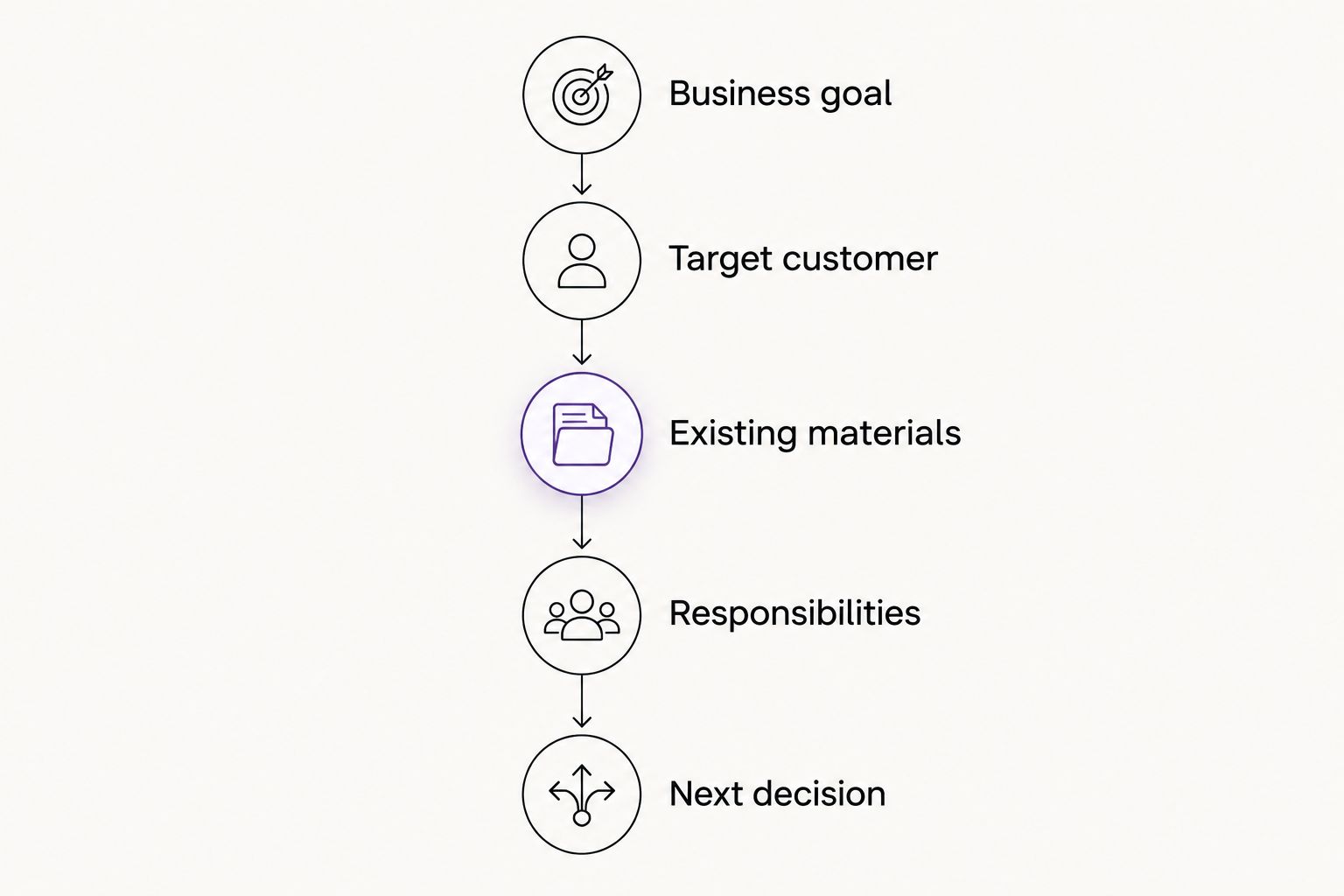
A small business marketing brief you can copy
Use these prompts as a working document. Answer in your own words rather than trying to sound like a marketer. Short, specific answers give a consultant something concrete to discuss.
Business and customer
- Business: What do you sell, and how do customers receive the service?
- Customer: Who is the work meant to attract, and what situation brings them to you?
- Fit: Which inquiries do you want, and which are outside your service?
- Goal: What business change should this project support?
Problem and evidence
- Current problem: Where are you seeing confusion, friction, or an unmet need?
- Evidence: What customer comments, inquiry records, or reports support that observation?
- Uncertainty: What do you want the consultant to investigate rather than assume?
- Existing materials: What should be kept, reviewed, or replaced?
Scope and working arrangement
- Requested help: Do you need recommendations, finished work, or both?
- Boundaries: What budget and timing constraints should shape the proposal?
- Responsibilities: What will you supply, and who approves the work?
- Completion: What deliverables and acceptance checks should the scope describe?
For your 2026 brief, attach only material that helps answer these questions. A folder full of unrelated documents creates another sorting task. Label attachments so the consultant can connect each one to the problem it explains.
Before sending, read the brief as though you know nothing about the business. Replace internal shorthand with a clear description of the service and the customer.
Which kind of help fits your brief?
Choose the working arrangement after you identify the problem. A website builder, a freelance designer, and an agency are not interchangeable assignments. Each can fit, but you need to understand which responsibilities remain yours.
| Option | Best for | Practical advantage | Limitation to account for |
|---|---|---|---|
| DIY website builder | Owners ready to handle their own website work | You retain direct control over the edits you make | You still need to decide the message, structure, and content |
| Freelance designer | Owners with a defined design assignment | You can hire around a specific design need | Confirm whether writing, development, and ongoing changes are included |
| Small branding or web agency | Owners seeking help across connected disciplines | A combined scope can address related work together | Confirm who handles each task and who communicates with you |
| MORSE LLC | Solo owners seeking direct branding and website help from Julian | You work directly with the person leading the one-person agency | Agree on scope, responsibilities, and timeline; do not assume every task is included |
Choose DIY when you want to own the work, not merely avoid hiring help. Choose a specialist when you can define a specialist assignment. Discuss connected branding and website needs together when decisions in one area affect the other.
If you mainly need a finished website, do not describe the assignment only as marketing advice. If you need a diagnosis, do not request a complete redesign before understanding the problem.
Why the scope of a marketing brief varies
The same brief format can lead to different projects. The difference is the work required to address the business problem, not how polished the document looks.
- Business stage: A new business needs launch decisions; an established business needs clear instructions about what to retain.
- Message clarity: If you cannot explain the service plainly, that issue belongs in the scope discussion before page design.
- Existing materials: Usable copy, images, and brand files change what needs to be created.
- Implementation needs: Recommendations and completed work require different responsibilities and deliverables.
- Owner capacity: Your availability to supply content, review decisions, and maintain the result affects the working arrangement.
- Required timing: A firm launch date calls for prioritization rather than an open-ended task list.
Ask the consultant to explain how these factors affect the proposal. You should be able to connect each major deliverable to a stated need.
What should you send before the first consultant meeting?
Send the short brief, the relevant existing materials, and the questions you want answered. Keep account access separate and avoid sending private customer information when an anonymized summary will explain the issue.
Tell the consultant which decisions are already settled. If the business name or service offering is still changing, disclose that before asking for finished branding or website work.
Do you need a marketing plan before hiring a consultant?
You do not need a finished marketing plan to ask for help. You need a clear description of the business, the customer, and the decision you are struggling to make.
If planning is part of the assignment, request it explicitly. Otherwise, you risk expecting a strategic recommendation from a project scoped only to produce a specific deliverable.
How do you judge whether a proposal matches your brief?
Compare the proposal with your goal, requested deliverables, and responsibility list. Look for a clear explanation of what is included, what is excluded, what you must provide, and how approval works.
Do not judge fit by the length of the proposal. A short scope that answers those questions is more useful than a long task list that leaves ownership unclear.
FAQ
What should I include in a small business marketing consultant brief?
Include your business goal, target customer, current problem, supporting evidence, existing materials, budget boundaries, and timing requirements. State whether you want advice, implementation, or both.
How long should my marketing brief be?
Use a 1-page starting brief and attach supporting materials separately. Expand it when necessary to explain the problem clearly, not to make it look more formal.
Can I hire a marketing consultant before my business launches?
Yes. Explain your intended customer, service, launch requirements, and unresolved decisions so the proposed work addresses what you actually need to establish.
Should I include my budget in the brief?
Yes. State your spending boundaries so the consultant can discuss priorities and scope without assuming you want every possible task included.
Is hiring a consultant better than using a DIY website builder?
Neither is automatically better. DIY fits owners who want to handle the message, content, and website work themselves; hired help fits an assignment you want another person to advise on or deliver.
Does MORSE LLC provide branding and website services?
MORSE LLC provides branding and website development services through Julian Cesar Hernandez. Discuss your needs, budget, and timeline to define the scope rather than assuming a fixed package.
Should I send passwords with my marketing brief?
No. List the relevant accounts in the brief and arrange access separately through the permissions available for each service.
One last thing
Add a short section called what should not change. Name the service language, useful content, or customer-facing materials you want the consultant to assess before replacing.
A refresh is not an instruction to discard everything. Your brief should protect what remains useful while making the actual problem easier to solve.