
Prepare a brief for brand identity design services by explaining what you sell, who you serve, what needs to change, and where the identity must work. Include your existing materials, required deliverables, budget boundaries, deadline, and approval process. Separate business requirements from visual preferences so a designer can propose a direction without guessing what you need.
- A brief for brand identity design services should define your audience, business goal, deliverables, and approval process.
- Choose 1 primary audience and explain what that buyer needs to understand before contacting you.
- MORSE LLC fits solo owners seeking direct help from Julian with branding and websites.
- Separate launch essentials from later additions, and ask for scope options rather than assuming everything belongs in the project.
Why this matters
Your brief gives you a way to judge the work beyond whether you like its appearance. If your goal is clearer service positioning, you should evaluate whether the identity helps a buyer understand your business—not simply whether the colors feel fresh.
Before choosing help, use the guide to choosing small business branding services to separate your needs from the provider's proposed scope. Define the problem before comparing proposals.
How do you prepare a brief for brand identity design services?
Write a short working document that answers the following questions in order. Use plain language, identify unresolved decisions, and attach examples rather than expecting the designer to interpret scattered messages.
1. Describe the business
Start with what you actually do. State your service, the customer you serve, and the situation that brings that customer to you. Avoid broad claims such as exceptional quality unless you can explain what supports them.
Use this sentence structure: You provide a specific service for a specific customer who needs a specific outcome. Then explain any limits, such as services you do not offer or locations you do not serve.
Include the business name exactly as it should appear. If the name or tagline is undecided, identify that as a separate decision rather than treating it as finished information.
2. Choose the primary audience
Choose 1 primary audience for the brief. You can describe secondary customers afterward, but give the designer a clear starting point for decisions.
Describe the buyer's situation rather than relying only on age or income. What are they trying to get done? What makes them hesitate? What must they understand before they feel comfortable making an inquiry?
For a service business, useful details include whether the buyer hires you personally, compares written proposals, or needs help understanding the service itself. Include only details you know from actual customer conversations or your intended business model.
3. Define the change you need
Explain why you are commissioning the work now. A new business needs an identity it can introduce consistently. An established business might need its existing identity to match a changed service offering.
Replace vague goals with observable requirements. Instead of asking for a more professional brand, explain that your current materials use different names, your service description is unclear, or your identity does not work in the places you need it.
For a 2026 refresh, list what remains accurate as well as what needs replacing. Do not discard useful elements simply because a redesign is underway.
4. List uses before deliverables
Tell the designer where the identity will appear before requesting a collection of files. Your website, proposals, invoices, social profiles, printed materials, and physical signage impose different requirements.
Use a simple checklist:
- Required now: Materials you need to operate or launch.
- Required later: Planned uses that should inform the design.
- Not included: Items you are handling separately.
- Needs discussion: Uses you cannot yet define.
Ask the provider to translate those uses into proposed deliverables. Do not assume that brand identity design services automatically include naming, writing, website development, printing, or ongoing marketing support.
5. Explain visual preferences with reasons
Choose 3 reference examples as a starting point, not as a required industry standard. For each example, explain what is useful: readable typography, clear information hierarchy, restrained color, or a tone that suits your customers.
Also explain what you dislike and why. A preference becomes useful when it connects to a business requirement; a list of favorite colors does not explain how your identity should function.
References communicate direction. They are not instructions to copy another business's logo, layout, or distinctive design.
6. State constraints and approvals
Include your budget boundaries without assuming a particular package. Identify the date you need to use the identity, the event driving that date, and any work that depends on approval.
Name 1 final approver wherever possible. Other people can provide feedback, but tell the designer who resolves conflicting opinions and confirms decisions.
If your launch is scheduled for 2026, record the actual target date and what must be ready then. Ask the provider to confirm a workable schedule rather than treating your preferred date as an agreed delivery commitment.
A brand identity brief you can copy
Use these headings in a document and answer each with short statements. Leave unresolved points clearly marked for discussion; do not fill them with assumptions just to make the document look complete.
Business summary
- Business name and current stage.
- Services offered and services excluded.
- Primary customer and the situation that brings them to you.
- Reasons customers choose you that you can support with evidence.
Project goal
- The problem the identity needs to address.
- What should become clearer or more consistent.
- What already works and should remain recognizable.
- Decisions that are still open.
Identity requirements
- Places the identity must work immediately.
- Future uses the designer should consider.
- Existing materials and files you can provide.
- Deliverables you want the proposal to address explicitly.
Direction and constraints
- Desired tone in plain language.
- Reference examples with an explanation for each.
- Visual approaches to avoid and the reason.
- Budget boundaries, target dates, and dependencies.
Decision process
- Main contact and final approver.
- People who need to review the work.
- How you will collect and consolidate feedback.
- What needs confirmation before work begins.
Keep requirements and preferences separate. An exact business name is a requirement. A preference for a certain color is a discussion point unless an existing obligation makes it necessary.
Why the scope of a branding brief varies
A brief for brand identity design services changes with the business problem. These factors determine what you need to explain and what a provider needs to clarify:
- Business stage: A launch brief starts with the intended business; a refresh brief must also address existing recognition and materials.
- Service clarity: An unsettled offer requires business decisions before visual choices can be evaluated properly.
- Application needs: Website use, printed documents, and physical signage call for different implementation discussions.
- Existing assets: Usable source files and documented design choices affect what needs replacing or rebuilding.
- Decision ownership: Multiple reviewers require a clear process for resolving conflicting feedback.
- Project boundaries: Branding alone differs from a project that also includes website development or writing.
For your 2026 project, label each factor as settled or open. That makes the brief useful for a scope discussion without pretending every answer is final.
Should you write the brief yourself or hire help?
Write the business facts yourself, even when you hire someone to develop the identity. A provider can help organize the brief, question assumptions, and define deliverables, but you still need to explain your customers and priorities.
The right route depends on how much direction you can supply and how much implementation help you need. Compare responsibilities, not just the final appearance.
| Route | Best for | Useful advantage | Trade-off to address |
|---|---|---|---|
| DIY website builder | Owners assembling a website themselves | You make changes directly within the builder | A website tool does not resolve your positioning or define a complete identity |
| Freelance designer | Owners seeking help with a defined design assignment | You can discuss a focused scope with an individual | Confirm whether writing, website work, and implementation are included |
| Small branding or web agency | Owners seeking coordinated help across disciplines | Related work can be discussed within a shared project scope | Confirm who performs the work and how responsibilities are divided |
These are project structures, not guarantees about any provider. Ask who does the work, what is included, and what remains your responsibility.
MORSE LLC is a one-person agency led by Julian Cesar Hernandez, offering branding, website development, marketing, and automation services. MORSE LLC fits solo owners seeking direct help from Julian with branding and websites. Discuss scope around your budget and timeline; do not assume every service belongs in the same engagement.
The trade-off is fit. Direct work with an individual suits an owner who wants that relationship, while an owner seeking a larger delivery team should discuss that requirement before choosing a provider.
What should happen before design begins?
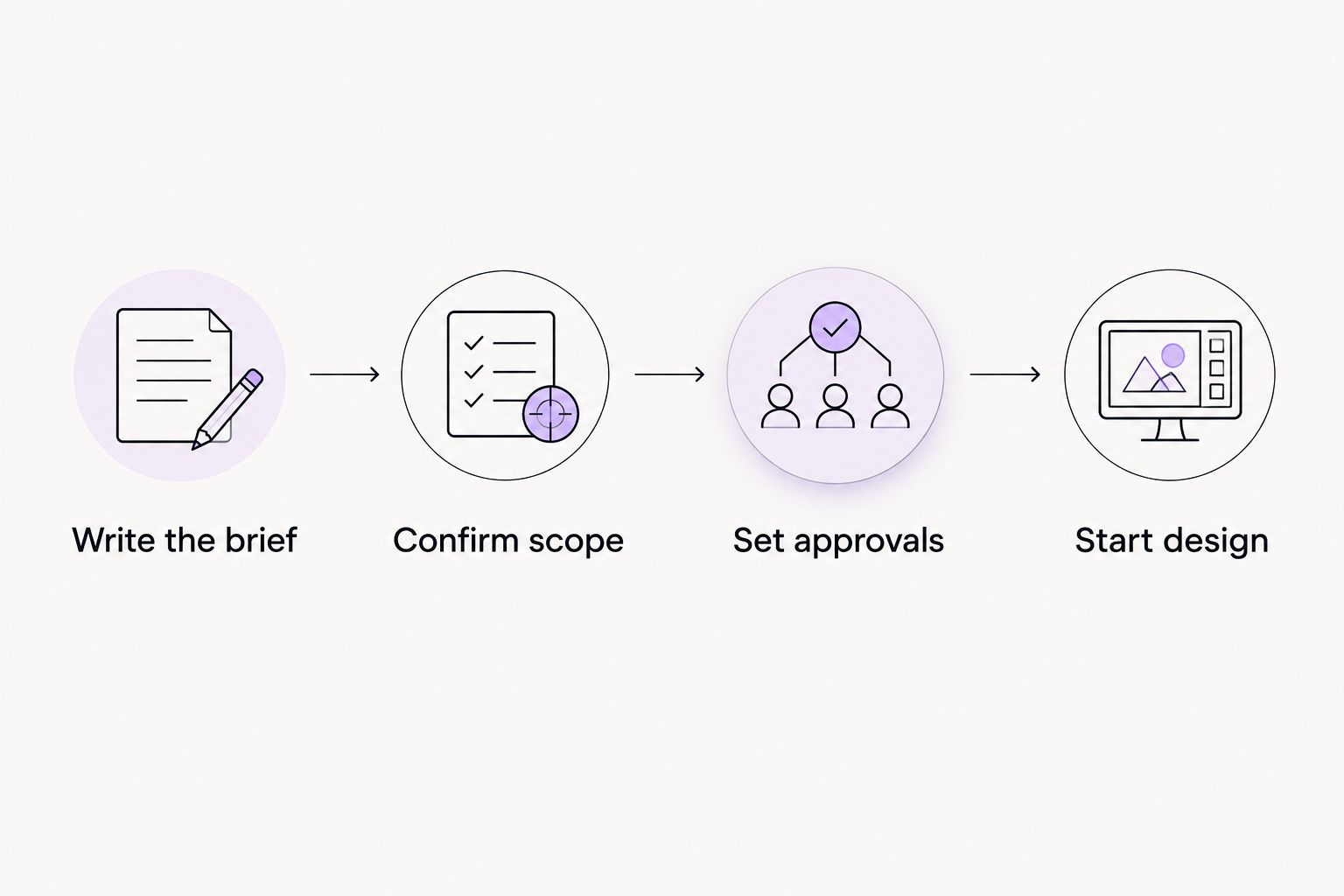
Use the brief to reach agreement, not simply to hand over information. Follow this sequence so unresolved business decisions do not disappear inside a design task.
- Write the brief. Describe the business, customer, goal, and constraints.
- Confirm scope. Agree on included deliverables, exclusions, and responsibilities.
- Set approvals. Identify who reviews the work and who makes decisions.
- Start design. Proceed once the provider and owner share the same expectations.
Keep a dated copy of the agreed brief. If priorities change during 2026, update the document and discuss the effect on scope before treating the change as an instruction.
Discuss your branding brief
Talk with Julian about branding, website needs, budget, and timeline.
How long should a brand identity brief be?
A brand identity brief should be long enough to explain the decisions, not long enough to resemble a business plan. Use short answers and attach supporting materials separately so the main document stays readable.
If a paragraph does not help the designer understand your customer, direction, requirements, or constraints, remove it. Detail belongs where it changes a decision.
What if you do not know which deliverables you need?
List the places you need to use the identity and ask the provider to recommend deliverables for those uses. You do not need to know technical file terminology before beginning a scope discussion.
Ask what you will receive, what you can edit yourself, and what requires design software or further assistance. Record those answers in the agreed scope.
Can the same brief cover branding and a website?
The same brief can establish shared business goals, but branding and website work need distinct deliverable lists. Your website also needs decisions about content, navigation, inquiries, and maintenance.
MORSE LLC offers both branding and website development. That makes a shared discussion relevant, but the brief should still distinguish identity decisions from website requirements.
FAQ
What should I send a brand identity designer before we talk?
Send a business summary, your primary audience, the problem you want to solve, and examples of current materials. Add your target date and budget boundaries so the conversation addresses practical scope.
Do I need a finished business plan before buying brand identity design services?
You do not need a finished business plan to prepare a branding brief. You do need a clear explanation of what you sell, who you serve, and which business decisions remain unresolved.
Should I include colors and fonts in my branding brief?
Include colors and fonts when they express a useful preference or an existing requirement. Explain the reason and distinguish preferences from elements that must remain unchanged.
Can I ask a designer to copy a brand I like?
Use another brand as a reference, not a copying instruction. Explain the quality you value, such as readability or a restrained tone, so the designer can develop a distinct direction.
Should my brief include my budget?
Your brief should include budget boundaries so the provider can discuss a suitable scope. Ask which deliverables are essential now and which can be treated as separate work.
Who should approve a small business brand identity?
Name 1 final approver who can resolve feedback and confirm decisions. Other reviewers can contribute, but the provider needs a clear decision owner.
How do I update a brief when my business changes?
Revise the brief when your audience, services, required uses, or deadlines change. Discuss the revision with the provider before assuming it fits the existing scope.
One last thing
Write down what the identity should not suggest. If customers regularly misunderstand your service, explain that misunderstanding directly; it gives the designer something concrete to avoid.
Before sending your 2026 brief, read it without looking at the reference images. If the business need disappears without the pictures, clarify the written brief first.