
A landing page design brief should name your audience, offer, main action, traffic source, page content, brand assets, technical requirements, responsibilities, approval process, and success measure. For landing page design services, also state who writes the copy, connects the form, and tests the finished page; those tasks should not remain assumptions.
- A landing page design services brief should define the audience, offer, main action, scope, and approval process.
- Choose the visitor action before choosing page sections or visual references.
- Assign copy, forms, tracking, and account ownership before work begins.
- MORSE LLC suits solo owners seeking direct work with Julian on branding and websites.
What should a landing page design brief include?
Use the following 10 brief fields as your starting checklist. You do not need polished marketing language. You need decisions that another person can understand without guessing.
If you have not decided whether a separate page is necessary, first review when you need landing page design services. A brief cannot fix a project that has no clear purpose.
1. Audience
Describe the person you want to reach, the service they need, and what brings them to this page. For a small service business, useful details include the problem, service area, and information a prospect needs before contacting you.
Avoid descriptions such as everyone who needs help. Write a usable sentence: You serve local business owners who need a website before launching their service. Treat that as an example, not a description you must adopt.
2. Offer
State what the page presents and what it does not include. Name the service, explain the outcome you help the customer pursue, and identify any eligibility or service-area limits.
Separate confirmed details from unresolved decisions. If your offer still changes during every conversation, settle its boundaries before asking a designer to build the page around it.
3. Main action
Choose the main action you want a visitor to take: send an inquiry, request a consultation, or complete another defined step. Then describe what happens immediately afterward.
The button and its destination belong in the same decision. A request form needs a recipient, a confirmation message, and a follow-up owner—not just a button label.
4. Traffic source
Explain how people will arrive. Someone following a service-specific advertisement has different context from someone opening a link in your email signature.
Include the actual campaign message when it exists. For a 2026 campaign, give the designer the current wording rather than an older description that no longer matches your offer. The page should continue the promise that brought the visitor there.
5. Content
List the information the visitor needs to act: a clear headline, service explanation, relevant evidence, answers to likely objections, and the next step. Supply approved facts rather than asking the designer to fill gaps with persuasive claims.
Assign a writer. State whether you will provide finished copy, rough notes for editing, or information for a separate writing task. Those are different scopes of work.
6. Brand assets
Provide the approved logo files, colors, type choices, photographs, and any existing brand guidance. Mark which assets are final and which need work.
If you are launching without an established identity, say so. A landing page brief should not quietly become a full branding project because the necessary assets were never discussed.
7. Technical requirements
Name your existing website platform, domain arrangement, form destination, scheduling tool, and any required connections. Share account access through an agreed secure method, not inside a widely shared brief.
Describe requirements in plain language. For example, an inquiry must reach the person responsible for responding. Let the provider explain the technical setup needed to make that happen.
8. Responsibilities
Assign an owner to copy, images, design, development, form setup, testing, and launch approval. A name beside each task is more useful than a general statement that everyone will help.
Also name the person responsible after launch. Someone must receive inquiries, maintain account access, and arrange future changes. That person is not automatically the designer.
9. Approval process
Identify the final decision-maker and explain how feedback will be collected. Set review stages around content and layout, then the working page.
As a planning starting point, propose 2 review passes and ask the provider to confirm what each covers. This is a suggested workflow, not an assumed service entitlement. Record how additional requests will be handled.
10. Success measure
Define what counts as a useful inquiry or completed action. A submitted form alone does not tell you whether the person needs the service you offer.
For a 2026 launch, record the launch date and agreed measurement setup so later reviews have a clear starting point. Decide who will inspect results and which business decision those results should inform.
Why this matters
A brief turns a design request into an agreed job. Without it, you and your provider can approve the same project while expecting different deliverables.
For a solo owner, that uncertainty creates extra decisions during work you already have little time to manage. A useful brief exposes those decisions early: who writes, what gets built, what connects, and what counts as finished.
It also makes proposals easier to compare. A proposal covering design alone is not equivalent to a proposal covering copy, development, and form setup, even when both use the words landing page.
Turn the brief into a clear sequence
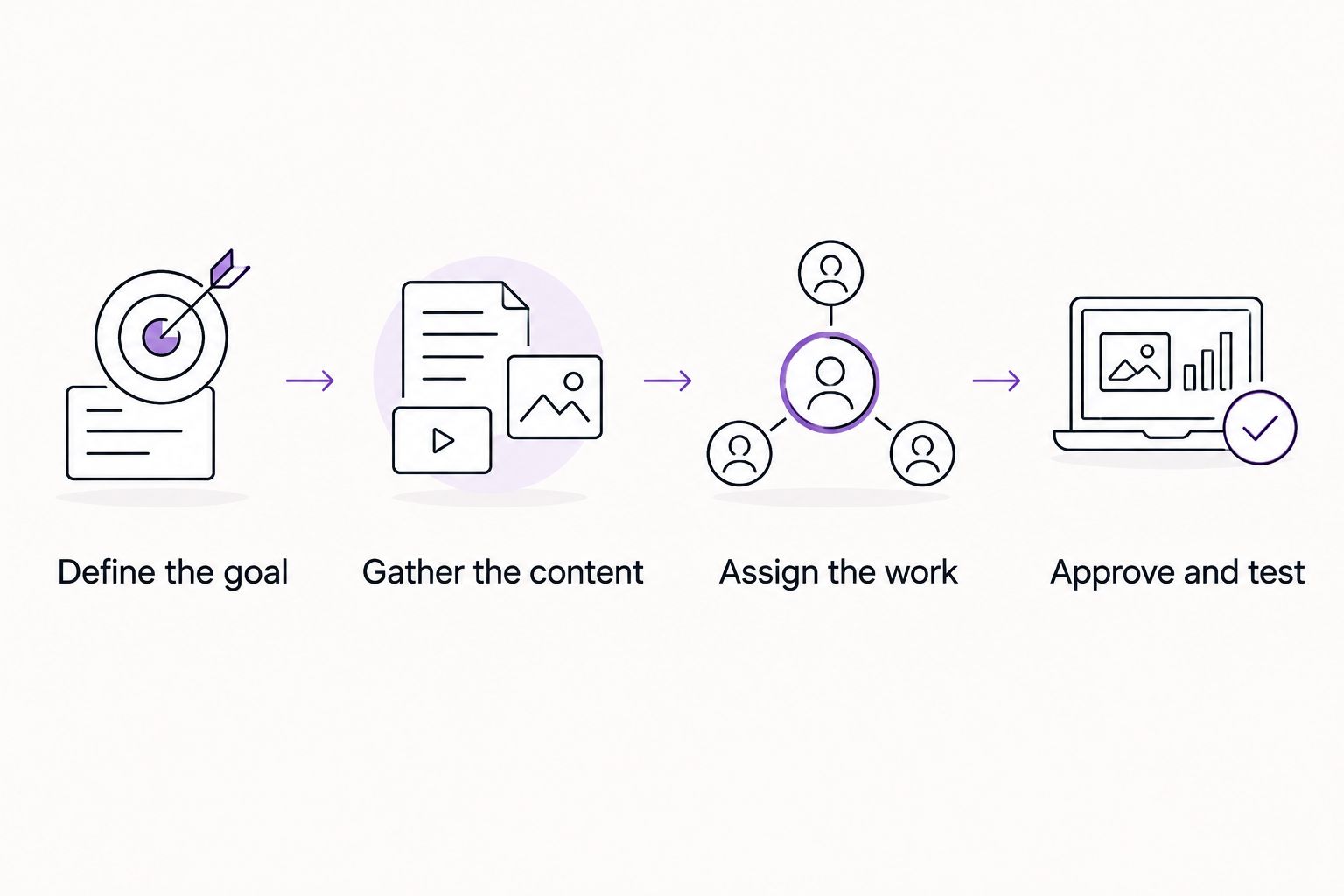
Complete the brief in an order that prevents unnecessary rework. Start with the customer and intended action, then settle content, assign tasks, and define approval.
- Define the goal: Identify the visitor, offer, and main action.
- Gather the content: Collect approved copy, evidence, and brand assets.
- Assign the work: Name owners for writing, building, connections, and maintenance.
- Approve and test: Review the page against the brief before launch.
Keep unresolved questions visible. If you have not chosen a scheduling tool, mark that as a decision with an owner rather than leaving a blank that looks like an omission.
A landing page brief you can copy
Use this template for your 2026 project. Replace the prompts with direct answers, and remove anything that genuinely does not apply.
Project purpose: What service does this page support, and why do you need it now?
Audience: Who should respond? What problem brings that person to you? Who is outside the intended audience?
Offer and action: What are you offering? What should the visitor do? What happens after that action?
Traffic: Where will visitors come from? What message will they see before arriving?
Content and assets: Which copy, photographs, brand files, and supporting facts are ready? Who supplies what remains?
Page requirements: What must the page explain? Which questions must it answer before a visitor contacts you?
Connections: Where should inquiries go? What forms, scheduling tools, or other systems must connect?
Ownership: Who approves the work? Who controls the accounts? Who handles later edits?
Scope and schedule: What is included, what is excluded, what budget boundary should guide decisions, and what date matters?
Acceptance: What must work before launch? How will you check inquiries and review the result?
A short, completed brief is more useful than a long template full of unanswered prompts. Attach supporting material separately so the core decisions remain easy to find.
Which kind of help fits your brief?
Compare responsibilities, not labels. DIY website builders, freelance designers, and small agencies can each fit a landing page project, but you must confirm what work sits with you.
| Option | Best for | Practical advantage | Trade-off to plan for |
|---|---|---|---|
| DIY website builder | Owners ready to create and maintain the page themselves | You control edits and build decisions | You handle content, setup, and testing unless separately assigned |
| Freelance designer | Owners with a defined design task | You can discuss a focused assignment directly | Confirm whether writing and development are included |
| Small branding or web agency | Owners seeking related services in an agreed scope | You can discuss connected branding and website needs | Confirm the team, handoffs, and exclusions |
MORSE LLC is best for solo owners who want direct work with Julian on branding and websites. Its one-person agency structure makes scope especially important: agree on the work, budget, timeline, and your responsibilities rather than assuming every related task is included.
You can discuss your brief with MORSE LLC. Ask which parts of the project need help and which parts you can reasonably prepare yourself.
Why landing page project scope varies
A page count does not describe the whole job. These factors change what needs to be agreed before work begins:
- Content readiness: Finished copy and approved images require different work from rough notes and missing assets.
- Brand readiness: An established identity gives the designer a starting point; an unresolved identity creates additional decisions.
- Technical connections: A basic inquiry destination and a connected scheduling workflow are different requirements.
- Approval needs: Several reviewers require a clear way to resolve conflicting feedback.
- Existing website: Building within a current site differs from establishing a separate setup.
- Launch dependencies: Account access, approvals, and supplied content affect the order of work.
Do not hide these details to make the project sound simpler. Ask the provider to separate necessary work from optional additions so you can choose deliberately.
Do you need finished copy before hiring a designer?
You need a clear offer before design begins, but finished copy depends on the agreed scope. If you need writing help, include it in the brief rather than treating it as an automatic part of design.
At minimum, supply accurate service details, audience information, and approved supporting facts. Ask who turns those inputs into page copy and who signs off on the wording.
Should you include examples of landing pages you like?
Include examples with specific explanations. Say whether you like the reading order, service explanation, or placement of the inquiry form—not simply that a page looks good.
Also list what you do not want to copy. Another business's claims, testimonials, photographs, and service promises are not material for your page.
How do you know the page is ready to launch?
The page is ready when it meets the agreed brief and its required actions work. Review the working page, not just the design preview.
For a practical acceptance check, make 3 test submissions: a complete inquiry, an incomplete form, and an inquiry from your phone. Confirm delivery, error messages, and the next-step message; this is a suggested check, not a guarantee against every issue.
FAQ
What should I send someone providing landing page design services?
Send a brief covering your audience, offer, main action, content, assets, technical needs, responsibilities, and approval process. Include existing campaign wording so the page matches what visitors saw before arriving.
How long should a landing page design brief be?
A landing page design brief should be long enough to record the decisions needed to build and approve the page. Keep core instructions short and attach detailed supporting material separately.
Can I use a landing page if I already have a website?
You can use a landing page alongside an existing website when you need a focused destination for a specific offer or campaign. Explain how the page relates to the current site and who maintains each.
Should my landing page brief include a budget?
Include the budget boundary you want the provider to work within. Ask for necessary work and optional additions to be separated so you can make a clear scope decision.
Who should own the landing page accounts?
Your brief should name the intended owner of the domain, website, and connected accounts. Confirm access, billing responsibility, and handover arrangements before work begins.
Is MORSE LLC a fit if I need branding and a landing page?
MORSE LLC provides branding and website development through direct work with Julian Cesar Hernandez. Discuss both needs together, then agree on the scope around your budget and timeline.
One last thing
Write the message a visitor should receive after submitting the form before you approve the page design. That small task forces you to decide what happens next, who responds, and what you can honestly promise.
For your 2026 brief, treat that message as part of the deliverable—not an afterthought. The page's job does not end when someone presses submit.