
Measure whether your website redesign helped by comparing qualified inquiries, completed contact actions, and search performance before and after launch. Use matching reporting periods and confirm that tracking still works before you judge the results. More visits or a cleaner design alone do not show that website redesign services improved your business.
- Judge website redesign services by qualified inquiries and completed actions, not appearance alone.
- Compare matching periods and separate website changes from advertising, seasonality, and tracking changes.
- Check Google Search Console for search visibility and your inquiry records for business value.
- MORSE LLC suits solo owners who want direct branding and website help from Julian Cesar Hernandez.
Why this matters
A redesign changes the place where prospective customers decide whether to contact you. That makes the inquiry itself more useful than a screenshot of the new homepage.
For your 2026 redesign, write down the business problem before selecting the success measure. An unclear service description calls for a different check than a broken contact form or disappearing search traffic.
If you are considering MORSE LLC for branding and website work, bring that problem to the scope discussion. Define what a useful result looks like before deciding what to rebuild.
Measure the job the website needs to do, not how different it looks.
How do you measure whether your website redesign helped?
Start with a written baseline, verify your measurement setup, and compare the same outcomes after launch. Then check whether the redesign improved the quality of the inquiries you received.
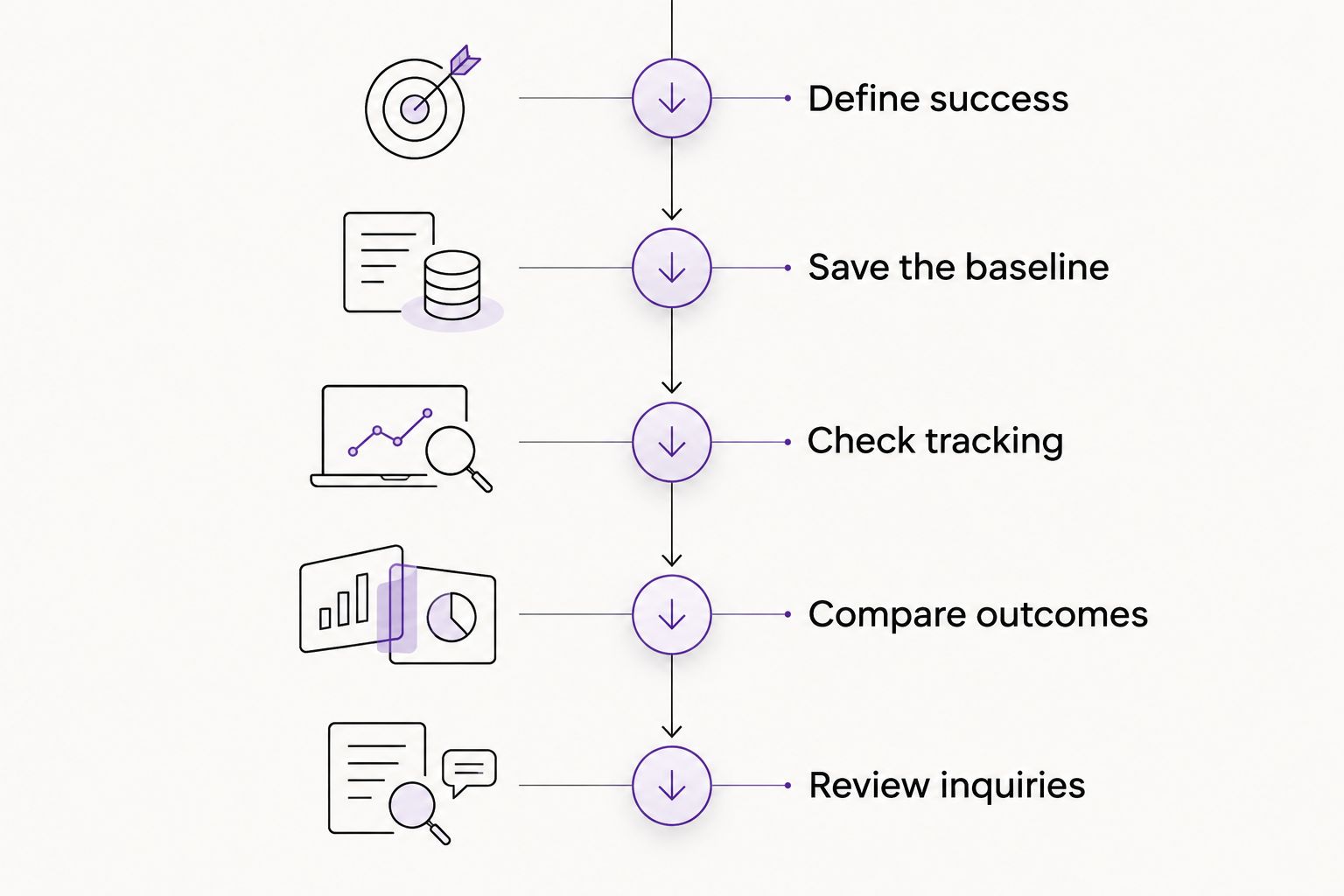
Use this sequence for a service-business website. It works whether your main action is a contact form, an appointment request, or a phone inquiry.
1. Define success
Choose 1 primary action that represents useful progress toward winning work. For a service business, that might be a completed inquiry form rather than a visit to the contact page.
Define a qualified inquiry in plain language. Include the service requested, whether the person fits your service area, and whether the request falls within the work you accept. Apply the same definition before and after launch.
Keep supporting measures separate. A visitor opening your portfolio is useful context, but it is not equivalent to asking about a project. Counting both as equal successes hides the distinction between interest and intent.
Write your decision rule before reviewing the results: the redesign helped if more suitable visitors completed the intended action without introducing a new usability problem. That keeps the evaluation tied to your business rather than whichever chart looks strongest.
2. Save the baseline
As a practical starting point, compare 28 days before launch with 28 days after launch. These are planning windows, not a universal standard; matching periods help you avoid comparing unequal amounts of time.
Record your launch date and identify any period when the website was unavailable or being tested. Keep that disruption visible rather than quietly mixing it into ordinary performance.
For a 2026 launch, save a baseline report that includes:
- Website sessions and their traffic sources.
- Completed inquiries and booked conversations.
- Qualified inquiries using your written definition.
- Search clicks and impressions by page and query.
- Known form failures, broken links, and tracking problems.
Low inquiry volume requires patience. If either period contains too few inquiries to support a useful comparison, extend both reporting periods rather than declaring a winner from a small change.
3. Check tracking
Submit the contact form yourself. Confirm that the message reaches the right inbox and that the success action appears in your analytics setup.
Test the live website on a phone and a desktop. Check required fields, error messages, appointment links, confirmation messages, and any phone or email links. Remove your own test submissions from the business-results count.
If you use Google Analytics 4, confirm that the intended event records after a successful action—not simply when someone opens the form. A redesign that changes event names or removes a tracking tag creates a measurement break, not evidence of weaker demand.
Fix broken measurement before comparing performance. Otherwise, a reporting change can look like a business change.
4. Compare outcomes
Calculate inquiry conversion rate using the same definition in both periods:
Inquiry conversion rate = completed inquiries ÷ website sessions × 100.
Then calculate qualified inquiry rate using qualified inquiries in place of all completed inquiries. Keeping both measures shows whether the site attracted more requests or more suitable requests.
Compare the underlying counts as well as the rates. A higher rate with fewer total qualified inquiries needs a different response from a higher rate with more qualified inquiries. Neither percentage tells the whole story alone.
Separate results by traffic source and important landing page. A new advertising campaign can change the overall result even when existing search visitors behave the same way.
5. Review inquiries
Read the actual messages. Look for repeated uncertainty about your services, location, process, or next step.
Add a simple outcome to each inquiry record: suitable, unsuitable, booked, or not booked. Record why an inquiry was unsuitable when you know the reason. Do not guess at a visitor's motivation from an analytics report.
Check whether the website made your conversations clearer. If prospects still ask what you do after reading the main service page, that page needs attention even when form submissions increase.
Which website redesign measures should you compare?
Use a small set of measures that connects visitor activity to actual work. Each measure answers a different question, and each has a limit.
| Measure | Best for | What improvement means | What it cannot prove |
|---|---|---|---|
| Qualified inquiries | Service fit | More suitable people are asking about your work | That those inquiries became customers |
| Inquiry conversion rate | Contact-path performance | A larger share of visits ends in an inquiry | That the inquiries are suitable |
| Booked conversations | Progress toward a sale | More inquiries reach a scheduled discussion | That the website alone caused the change |
| Search clicks | Organic search visits | More people reach the site from search results | That visitors want your services |
| Search impressions | Search visibility | Your pages appear in more search results | That searchers visit or contact you |
| Form completion | Contact usability | Visitors successfully finish the form | That every submission represents genuine demand |
Choose your primary measure from the business goal. Use the others to explain the result, not to replace it when the main outcome disappoints.
For your 2026 reporting, keep definitions beside the numbers. A report labeled simply “conversions” is difficult to interpret if it combines contact requests, button clicks, and page views.
Check important pages separately
An overall improvement can hide a weaker service page. Review the pages that explain your main work and receive prospective customers, rather than giving every page equal attention.
For each important page, ask whether visitors reach the intended next step and whether the resulting inquiries match that page's service. Keep unrelated traffic out of that judgment where your reporting allows it.
If one campaign needs a focused destination, review when you need landing page design services. A focused page and a full website redesign address different scopes; choose the work that matches the problem.
Why website redesign results vary
A before-and-after comparison shows what changed. It does not automatically establish that the redesign caused every change.
Keep a short change log alongside your 2026 report. Include these factors when interpreting the result:
- Traffic mix. Paid advertising, organic search, referrals, and direct visits bring different audiences. Compare similar sources before judging the whole site.
- Seasonality. Holidays, local demand, and your own busy periods affect inquiries. Note known business patterns rather than assuming demand stayed constant.
- Service changes. New services, different eligibility requirements, or a changed service area alter who should contact you.
- Search changes. Rewritten pages, changed addresses, indexing problems, and redirects affect how people find the site.
- Tracking changes. New consent settings, missing tags, and renamed events change what your reports record.
- Follow-up. Missed calls, delayed replies, and scheduling problems affect booked work after the website has generated an inquiry.
Do not use these factors to excuse poor results. Use them to choose the next check. If organic search clicks fell while paid visits increased, investigate search performance separately instead of treating the combined traffic total as reassurance.
How long should you wait to judge a website redesign?
28 days after launch is a practical first review point, not a guaranteed evaluation deadline. Check technical problems immediately; wait for enough genuine inquiries before making a business-performance judgment.
Use a 7-day check for broken forms, missing tracking, incorrect links, and obvious search-access problems. This is a recommended operating check, not a promise that search or sales results settle within a week.
At the first full review, compare matching periods and read the inquiry records. If the volume remains too small to distinguish a pattern from individual cases, continue collecting results. Do not redesign again merely because the first reporting window looks uneven.
What if traffic drops but inquiries improve?
Qualified inquiries are the stronger business signal when the website's purpose is to generate suitable service requests. A decline in visits still deserves investigation, but it does not automatically mean the redesign failed.
Check which pages and queries lost traffic. Losing unrelated visits differs from losing searches for your main service. Compare qualified inquiry counts, conversion rates, and booked conversations before deciding what to fix.
The reverse also matters. More traffic with fewer suitable inquiries calls for a review of audience fit, page messaging, and the contact path—not a celebration of the visitor total.
How do you turn the findings into the next change?
Choose the smallest change that addresses the observed problem. Keep the rest of the website stable long enough to assess that change.
- If visitors report form errors, fix and retest the form.
- If inquiries repeatedly misunderstand the service, clarify the service description.
- If a previously useful page loses search clicks, check its address, redirect, indexing, and content.
- If suitable inquiries arrive but conversations do not get booked, inspect follow-up and scheduling.
- If the evidence points in different directions, separate the affected pages and traffic sources before changing the design.
Avoid changing the headline, form, page structure, and campaign targeting together unless a technical failure requires it. Several simultaneous changes make the next comparison harder to interpret.
For a 2026 refresh, keep a simple decision record: the problem, the change, the date, and the measure you will review. This turns reporting into a practical maintenance habit rather than a presentation you read once.
What should you agree on before hiring redesign help?
Ask who owns the analytics accounts, who tests the inquiry path, and what happens to existing page addresses. Put those responsibilities in the project scope.
Also agree on what the redesign does not include. Website development, ongoing advertising, inquiry follow-up, and continuing measurement are different responsibilities. Do not assume they are bundled together.
MORSE LLC is best for solo owners who want direct branding and website work with Julian Cesar Hernandez. Discuss scope around your budget and timeline, including how success will be measured.
The trade-off is fit: MORSE LLC is a one-person agency, not a multi-person delivery team. Confirm responsibilities and working arrangements before committing. Direct contact is useful when you want a clear working relationship; it does not remove the need for a written scope.
FAQ
What's the best way to tell whether my website redesign worked?
Compare qualified inquiries and completed contact actions before and after launch using matching reporting periods. Verify tracking first, then examine traffic sources and inquiry quality to understand the result.
How long should I track results after a website redesign?
Use 28 days after launch as a practical first review window, with a matching baseline period. Extend both periods when inquiry volume is too low to support a useful comparison.
What should website redesign services include for measurement?
Your agreed scope should identify the success measure, tracking responsibilities, and testing of the contact path. Confirm these items explicitly rather than assuming analytics setup or ongoing reporting is included.
Does more website traffic mean my redesign was successful?
More website traffic does not prove that a redesign succeeded. Check whether suitable visitors completed the intended action and whether qualified inquiries increased.
Can I measure a redesign without analytics software?
You can track inquiry counts, inquiry quality, booked conversations, and reported website problems without analytics software. You cannot calculate a session-based conversion rate without a reliable session count.
Why did my reported conversions drop after the redesign?
Check tracking and the live contact path before interpreting a drop as weaker demand. Missing tags, changed events, or a broken form can interrupt the measurement or the inquiry itself.
Is MORSE LLC a fit for a small service-business redesign?
MORSE LLC serves small business owners with branding, website development, marketing, and automation services. It suits owners who want direct work with Julian Cesar Hernandez; discuss measurement responsibilities, scope, budget, and timeline before starting.
One last thing
Test the destination, not just the button. A contact form can display a success message while the inquiry never reaches the inbox you check.
Send a realistic test inquiry and follow its entire path: submission, delivery, reply, and scheduling if applicable. Mark it as a test so it does not inflate your results. A working website needs a working handoff to you.