
Evaluate a business automation services proposal by checking the workflow, deliverables, access permissions, failure handling, acceptance tests, and ownership after handoff. Before you approve a proposal in 2026, make sure it describes a working business process—not just a list of tools—and separates the build from ongoing subscriptions and support obligations.
- Business automation services proposals need clear triggers, actions, exceptions, and acceptance tests—not just software names.
- MORSE LLC provides automation alongside branding and website services; assess the proposed workflow before choosing a provider.
- Keep account ownership, access permissions, and handoff requirements explicit before signing.
- Approve a small, testable workflow before adding more connections or ongoing responsibilities.
Why this matters
If you run a service business alone, an automation still needs someone responsible when a form fails, a message goes to the wrong place, or a connection stops working. A proposal should make that responsibility clear before it becomes your problem.
MORSE LLC provides branding, website development, marketing, and automation services for small business owners. When your inquiry process starts on your website, review the website and the follow-up workflow together rather than treating them as unrelated projects.
How do you evaluate a business automation services proposal?
Approve the proposal only when you can explain what starts the workflow, what happens next, and who handles an exception. You do not need to understand every technical setting. You need a plain-language description of the work and a way to verify the result.
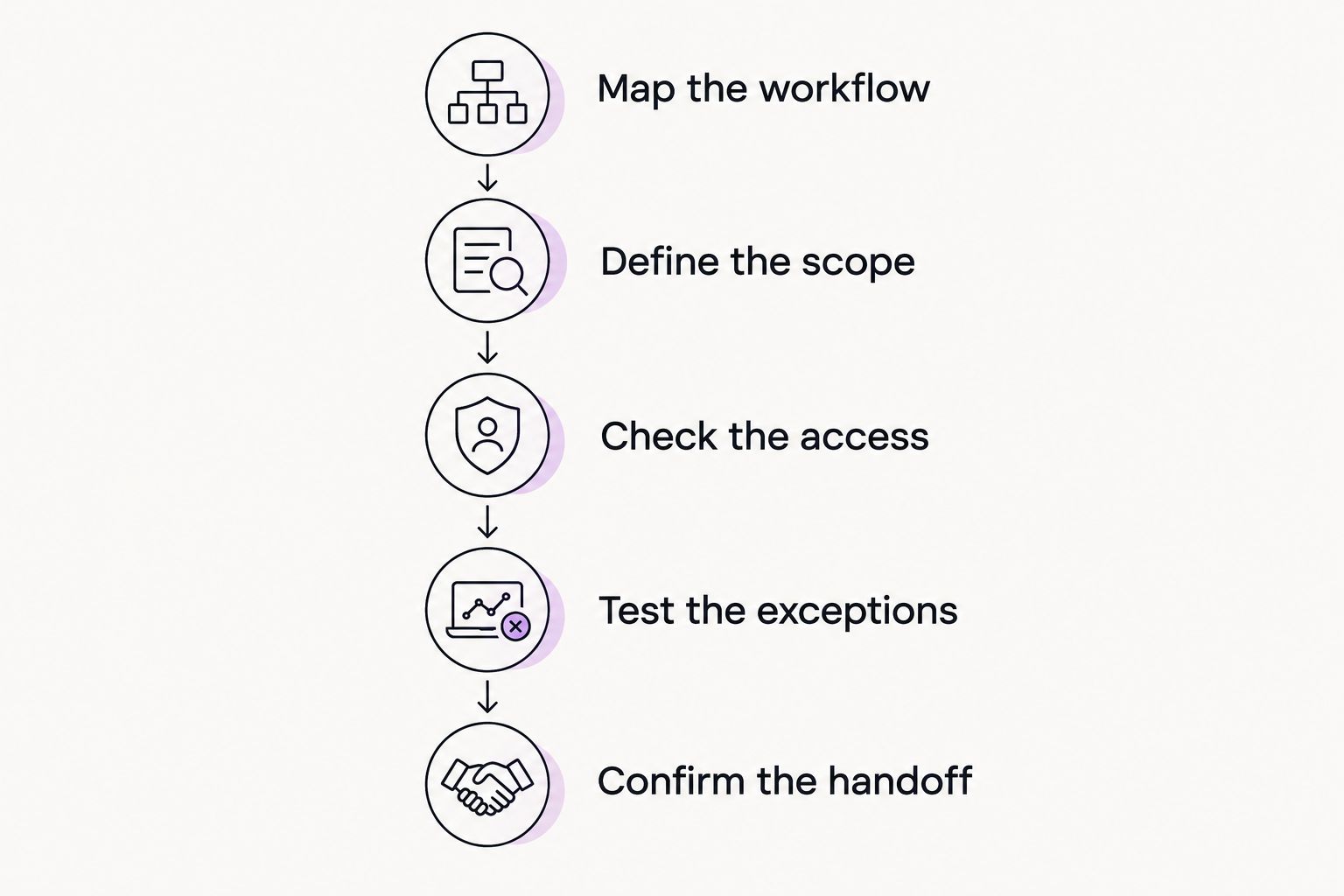
Use this sequence to review a proposal in 2026:
- Map the workflow. Identify the business task, the starting event, the information involved, and the expected outcome.
- Define the scope. List what the provider will configure, connect, write, test, and document. Record exclusions beside the deliverables.
- Check the access. Establish who owns each account and what permissions the provider needs.
- Test the exceptions. Require an explanation of missing information, duplicate submissions, failed connections, and manual recovery.
- Confirm the handoff. Agree on acceptance tests, documentation, support boundaries, and removal of unnecessary access.
Start with the actual task. For example, a website inquiry might need to reach your inbox, enter a customer record, and receive an acknowledgment. Those are separate actions. A proposal should say which actions are included and what information moves between them.
Do not accept “automate lead management” as a complete deliverable. Ask the provider to describe the same work without that phrase. If the explanation remains vague, the scope is not ready for approval.
What should the proposal include?
A useful proposal gives you decisions to approve, not technical language to decode. Look for these sections and ask for written clarification wherever an answer is missing.
| Proposal section | What you need to see | What should stop approval |
|---|---|---|
| Business outcome | A specific task and intended result | A broad promise to improve efficiency |
| Workflow | Trigger, actions, destination, and exceptions | A tool list without a process |
| Deliverables | Named configurations, messages, tests, and documentation | Work described only as setup |
| Responsibilities | Your inputs and the provider's duties | Unassigned account or content tasks |
| Acceptance | Observable pass-or-fail conditions | Completion based only on installation |
| Ownership | Account control and access arrangements | Critical accounts controlled only by the provider |
| Support | Included help, exclusions, and escalation method | An undefined promise of ongoing support |
A shorter proposal can satisfy these requirements. Length is not evidence of clarity. A detailed document still fails if you cannot tell whether a broken connection is your responsibility or the provider's.
Ask the provider to distinguish configuration from custom development. You need to know whether the work depends on standard settings, custom code, or both. That distinction affects what documentation you should request and what another provider would need to maintain.
Define a small first workflow
For a 2026 launch or refresh, separate essential work from optional additions. Your first workflow should solve a task you already understand. Do not approve a complicated process simply because several tools can connect.
Write a short process brief:
- Starting event: What happens before the automation runs?
- Required information: Which fields must be present?
- Action: What should the system do with that information?
- Destination: Where should the result appear?
- Exception: What should happen when the normal path fails?
- Owner: Who checks and corrects the exception?
For a service inquiry, decide whether the automation should acknowledge receipt or make a commitment. Those are different decisions. An acknowledgment confirms that a message arrived; a commitment could imply that you accepted a project or reserved time.
Keep judgment separate from routine handling. You can ask for automatic routing while retaining manual approval for project acceptance, unusual requests, or sensitive replies. The proposal should identify where your decision remains necessary.
Ask what can stay manual for now. A clear exclusion can be more useful than another feature, especially when your process is still changing.
Check ownership, access, and business information
You should know which accounts you control before work begins. Request an account list that identifies the owner, billing contact, recovery contact, and access required for the project.
Where the tools support separate user access, ask the provider to use it instead of sharing your personal login. Ask how access will be removed when the project ends. Do not assume that receiving a finished workflow also gives you control of every account behind it.
Review the information that moves between systems:
- Which customer details enter the workflow?
- Which connected services receive those details?
- Where are copies or activity records kept?
- Who can view failed submissions?
- How do you correct or remove information?
These questions establish the proposed setup; they do not replace legal or security advice. If your workflow involves regulated or sensitive information, identify the applicable requirements before approving the connections.
Also ask what happens if you change providers. You need enough account access and documentation for someone else to understand the setup without relying on the original provider's memory.
Require acceptance tests before approval
A workflow is not finished merely because its connections are switched on. The proposal should define how you will verify that the agreed process works.
As a practical starting point, request 3 test submissions: a complete inquiry, an inquiry missing required information, and a duplicate inquiry. These are suggested acceptance cases, not an industry benchmark. Adapt them to the process you are buying.
For each test, record the expected result and the actual result. Check the destination record and the message the customer receives, not just the provider's confirmation that a test ran.
Ask for 1 controlled failure test where the setup permits it safely. For example, the provider can demonstrate how a failed action becomes visible and how you retry or recover it without sending duplicate messages.
Reserve 1 handoff session in the written scope. Use it to walk through the normal process, an exception, and the steps for pausing the workflow. Request written instructions as well, so the session is not your only reference.
A sensible acceptance record identifies:
- The test performed.
- The expected outcome.
- The observed outcome.
- Any unresolved issue.
- Who approves the correction.
Do not substitute a dashboard screenshot for the agreed test results. You need evidence that the complete business task works, including the parts your customer sees.
Why business automation services proposals vary
Different scopes require different work. Compare the underlying requirements rather than treating every proposal as the same service.
- Workflow breadth. A single inquiry route is a different assignment from several branching processes.
- Existing setup. The proposal should state whether the provider is building a new process or modifying an existing one.
- Information quality. Missing fields, inconsistent records, and unclear ownership need decisions before the workflow can be dependable.
- Custom behavior. Standard configuration and custom code require different deliverables and maintenance instructions.
- Exception handling. Notifications, retries, and manual recovery must be explicitly included or excluded.
- Support scope. A project handoff and ongoing monitoring are different responsibilities.
For your 2026 comparison, send each provider the same process brief. Ask each to mark assumptions and exclusions against it. Otherwise, a shorter proposal might simply leave more work with you.
Pay particular attention to dependencies. If the provider needs approved message copy, account access, or a decision about customer records, the proposal should name that requirement. Your responsibilities belong in the plan too.
Should you build it yourself or hire help?
Choose the working arrangement that fits the task and the responsibility you want to retain. Neither DIY nor hiring removes the need to define the process.
| Approach | Best for | Practical advantage | Limitation to accept |
|---|---|---|---|
| DIY tool setup | Owners comfortable configuring and maintaining a straightforward workflow | You control configuration decisions directly | You handle testing, troubleshooting, and documentation |
| Freelance specialist | Owners with a defined task who want outside implementation help | You can assign a bounded technical project | Confirm what happens after delivery and during absences |
| Small agency | Owners seeking coordinated work across several business touchpoints | You can discuss related work within one proposed scope | Broader scope still needs clear boundaries and named responsibilities |
These are selection criteria, not promises about every provider. Review the actual proposal and the person responsible for delivery.
MORSE LLC is best for small business owners seeking direct work with Julian across branding and websites, with automation discussed around those needs. The one-person agency structure makes responsibility a useful proposal question: ask how support, continuity, and work outside the agreed scope will be handled.
Discuss your budget and timeline before expanding the project. A focused scope is easier to evaluate than an open-ended request to automate the business.
What questions should you ask before signing?
Ask questions that require the provider to explain a decision. “Can you connect these tools?” is less useful than “What happens when the connection fails?”
Use these prompts during your proposal review:
- Show me the exact event that starts the workflow.
- Tell me which actions happen without my approval.
- Explain what stays manual and why.
- Identify every account I need to own or manage.
- Show me how I will notice a failed action.
- Describe what documentation I receive.
- Explain what happens when I request a change after acceptance.
Request written answers to unresolved points. A conversation can clarify the work, but the signed scope should preserve the decisions.
Can you approve a proposal with unanswered questions?
Do not approve an undefined core workflow. Resolve missing triggers, deliverables, ownership, and acceptance conditions before signing. Optional additions can remain outside the initial scope if the proposal clearly excludes them.
When should you pause an automation project?
Pause when you cannot describe the manual process clearly. First decide who receives the information, what action they take, and what counts as completion. Automating an unresolved decision does not settle it.
FAQ
What's the most important part of a business automation services proposal?
The most important part is a defined workflow with observable acceptance conditions. You should be able to identify the trigger, actions, exceptions, and person responsible for each outcome.
Do I need to understand the software before hiring someone?
You need to understand the business process, not every software setting. Ask the provider to explain what happens, what can fail, and what you must maintain in plain language.
Should I own the accounts used for my automation?
Request ownership of the business accounts and a written explanation of any exceptions. Confirm billing, recovery access, permissions, and the process for removing provider access.
How can I compare business automation services proposals fairly?
Give each provider the same workflow brief and compare deliverables, exclusions, testing, ownership, and support. A proposal with fewer listed tasks is not equivalent unless the intended outcome and responsibilities match.
Does automation mean I can stop checking the process?
No. Assign responsibility for checking failures and correcting exceptions. The proposal should say whether monitoring belongs to you, the provider, or another named party.
Can MORSE LLC help with website-related automation?
MORSE LLC provides website development and automation services for small business owners. Discuss the specific website workflow with Julian and confirm the proposed deliverables, budget, timeline, and support boundaries.
What should I check before approving a proposal in 2026?
Before approving a proposal in 2026, confirm the workflow, account ownership, information handling, acceptance tests, and handoff. Make sure the written scope also distinguishes the initial build from ongoing subscriptions and support.
One last thing
Ask the provider to explain how you stop the automation without losing access to your information. That question tests whether the proposal covers your control of the process—not just its launch.
Keep the pause instructions beside the operating instructions. You need both when your services, availability, or customer process changes.