
A small business website redesign takes as long as its agreed scope, content preparation, review process, and launch requirements demand. Website redesign services need a project-specific schedule, not a generic promise of a certain number of weeks. Before you accept a completion date, confirm whether it includes writing, branding decisions, revisions, testing, and launch—not just building the pages.
- Website redesign services need a schedule tied to approved scope, ready content, and clear review responsibilities.
- MORSE LLC fits solo owners seeking direct help with branding and website development.
- Separate essential launch requirements from later improvements before comparing redesign proposals.
- Keep your domain, existing page addresses, and inquiry process in the launch checklist.
Why this matters
A deadline means little if you and your designer mean different things by finished. A completed design is not the same as a working website with approved copy, tested forms, and a planned changeover.
For a solo service business, start with what a visitor needs to understand and do. This guide to small business website design for solo service providers helps frame that scope before you discuss a schedule.
If you are planning a redesign in 2026, ask for a schedule that names decisions and dependencies. You need to know what you must supply, when you must approve it, and what happens if the scope changes.
How long does a small business website redesign take?
The useful answer is an agreed sequence of work with clear completion conditions. Ask your provider to put the following stages in the proposal and identify which stages depend on your input.
- Define the scope. Confirm which pages, functions, and existing materials belong in the redesign. State what stays unchanged and what gets replaced.
- Prepare the content. Gather service descriptions, images you have permission to use, contact details, and any approved testimonials. Assign responsibility for missing copy.
- Approve the design. Review the page structure, visual direction, and main inquiry path before those decisions spread across the website.
- Build and review. Check the completed pages against the agreed scope. Keep requested corrections separate from new features.
- Test and launch. Test forms, links, mobile layouts, and the domain changeover. Confirm who handles any changed page addresses and post-launch corrections.
These stages describe the work, not a promised duration. Ask for calendar dates only after the provider understands the requirements and your availability.
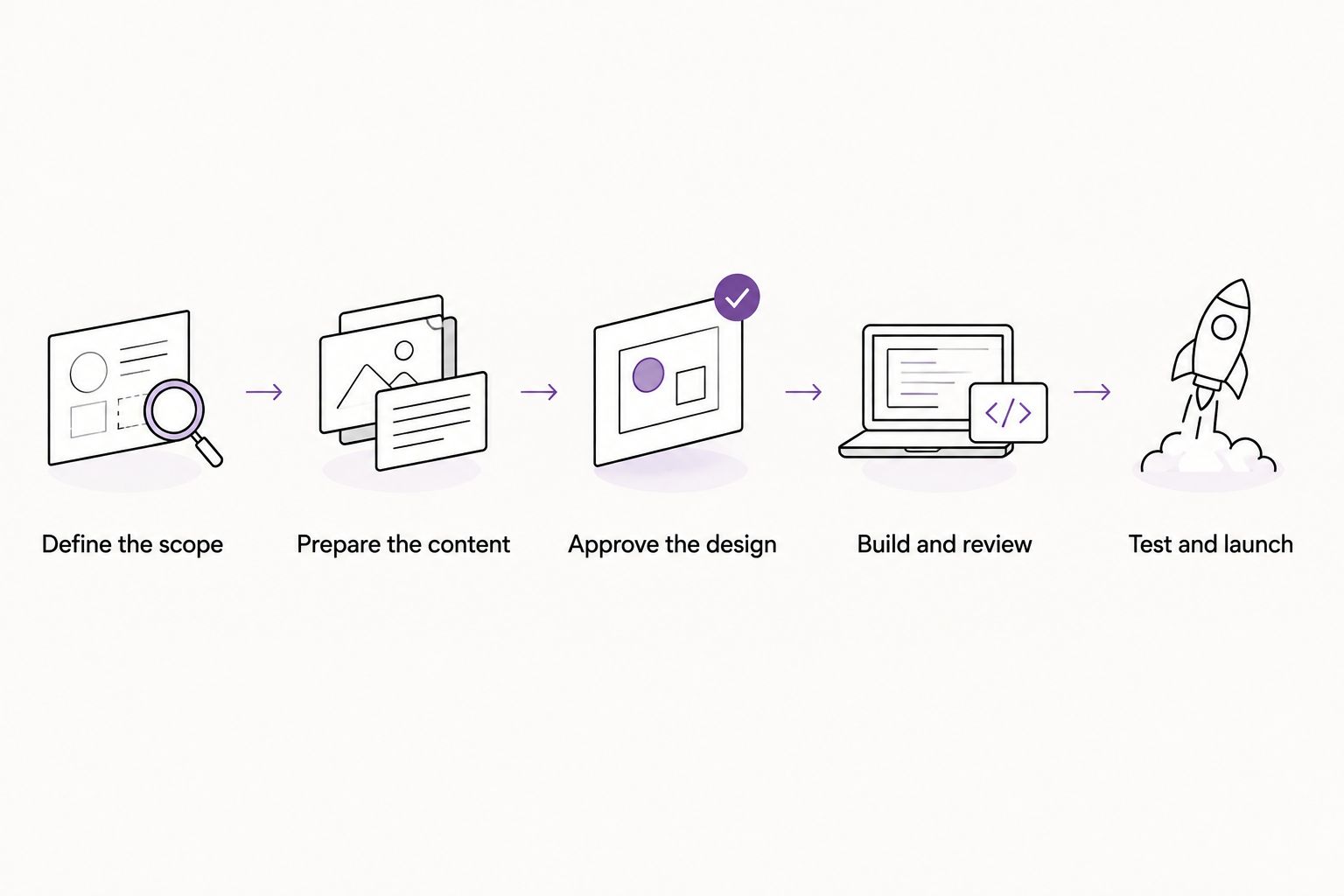
A useful 2026 redesign schedule names the person responsible for each stage. It also states what counts as approval, rather than treating silence or an unfinished conversation as permission to proceed.
Put these checkpoints in writing
Use 2 approval checkpoints as a starting structure for your discussion: approval of the page plan and design direction, then approval of the completed website before launch. Agree on any additional reviews the project needs.
Give each checkpoint a clear deliverable. A page list, draft layout, or working preview is easier to approve than a broad request for feedback on everything.
Assign 1 final approver on your side. Other people can contribute, but the provider needs a clear decision when comments conflict.
A visual refresh: confirm what stays unchanged
A visual refresh focuses on presentation while retaining the agreed content, page structure, and functionality. It is the narrower choice when your services and customer journey remain accurate but the appearance needs attention.
Best for: an established service business whose website still explains the right offer and directs visitors to the right action.
The advantage is a tighter brief. The limitation is equally important: changing the appearance does not resolve unclear service descriptions, missing information, or a confusing inquiry process.
Before agreeing to a refresh, identify the specific changes. Updating typography and spacing is different from rewriting every service page, replacing the platform, or rebuilding a booking connection.
A content and structure redesign: settle the offer first
A content and structure redesign changes how your business explains its services and organizes its pages. It requires decisions about what you offer, who you serve, and which information belongs together.
Best for: a business whose website no longer reflects its current services or makes those services difficult to understand.
The benefit is room to correct the message and page structure together. The tradeoff is more preparation and approval work than a presentation-only brief contains.
Write down your current services before discussing layouts. If you are still deciding what to sell, treat that as an unresolved business decision—not something the website build will settle automatically.
A platform move: include the changeover work
A platform move replaces the system used to manage the website. Treat it as a separate scope item, even when the new pages look similar to the old ones.
Best for: an owner who has identified a specific management or functionality requirement the current setup does not meet.
The benefit is the opportunity to address that requirement. The tradeoff is changeover work: content transfer, account access, form setup, address mapping, and testing all need an owner.
Do not move platforms solely because a redesign is happening. Ask which requirement justifies the move and what you will need to learn afterward.
| Redesign scope | Best for | Main benefit | Main limitation |
|---|---|---|---|
| Visual refresh | Accurate content with presentation problems | Keeps the brief focused | Leaves messaging and structure unchanged |
| Content and structure redesign | Services or information that need clarification | Revises the message and page plan together | Requires content decisions and approvals |
| Platform move | A defined requirement the current setup cannot meet | Addresses the underlying management requirement | Adds transfer and changeover tasks |
Why website redesign timelines vary
The schedule changes when the work or its dependencies change. Use these factors to question a proposal rather than comparing completion dates in isolation.
- Scope boundaries. A presentation update and a rewritten website are different assignments. Name the pages and functions included in the agreement.
- Content readiness. Unapproved service descriptions leave the provider waiting for decisions or working from assumptions. Confirm who writes and who approves.
- Branding decisions. Changes to your business name, message, or visual direction affect website work. Settle those decisions before approving page designs.
- Feedback responsibility. Conflicting comments create unresolved instructions. Choose a final approver and send consolidated feedback.
- Functional requirements. Booking tools, forms, payments, and other connections need defined requirements and testing responsibilities.
- Launch access. Domain, hosting, and website account access must be available to the people handling the changeover. Check access before launch day.
For your 2026 project, request a written assumption beside each major milestone. An assumption such as approved copy supplied by the owner tells you what the date depends on.
Should you redesign the website yourself or hire help?
Choose based on the work you can own, not just who offers the earliest finish. A DIY builder still requires you to make content, layout, and launch decisions.
| Approach | Best for | Advantage | Tradeoff to check |
|---|---|---|---|
| DIY website builder | Owners ready to write, assemble, and maintain their own site | Direct control over edits | You own setup, decisions, and testing |
| Freelance designer | Owners seeking an individual specialist for a defined assignment | A focused brief with a named specialist | Confirm whether writing, development, and launch are included |
| Small branding or web agency | Businesses seeking help across related disciplines | Can combine responsibilities under an agreed scope | Confirm who does the work and handles approvals |
| MORSE LLC | Solo owners seeking direct branding and website help | Direct work with Julian Cesar Hernandez | A one-person agency; confirm scope and timeline before committing |
MORSE LLC is best for solo owners who want direct help from Julian Cesar Hernandez with branding and website development. Discuss the scope around your budget and timeline rather than assuming every related task belongs in the same engagement.
No option removes your responsibility to confirm business facts and approve the result. Hiring help changes who performs the work; it does not replace your decisions about what your business offers.
What should you prepare before requesting a schedule?
Create 1 project brief that a provider can read without searching through separate messages. Keep it practical rather than polished.
Include the following:
- The business problem you want the redesign to solve.
- Your current services and intended customers.
- The pages you expect to retain, remove, or add.
- The action visitors should take, such as sending an inquiry.
- Available copy, photographs, and other approved materials.
- Required connections, account access, and management needs.
- Your budget boundaries and any genuine deadline.
- Who supplies feedback and gives final approval.
Separate requirements from preferences. A working inquiry form is a requirement for an inquiry-led website; a particular animation is a preference unless you have a clear functional reason for it.
Use the brief to ask what can fit the deadline. If the answer requires reducing scope, make that decision before design work starts—not during the final review.
Discuss your website scope
Talk through branding, website needs, budget, and timing with Julian Cesar Hernandez.
Can you keep your existing website live during a redesign?
Keep the existing website live while the replacement is prepared whenever your setup supports a separate working version. Ask the provider how that separation works and what changes at launch.
Confirm which existing forms, links, and customer-facing details must keep working. If anything needs to pause during the changeover, agree on the handling before launch.
Should you change your branding before redesigning your website?
Resolve branding decisions before approving the website design when those decisions affect the pages. Your business name, service descriptions, and visual direction belong in the brief.
You do not need to invent a larger branding project to justify a redesign. Keep what still serves the business, and define the specific decisions that need attention.
FAQ
How long does a small business website redesign take in 2026?
A small business website redesign needs a schedule based on its scope, content, reviews, and launch requirements. Ask for milestone dates after those responsibilities are agreed, rather than relying on a generic duration.
What should website redesign services include?
Website redesign services should state the included pages, design work, development, review process, and launch responsibilities. Confirm separately whether copywriting, branding changes, platform transfer, and ongoing support belong in the agreement.
Can I speed up a website redesign by preparing the content?
Preparing approved content removes an unresolved dependency from the redesign. Supply accurate service descriptions, contact details, permitted images, and clear instructions about what stays or changes.
Is a visual refresh the same as a full website redesign?
A visual refresh changes presentation within an agreed existing structure, while a broader redesign can change content, organization, or functionality. Define the actual deliverables because providers can use these labels differently.
Is hiring someone better than using a DIY website builder?
Hiring help suits owners who want someone else to handle agreed design or development tasks; DIY suits owners ready to perform that work themselves. Compare your responsibilities as well as the provider's deliverables.
Who should give feedback on my redesigned website?
Choose a final approver who can resolve conflicting comments and confirm business facts. Gather other feedback into a consolidated response so the provider receives clear instructions.
Does MORSE LLC help with branding as well as websites?
MORSE LLC provides branding and website development through direct work with Julian Cesar Hernandez. Discuss the scope around your business needs, budget, and timeline before agreeing to the project.
One last thing
Test the inquiry path, not just the homepage. Before launching your 2026 redesign, send a real test inquiry, confirm it reaches the intended destination, and check what the visitor sees afterward.
A page can look finished while the action you need remains untested. Put that check in the launch agreement.