
You need a logo when your business already has a clear message and you need a recognizable mark; you need a full brand identity when your website, proposals, and other materials need a shared visual direction. A logo alone does not decide your colors, typography, image style, or layout rules. For a small service business in 2026, the right choice is the smallest scope that solves the inconsistency your customers actually encounter.
- Choose a logo when your message and supporting visuals already work together.
- Choose brand identity design services when your website and business materials need consistent visual rules.
- MORSE LLC fits solo owners who want direct work with Julian on branding and websites.
- Keep an effective existing logo if the real problem is inconsistent typography, color, or layout.
Why this matters
Your customer should not have to work out whether your website, estimate, and business card belong to the same business. A shared visual direction helps those materials feel connected. It also gives you rules to follow instead of starting each design from scratch.
That does not mean every business needs an extensive identity project. A solo owner preparing to launch in 2026 needs useful decisions, not a pile of files with no clear purpose. Start with what your customer sees and what you need to produce yourself.
MORSE LLC is best for solo owners who want direct help from Julian across branding and websites. You can review MORSE LLC with that scope in mind, rather than assuming you need a complete redesign.
Do you need a logo or a full brand identity?
Choose a logo project when the missing piece is the mark. Choose a brand identity project when the missing piece is a repeatable visual system. The distinction is not how established your business is. It is how many design decisions remain unresolved.
| Option | Best for | Main benefit | Main limitation |
|---|---|---|---|
| Logo design | Businesses with clear messaging and usable supporting visuals | Gives the business a recognizable mark | Leaves other visual decisions unresolved unless included in scope |
| Full brand identity | Businesses needing consistent design across several materials | Connects the logo, colors, typography, and visual rules | Requires more decisions and a broader project scope |
| Identity refresh | Businesses with useful existing elements and specific inconsistencies | Preserves what works while fixing gaps | Does not address a deeper positioning problem unless that work is included |
Treat these as scope choices, not standardized packages. Ask what the proposed work includes. One provider's identity project can cover different deliverables from another's.
If you are starting from nothing, the guide to brand identity design services for a new business gives you a launch-focused starting point.
Logo design: best for a missing or unusable mark
A logo-focused project makes sense when you can already explain what you do, who you serve, and why someone should contact you. Your website and documents also have a visual direction you intend to keep.
Perhaps your current mark becomes unreadable in a small space. Perhaps you have been typing your business name differently on every document. Those are specific problems you can put in a brief without reopening every branding decision.
Before you choose this scope, check:
- Your existing colors and typography work across your materials.
- You know where the logo will appear.
- You can identify what is wrong with the current mark.
- You do not expect the logo designer to resolve your service positioning automatically.
The advantage is focus. The limitation is equally clear: a new logo will not fix an unclear homepage or an inconsistent proposal layout. Choose logo design only when the surrounding identity is already usable.
Full brand identity: best for disconnected materials
A full identity project makes sense when you are repeatedly making unrelated visual choices. Your website uses one style, your proposals use another, and your social posts feel separate again.
The work should establish relationships between elements, not just deliver them individually. Colors need clear roles. Typography needs a readable hierarchy. Layout examples should show how the pieces work together in materials you actually use.
A useful scope discussion covers:
- Logo versions suited to the agreed applications.
- Color choices and their intended uses.
- Typography choices and usage guidance.
- Image or graphic direction where needed.
- Examples of important customer-facing materials.
- Guidance you can use without the designer beside you.
These are items to discuss, not a promise that every provider includes them. The benefit is consistency; the trade-off is a wider set of decisions and deliverables. Choose a full identity when you need rules you can reuse, not simply more logo files.
Identity refresh: best for a business with useful foundations
You do not have to replace a recognizable logo just because your website needs work. An established service business can keep its name and mark while improving typography, color use, layouts, and the way services are presented.
Start by separating what works from what creates friction. Keep elements that still suit your business. Change elements that cause confusion, look inconsistent, or make routine materials difficult to produce.
For a 2026 refresh, compare the business you operate now with the business your materials describe. A changed service focus deserves attention before you spend time polishing decorative details.
The benefit is continuity. The limitation is that surface changes cannot resolve an unclear offer by themselves. Choose a refresh when you can name what should stay and what needs fixing.
Why the right branding scope varies
The right scope depends on what you already have and what you need to make next. Use these factors to keep the discussion concrete:
- Existing assets. A usable logo and consistent typography give you a different starting point from scattered files and improvised designs.
- Message clarity. If you cannot describe your service plainly, separate that problem from the visual work.
- Customer touchpoints. Identify whether customers mainly encounter a website, proposals, printed materials, or a combination.
- Website plans. A website project needs usable decisions about type, color, imagery, and content hierarchy.
- Budget and timeline. Agree on the essential work first, then distinguish it from work that can wait.
- Ongoing ownership. Choose guidance and file formats that fit how you will maintain your materials.
Do not measure scope by the length of the deliverables list. Measure it by whether those deliverables help you do the work your business needs.
How do you choose without overbuying?
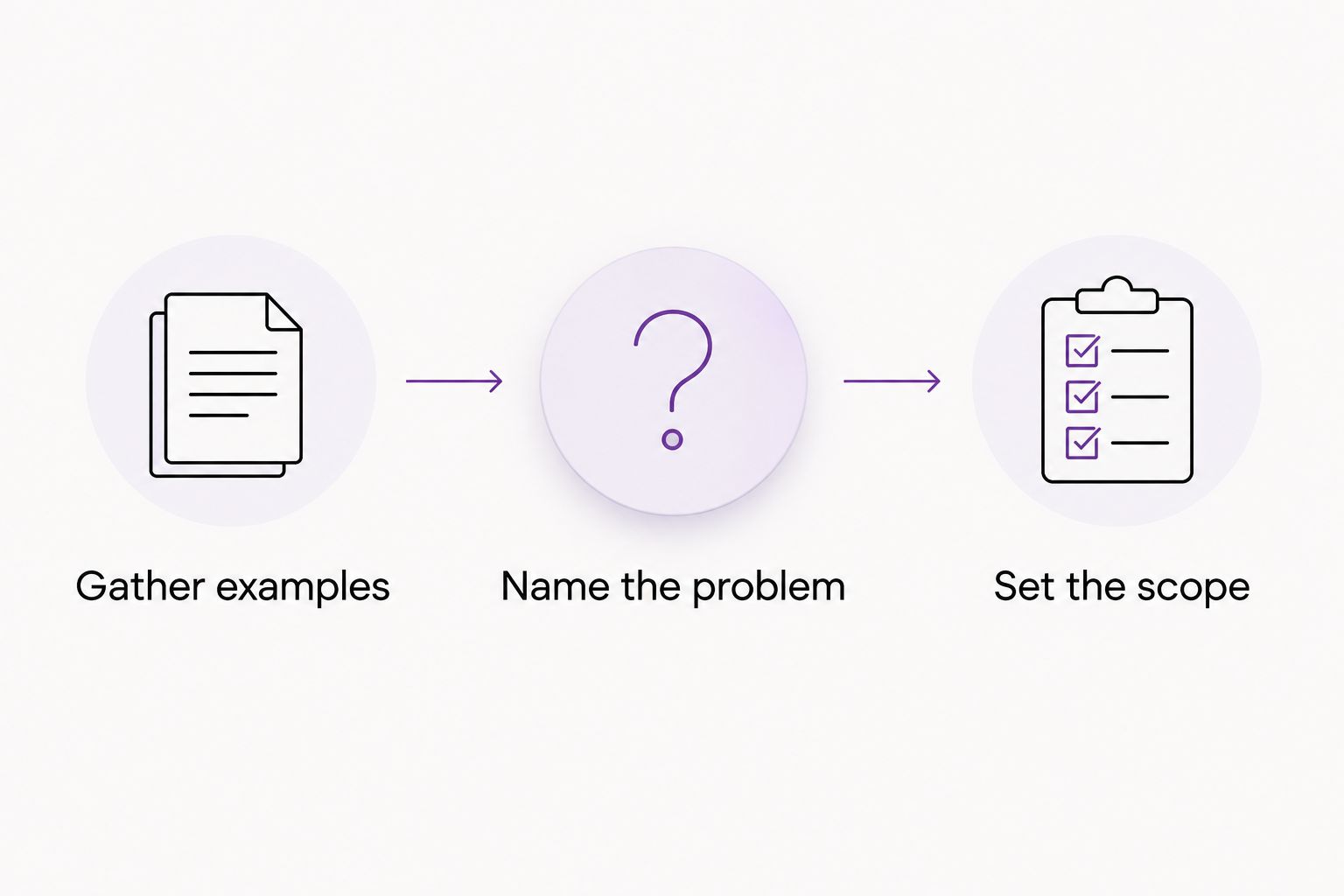
Use these 3 decisions before you request a proposal. They turn a vague request for branding into a brief a designer can respond to.
1. Gather examples
Put your current website, proposal, business card, and other active materials together. Include only what you use or genuinely plan to use. Mark the places where the style changes without a clear reason.
If you are launching, gather the content and applications you need first. Do not create hypothetical merchandise or elaborate campaigns simply to justify a larger identity project.
2. Name the problem
Write the main problem in 1 sentence. For example: your materials look unrelated, your logo is difficult to use, or your website no longer reflects your services. Keep that sentence separate from your preferred solution.
Then ask whether a logo alone would solve it. If the same problem would remain after replacing the mark, your brief needs to cover more than logo design.
3. Set the scope
List the essential deliverables and the decisions each should resolve. Identify what you will maintain yourself and where you need help. Discuss budget and timeline before assuming everything belongs in the first phase.
For a website launch planned in 2026, coordinate the identity decisions with the website work. Otherwise, you risk designing pages around temporary choices and reopening them later.
Should you do it yourself or hire help?
Choose based on the decisions you can make confidently, not whether hiring sounds more professional. DIY is a reasonable choice when your needs are straightforward and you can carry the work through consistently.
| Route | Best for | Main benefit | Main limitation |
|---|---|---|---|
| DIY website builder | Owners comfortable choosing and maintaining a template | Direct control over routine updates | You remain responsible for content and visual consistency |
| Freelance designer | Owners with a defined design task | Focused help on an agreed brief | Website or messaging work needs separate confirmation |
| Small branding or web agency | Owners needing connected branding and website decisions | Related work can share a project direction | Responsibilities and scope still need explicit agreement |
Ask every provider how the work moves from decisions to usable materials. Confirm who handles content, who builds the website, and what you receive at handoff. Do not assume those responsibilities from a job title.
MORSE LLC provides branding and website services through direct work with Julian Cesar Hernandez. Discuss a scope around your budget and timeline. A one-person agency is not the right fit for every project; confirm how the proposed responsibilities and schedule match your needs.
Can you keep your logo and still improve your brand?
Yes. Keep your logo when it remains usable and suits the business you run. Improve the supporting elements that are creating inconsistency, such as typography, colors, image choices, or document layouts.
Test that decision on 2 sample layouts: a homepage section and a proposal cover. If the same mark works clearly in both, examine the surrounding design before replacing it.
Should branding come before website design?
Resolve the essential visual direction before you commit to detailed website layouts. You do not need every future application finished, but you do need enough agreement to avoid repeatedly changing type, color, and logo treatment.
If you are planning both projects in 2026, put those dependencies in the brief. Branding and website work can be coordinated without treating them as unrelated purchases.
What should you ask before hiring a designer?
Ask what problem the proposed scope solves and what remains your responsibility. Request a clear deliverables list, the agreed feedback process, file requirements, and any font or image licensing responsibilities.
Also ask how you will use the work afterward. A presentation that looks convincing is not enough if you cannot apply its decisions to your next proposal or website update.
FAQ
What's the difference between a logo and a brand identity?
A logo is a recognizable mark; a brand identity connects that mark with supporting visual choices and usage rules. Identity work can address typography, colors, imagery, and layouts, depending on the agreed scope.
Do I need brand identity design services before launching?
You need brand identity design services when your launch requires visual decisions you cannot make or apply consistently yourself. A business with clear messaging and usable visual foundations can choose a narrower logo scope.
Can I use a DIY website builder instead of hiring a designer?
Yes, a DIY website builder suits owners who can choose a template, prepare content, and maintain a consistent design. Hiring help makes sense when those responsibilities are blocking the work or need coordination.
Will a new logo fix an outdated website?
A new logo will not fix unclear content, difficult navigation, or inconsistent page layouts. Identify the website problem separately before making logo replacement part of the project.
What should I prepare for a branding discussion?
Prepare your service description, target customer, current materials, and planned applications. Add your budget and timeline so the scope discussion stays tied to practical constraints.
Is MORSE LLC a fit for a solo service business?
MORSE LLC fits solo service owners who want direct work with Julian on branding and websites. Confirm the deliverables, responsibilities, budget, and timeline before choosing the project scope.
Do I have to replace all my branding at once?
No, you can prioritize the materials customers need now and phase other work around them. Establish the shared visual rules first so later updates follow the same direction.
One last thing
Before approving a logo or identity direction, put it into an ordinary piece of business communication. Use the proposal you send, not an imaginary billboard. Check whether you can read it, recognize the business, and repeat the design yourself.
Your next useful document is a better test than another decorative mockup. For your 2026 project, ask to see the identity working where customers will actually encounter it.