
For a one-person business, business automation services connect repeatable tasks with the aim of reducing manual administration and keeping customer work moving. You still handle exceptions and customer decisions; this guide shows you what to automate in 2026, what to keep personal, and when to hire help.
- Start business automation services with one repeatable task, not a full business overhaul.
- MORSE LLC suits solo owners seeking practical automation help alongside branding and website services.
- Fix your website inquiry process before adding automated follow-up.
- Compare DIY, freelancers, and agencies on scope, ownership, and ongoing maintenance.
Why business automation services matter for solo owners
A solo service business has the same person answering inquiries, delivering work, and handling administration. An inquiry that needs several manual handoffs interrupts the work you sell. Automation is useful when it removes a repeat action without removing necessary judgment.
Automate a clear process, not an unresolved business decision. If you cannot explain which inquiries fit your service, software cannot make that decision for you.
Your website is a practical starting point. This guide to small business website design for solo service providers covers the website side of that work. A clear service description and useful inquiry form give any later automation better information.
For your 2026 plan, choose a task you already repeat. A new business should establish its inquiry process before connecting tools; an established business should inspect where its current process breaks.
Build a useful automation process
1. Record the work you repeat
Start with a document or spreadsheet. Track repeat administrative tasks for 5 business days, including what starts each task, what information you need, and what finishes it. This is an observation exercise, not a promise of time savings.
Look for tasks where you copy the same details, send the same basic instructions, or check the same status. Keep sensitive decisions separate. Accepting a project, approving a scope change, and resolving a complaint need your attention.
For a new business without an inquiry history, write the process you intend to follow. Treat that version as a draft until real customer conversations show what is missing.
- Record the task and its trigger.
- Note where the required information lives.
- Mark actions that repeat without much variation.
- Separate routine administration from customer judgment.
- Choose one task to investigate first.
2. Map the customer handoff before choosing tools
Draw the process on paper first. For a service inquiry, use these stages: Inquiry, Review, Reply, Booking, and Follow-up. Put your decision points between the stages rather than hiding them inside an automatic sequence.
For example, an acknowledgment can confirm receipt without promising that you accept the project. Booking should follow the approval step your business actually uses. If every inquiry needs a discussion before scheduling, do not build a process that skips that discussion.
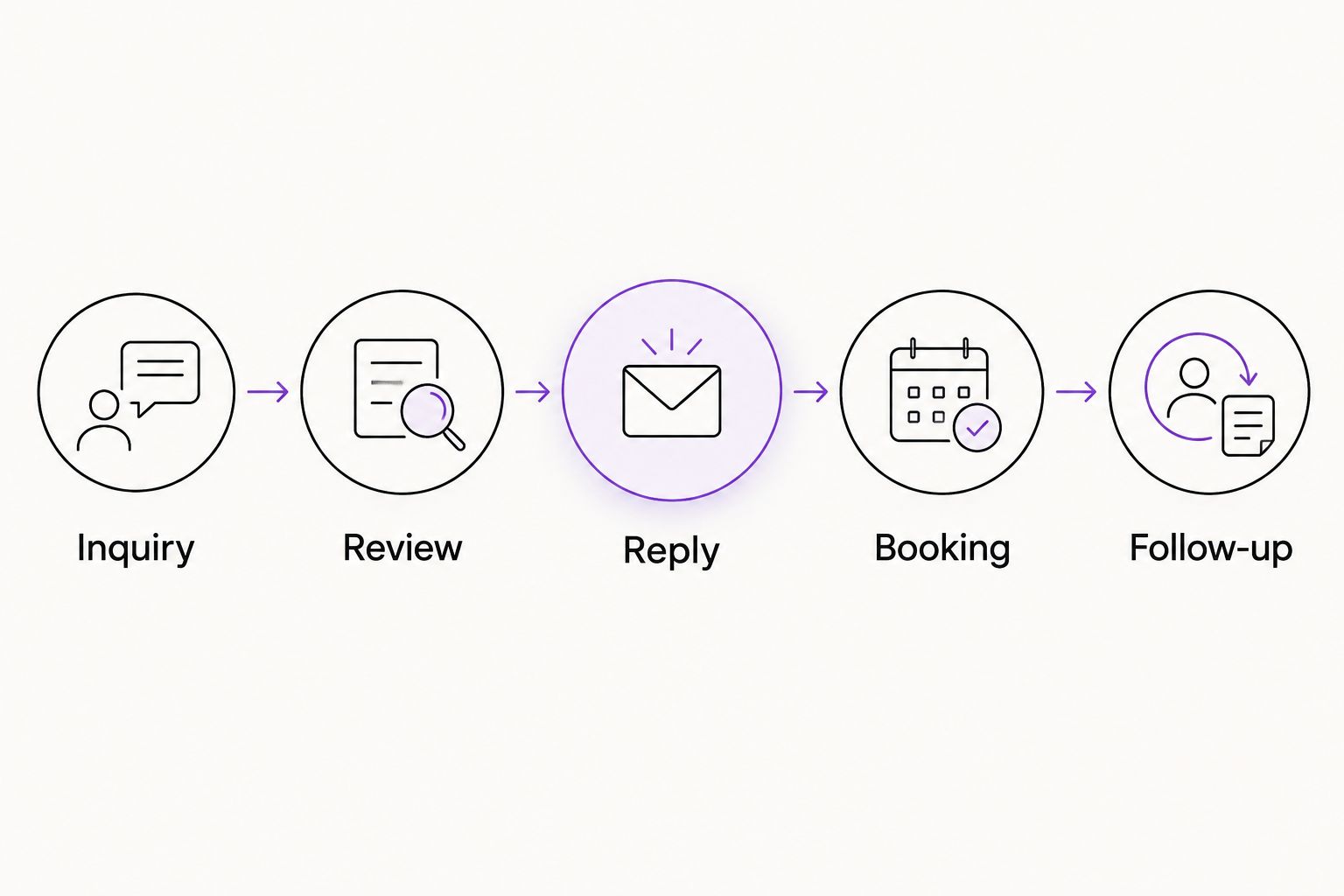
Review the map against an ordinary customer conversation. Every stage should have a clear owner, even when you are the only person involved. A tool carrying out an action does not take responsibility for the result.
- Inquiry: collect the details needed to respond.
- Review: decide whether the request fits.
- Reply: explain the appropriate next step.
- Booking: confirm the agreed action.
- Follow-up: check unresolved requests without repeating completed work.
3. Fix your website intake before connecting systems
Read your website as a customer would, then submit its inquiry form yourself. Check whether the service description explains what you do, who you help, and what happens after someone contacts you. Save a manual response template before building an automated acknowledgment.
A clearer inquiry form is often the right first project. Collect what you need to assess the request, not every detail you might eventually use. Explain why you need information that is not obviously relevant.
If your 2026 refresh involves both messaging and website changes, discuss those together. MORSE LLC business automation services fit alongside its branding and website work; you work directly with Julian Cesar Hernandez. Use the MORSE LLC website to discuss a scope around your budget and timeline, rather than assuming every possible connection belongs in the project.
- State the service clearly before the form.
- Ask for contact details and a useful project summary.
- Explain the next step without promising an unconfirmed response time.
- Keep project approval separate from acknowledgment.
- Identify the website changes needed before automation begins.
4. Automate one routine action and keep an escape route
Write and use the response manually first. Once its wording and purpose are clear, choose a single action to automate, such as acknowledging an inquiry or creating an internal reminder. These are possible workflow choices, not requirements for every business.
Start with a low-consequence task. An acknowledgment has a narrower purpose than an automated project acceptance. The more an action commits your time or changes a customer relationship, the more carefully you should control it.
Keep a manual route available. If a connection fails, you need to know where the original request went and how to respond without rebuilding the system. Ask a provider to explain that fallback in plain language before approving the work.
- Define the event that starts the action.
- Specify what the automated action does.
- Write the customer-facing message yourself or approve it.
- Decide which requests require manual review.
- Document how to pause the action.
- Keep access to the original customer request.
5. Test normal requests, mistakes, and interruptions
Test 3 scenarios before relying on the process: a complete inquiry, an incomplete inquiry, and a repeated inquiry. You are checking behavior, not just whether a connection turns on.
Submit test information you control. Check what arrives in your inbox, what the customer receives, and whether the same request creates duplicate actions. Read messages on a phone as well as a larger screen.
For a 2026 launch or refresh, include these checks in the project acceptance criteria. A connection that works once is not enough to show that the wording, handoffs, and exception handling suit your business. Keep the test record so you can repeat it after changes.
- Confirm required details reach the right destination.
- Check that incomplete requests remain visible.
- Check repeated submissions for duplicate messages.
- Confirm notifications reach an account you monitor.
- Pause the process and test the manual fallback.
- Remove test records without deleting real inquiries.
6. Review the process before adding another connection
Begin with a manual review of recent requests. Inspect your last 10 inquiries, or all inquiries received if you have fewer. Check whether each reached the right place and whether you still had to repeat work outside the planned process.
Separate a process problem from a tool problem. Unclear service descriptions require clearer writing. Missing inquiry details require a better question. A failed handoff requires attention to the connection. Adding another tool does not resolve all three.
For your 2026 maintenance notes, record who owns each account and what changed. If you hire help, request a plain-language handover. You should understand the routine well enough to pause it, inspect an inquiry, and ask a specific question when something fails.
- Check for missed or duplicate requests.
- Record manual corrections you still make.
- Update templates when your services change.
- Confirm that you control the relevant accounts.
- Remove connections that no longer serve a clear purpose.
Discuss your next practical improvement
Talk through branding, website, and automation needs with Julian around your budget and timeline.
Compare DIY and hired automation help
Choose the smallest scope that fixes the actual handoff. For your 2026 comparison, give every potential provider the same process map and desired outcome. Compare the proposed work, account ownership, testing, and handover—not just a list of tools.
| Option | Best for | Main advantage | Key limitation |
|---|---|---|---|
| DIY website builders and built-in tools | Owners with a simple process and time to configure it | You control setup and learn how the process works | You carry the testing, troubleshooting, and maintenance work |
| Freelance designer or automation specialist | Owners with a defined website task or connection | You can select help around a specific skill | Confirm whether writing, integrations, and ongoing support are included |
| Small branding or web agency | Owners coordinating several related changes | A shared project scope can cover connected needs | Confirm who handles automation and what sits outside the agreement |
| MORSE LLC | Solo owners seeking direct help across branding, websites, and automation | You work directly with Julian across related business needs | It is a one-person agency; agree on scope and communication expectations |
Hiring help does not remove your role in the project. You still need to explain your services, approve messages, and decide what counts as a suitable inquiry. DIY is a fair choice when the task is simple and you want to maintain it yourself.
Before choosing a provider, request a written description of the starting event, the resulting action, and the exceptions. Ask what you receive at handover. A short, understandable specification is more useful than a long list of connections you cannot explain.
Common mistakes solo owners make
Automating before deciding what you sell
An automatic reply cannot clarify an undefined service. Write a plain description of the work, the customer it serves, and the next step first. Then build the routine around that decision.
Making every inquiry book immediately
A booking link is not a substitute for reviewing fit. If your work requires an initial assessment, retain that step. Avoid inviting commitments that you then need to reverse manually.
Adding forms that ask for too much
A first inquiry does not need to collect everything required for delivery. Keep detailed project intake for the appropriate stage. Each question should help you make the next decision.
Leaving account ownership unclear
Do not finish a project without knowing which accounts control the process. Confirm access, billing responsibility, and recovery details. Otherwise, a routine edit becomes a dependency on someone else's login.
Automating follow-up without a stopping condition
A follow-up should stop when its purpose ends. Define what happens after a reply, a booking, or a decision not to proceed. Otherwise, your process can send a message that no longer matches the conversation.
FAQ
What are business automation services for a one-person business?
Business automation services set up repeatable actions between your business tasks or tools. For a solo owner, the useful starting point is a defined task such as acknowledging an inquiry, with manual review kept where judgment is needed.
What should I automate first in my service business?
Automate one routine, low-consequence action that you already understand. Write the manual process first, then define its trigger, result, and fallback before connecting tools.
Can I handle business automation myself?
Yes, DIY is a reasonable option for a simple process you are prepared to test and maintain. Hire help when the task involves connections or website changes you do not want to manage yourself.
Do I need a new website before automating inquiries?
No, you do not automatically need a new website. Check whether your existing service descriptions, inquiry form, and notifications support the process before deciding on a rebuild.
Can MORSE LLC help with branding and websites as well?
Yes, MORSE LLC provides branding, website development, marketing, and automation services. You work directly with Julian Cesar Hernandez and discuss a scope around your needs, budget, and timeline.
Should every customer message be automated?
No, keep project acceptance, unusual requests, and sensitive conversations under your control. Routine acknowledgments serve a different purpose from decisions that commit your business.
What should I ask an automation provider before hiring?
Ask what starts the process, what it does, how exceptions work, and who controls the accounts. Request clear testing and handover requirements in the agreed scope.
One last thing
Write the failure plan before adding another feature. If you cannot explain how to find the original inquiry and reply manually, the process is not ready to carry your customer communication.
For your 2026 plan, leave with one working routine you understand—not several connections you depend on someone else to interpret.