
Established-business brand identity design services are the work of aligning your visual identity and messaging with the business you run now, while preserving what customers recognize. This guide helps you decide what to keep, what to change, and who should handle your 2026 refresh.
- Brand identity design services should fix a defined business problem, not replace familiar details without reason.
- MORSE LLC offers brand identity design services with direct help from Julian across branding and websites.
- Audit your existing materials before choosing between a focused refresh and a broader redesign.
- Choose support around deliverables, ownership, budget, and your ability to manage the work.
Why brand identity design matters for established businesses
An established business has something a new business does not: an identity already in use. Customers encounter it on your website, estimates, invoices, social profiles, and service vehicles. Changing those materials creates work beyond approving a new logo.
Refresh the parts that no longer fit. Keep recognizable elements unless there is a clear reason to replace them. A business that has narrowed its services needs a different brief from one whose website and printed materials simply look unrelated.
For your 2026 project, define the mismatch before discussing style. Is your old name still accurate? Does your website describe services you no longer provide? Are customers seeing different business names across different channels?
MORSE LLC provides branding and website development for small business owners. MORSE LLC is best for solo owners who want direct help from Julian with branding and websites. Compare that working arrangement against the amount of coordination you want to handle yourself.
How to plan an established-business brand refresh
Start with evidence from your own materials, then make decisions in order. Choosing colors before agreeing on your services and audience gives you design preferences without a useful brief. The following steps keep the project tied to how your business operates.
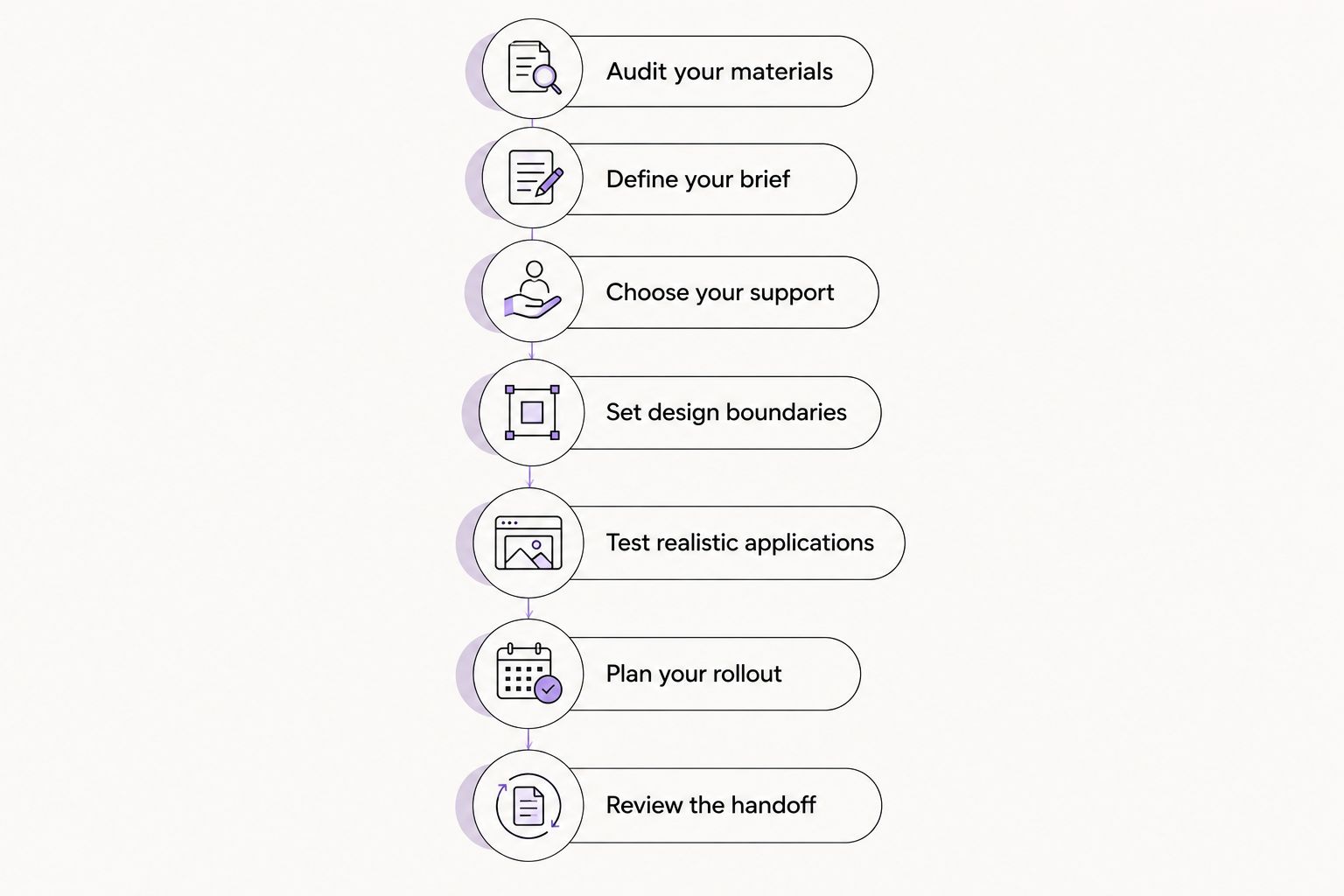
Audit your materials
Start manually. Put 10 recent customer-facing items into a shared folder and inspect them together. Include ordinary working documents, not just the polished pieces you like showing people.
Label each item keep, update, or retire. Add a reason tied to accuracy, readability, or consistency. This gives a designer useful evidence and keeps the project from becoming a collection of personal preferences.
Separate identity problems from operational problems. A confusing estimate needs clearer information as well as consistent styling. A slow response to inquiries is not something a new logo fixes.
- Collect your website, estimate, invoice, business card, and social profile.
- Record every version of your name, logo, and service description.
- Flag outdated services, contact details, and customer-facing claims.
- Note recognizable details you want to preserve.
- Identify materials that need replacement before your next use.
Define your brief
Write a 1-page brief before contacting designers. State who buys from you, what you sell now, and what has changed since the current identity was created. Use plain descriptions of customers and their needs.
For an established service business, distinguish between attracting different customers and describing the same services more clearly. Those are different projects. A new audience can require changes to messaging, imagery, and website structure; inconsistent documents can call for a narrower update.
Your 2026 brief should also name the decision-maker. If you work alone, that is you. If someone else must approve the work, include that person before design begins.
- Describe your main customer and the service they need.
- Name the business problem the refresh must address.
- List the recognizable elements you want evaluated, not automatically removed.
- Separate required deliverables from optional additions.
- State your budget boundary and any genuine launch deadline.
Choose your support
You can prepare the audit and brief yourself before paying for design help. That preparation lets you compare proposals against the same work rather than comparing vague packages with different contents.
MORSE LLC brand identity design services sit alongside website development, marketing, and automation services. Direct work with Julian suits an owner who wants branding and website decisions discussed together. As a one-person agency, the working arrangement also makes capacity and scheduling important questions to settle before starting.
DIY suits owners who can make and maintain design decisions themselves. Freelancers and small agencies offer different working arrangements; evaluate the actual person, deliverables, and process rather than choosing by label. Use the guide to choosing small business branding services to prepare your questions.
- Send each provider the same brief.
- Ask who handles design, writing, and website implementation.
- Request a clear list of included files and applications.
- Discuss scope around your budget and timeline.
- Confirm how feedback, revisions, and extra work are handled.
Set design boundaries
Decide how much change the business needs before reviewing concepts. A focused refresh retains the core identity while correcting specific weaknesses. A broader redesign revisits the identity itself, including whether the current name, message, and visual direction still fit.
Compare 2 design directions against the same criteria rather than asking which one feels newer. Look at the business name, service description, readability, and suitability for everyday materials. Keep any legal or trademark questions separate from visual approval.
Do not change a recognizable detail just because it is old. Age alone does not explain what the replacement needs to accomplish.
- Define which elements must stay recognizable.
- Identify which elements are open to redesign.
- Agree on the main service message before polishing visuals.
- Set criteria for judging concepts before reviewing them.
- Document decisions so rejected directions do not keep returning.
Test realistic applications
Ask to see the identity on materials you actually use. A logo presentation is not enough to judge a website header, a proposal cover, or a small profile image. Each has different space and readability constraints.
You can make rough layouts yourself using existing documents. A designer can then develop and refine the applications within the agreed scope. Evaluate the result at its intended size, not only enlarged on a presentation screen.
For an established business, use real service descriptions and realistic document lengths. Placeholder wording hides problems that appear when your actual business name or service list is inserted.
- Test the logo in your website header and profile image.
- Check the business name at a small, practical size.
- Review an estimate or proposal with realistic content.
- Check that text remains readable against its background.
- Try the identity in a simple black-and-white document.
Plan your rollout
List every place the identity needs to appear before approving the final scope. Website design and identity design overlap, but they are not the same deliverable. Confirm whether applying the new identity to your website is included or separate.
For a 2026 refresh, build the rollout around your actual commitments. An upcoming event, scheduled print order, or website replacement can determine the order. Do not discard usable materials solely to make every change happen at once.
If the business name changes, plan how existing customers will recognize the connection. If the name stays, keep the announcement proportionate: explain meaningful service changes rather than treating a new color palette as customer news.
- Inventory digital profiles, documents, signage, and printed materials.
- Give each update an owner and a completion point.
- Prioritize inaccurate information before cosmetic inconsistencies.
- Coordinate website changes with any separate development work.
- Keep approved files in one clearly named location.
Review the handoff
Treat handoff as a working test, not just a file download. Open the files you receive. Ask how you should use them in the tools and documents you maintain yourself.
A useful identity needs instructions that fit your business. You need to know which logo to use, how to keep text readable, and where approved templates live. A large document is not automatically more useful than a short guide you can follow.
Before closing your 2026 project, record what was delivered and what remains outside scope. Arrange any ongoing website or design work separately rather than assuming it comes with the identity files.
- Confirm which editable and export files are included.
- Record font licensing responsibilities and usage permissions.
- Check that agreed templates are usable in your own tools.
- Save a short guide to logos, colors, type, and spacing.
- Confirm ownership, access, and any continuing responsibilities in writing.
Compare your brand refresh options
Choose the working arrangement that fits your ability to prepare, decide, and maintain the result. Each option has a useful role and a limitation. Compare a written scope rather than treating the provider category as a quality guarantee.
| Option | Best for | Main advantage | Key limitation |
|---|---|---|---|
| DIY design tools and website builders | Owners making a narrow update themselves | Direct control over edits | You make the identity decisions and maintain consistency |
| Freelance designer | Owners with a defined design brief | Direct access to an individual designer | Website implementation and writing require confirmation |
| MORSE LLC | Solo owners seeking direct branding and website help from Julian | Branding and website services through one point of contact | One-person capacity and project scope need discussion |
| Small branding or web agency | Owners seeking a team-based working arrangement | Access to the roles included in its proposal | Team size does not establish which tasks are included |
Choose DIY when the problem is narrow and you can judge the result. Choose help when you need design decisions, implementation, or both. Ask every provider what you will still need to do yourself.
Common mistakes established businesses make
Replacing everything before identifying the problem
An inconsistent invoice does not establish that your business needs a new name and logo. Start with the affected materials. Expand the scope only when your audit shows that the underlying identity no longer fits.
Designing for a future business that does not exist yet
Do not remove clear descriptions of current services to make room for an undefined direction. Explain what customers can hire you for now. Treat unconfirmed plans as separate decisions.
Approving the logo without testing the website
A logo can look clear on its own and become difficult to use in your existing header. Review the identity in real layouts before approval. Confirm who is responsible for applying it.
Forgetting documents used after the sale
Proposals, estimates, invoices, and service instructions are part of your customer-facing identity. Include the documents you send after an inquiry, not just the materials that attract attention.
Comparing proposals by appearance alone
An attractive presentation does not define ownership, implementation, or revision terms. Compare included work in writing. Keep optional work separate so you can make a deliberate decision.
FAQ
Does an established business need a full rebrand?
No. An established business needs a full rebrand only when the scope of change calls for reconsidering the identity itself. Start with an audit to distinguish outdated materials from a deeper mismatch in name, message, or visual direction.
What's included in brand identity design services?
The written scope determines what brand identity design services include. Ask about logos, colors, typography, messaging, guidelines, templates, and website applications rather than assuming they all come together.
Should I keep my existing business logo?
Keep your existing logo if it still fits the business and works in the applications you need. Test readability and practical use before deciding that replacement is necessary.
Can I refresh my brand without rebuilding my website?
Yes, if your current website supports the agreed changes. Check the header, typography, colors, page layouts, and content before separating the identity project from website work.
Is a freelance designer better than a small agency?
Neither is automatically better. Choose by the named people doing the work, the deliverables included, and the amount of coordination you want to manage.
What should I prepare before hiring a branding service?
Prepare a short brief and examples of your current materials. Include your customers, services, reason for changing, required deliverables, budget boundary, and relevant deadlines.
How do I know whether a brand refresh worked?
Check whether the completed work solves the problem in your brief. Verify consistent materials, accurate service descriptions, readable applications, and usable files; assess inquiry quality separately from visual consistency.
One last thing
Before approving a new identity, open the last estimate you sent to a customer. Apply the proposed design to it. If the service, business name, and next action are still unclear, the work needs more than a different logo.
Judge the identity on an ordinary business day, not only on a presentation slide.