
Your first month with a small business marketing consultant should cover your business goals, current customer journey, branding and website gaps, and a written plan with clear responsibilities. It should also produce a focused improvement or a defined project scope—not just a list of marketing ideas. Agree on what the consultant will assess, what they will change, and how you will judge the work before the month begins.
- A small business marketing consultant should turn your goals into a written scope, practical priorities, and clear responsibilities.
- Review branding and website basics before adding marketing channels or automation.
- MORSE LLC fits solo owners seeking direct help with branding and websites from Julian Cesar Hernandez.
- Judge the first month by agreed deliverables and sound measurement, not promised rankings or sales.
Why this matters
You do not need every marketing service at once. You need to know what prevents the right customer from understanding your offer and contacting you.
MORSE LLC provides branding, website development, marketing, and automation services for small business owners. Whether you hire help or handle the work yourself, use your 2026 planning time to settle the basics before adding more activity. A campaign cannot substitute for a clear offer, and a redesigned website still needs a useful purpose.
What should your first month with a marketing consultant cover?
Your first month should connect diagnosis to action. Ask for a documented starting point, a short priority list, agreed deliverables, and a review of what happened. These are recommended checkpoints, not a fixed delivery promise.
Use this sequence to organize the engagement. Adjust it around your budget, access requirements, and availability.
- Set the goal. Define the service you want to promote, the buyer you want to reach, and the action you want that buyer to take.
- Review the starting point. Examine your messaging, website, inquiry process, and available marketing records.
- Choose the work. Separate urgent fixes from larger branding, website, or campaign projects.
- Complete and review. Finish the agreed work, check that it functions, and decide what comes next.
The sequence matters. Choosing a channel before agreeing on the offer leaves the rest of the engagement built around an unanswered question.
Week 1: Set the goal and establish the starting point
Start with the business decision, not the platform. Tell your consultant what you sell, who buys it, where you serve customers, and what makes an inquiry useful to you.
A goal such as getting more visibility leaves too much open. A more useful brief identifies the service, audience, and next action: help local homeowners understand your repair service and request an estimate. That is a planning example, not a promised outcome.
Define a qualified inquiry
Write down what makes someone a reasonable prospect. Include the service they need, any location restrictions, and the information you need before replying.
This prevents a common reporting mistake: treating every form submission as equally valuable. An inquiry about a service you do not offer is not evidence that the marketing is working well.
Gather the necessary materials
Prepare a small working folder rather than an elaborate presentation:
- Your current service descriptions and customer-facing business details.
- Existing logos, photos, and other materials you have permission to use.
- Website and marketing account access, shared through appropriate permissions.
- Available records of inquiries and where customers found you.
- Your budget boundaries, deadlines, and approval responsibilities.
Separate known facts from assumptions. If you do not know where inquiries originate, record that limitation and agree on a practical way to start tracking them.
Week 2: Review branding, the website, and the inquiry path
Your consultant should examine what a prospective customer actually encounters. Start with the message, then follow the path from finding your business to receiving a response.
For a new business, this review helps define launch requirements. For an established business, it helps distinguish a necessary refresh from changes that merely look different.
Check whether the message is clear
Can a visitor identify your service, intended customer, and next step without decoding broad claims? Review the main headline, service descriptions, and contact instructions together.
Branding work belongs here when the business lacks a clear identity or presents conflicting messages. Use the guide to choosing small business branding services to separate identity work from a website-only project.
Check whether the website supports the offer
Review the website on a phone as well as a larger screen. Read the pages, follow the links, submit the inquiry form, and confirm that the intended recipient receives it.
Do not confuse a visual preference with a functional requirement. A useful review explains which changes help customers understand, trust, or contact the business—and which changes can wait.
Check what happens after contact
Marketing work does not stop at the form. Identify who receives inquiries, where they are stored, and who replies when you are busy.
Automation belongs in this discussion only when the task is clear. Automating an unclear handoff makes the same confusion repeat without your attention.
Week 3: Choose the work and agree on scope
Choose the smallest useful scope that addresses the actual problem. A consultant should explain why a task comes first, what it depends on, and what you will receive when it is finished.
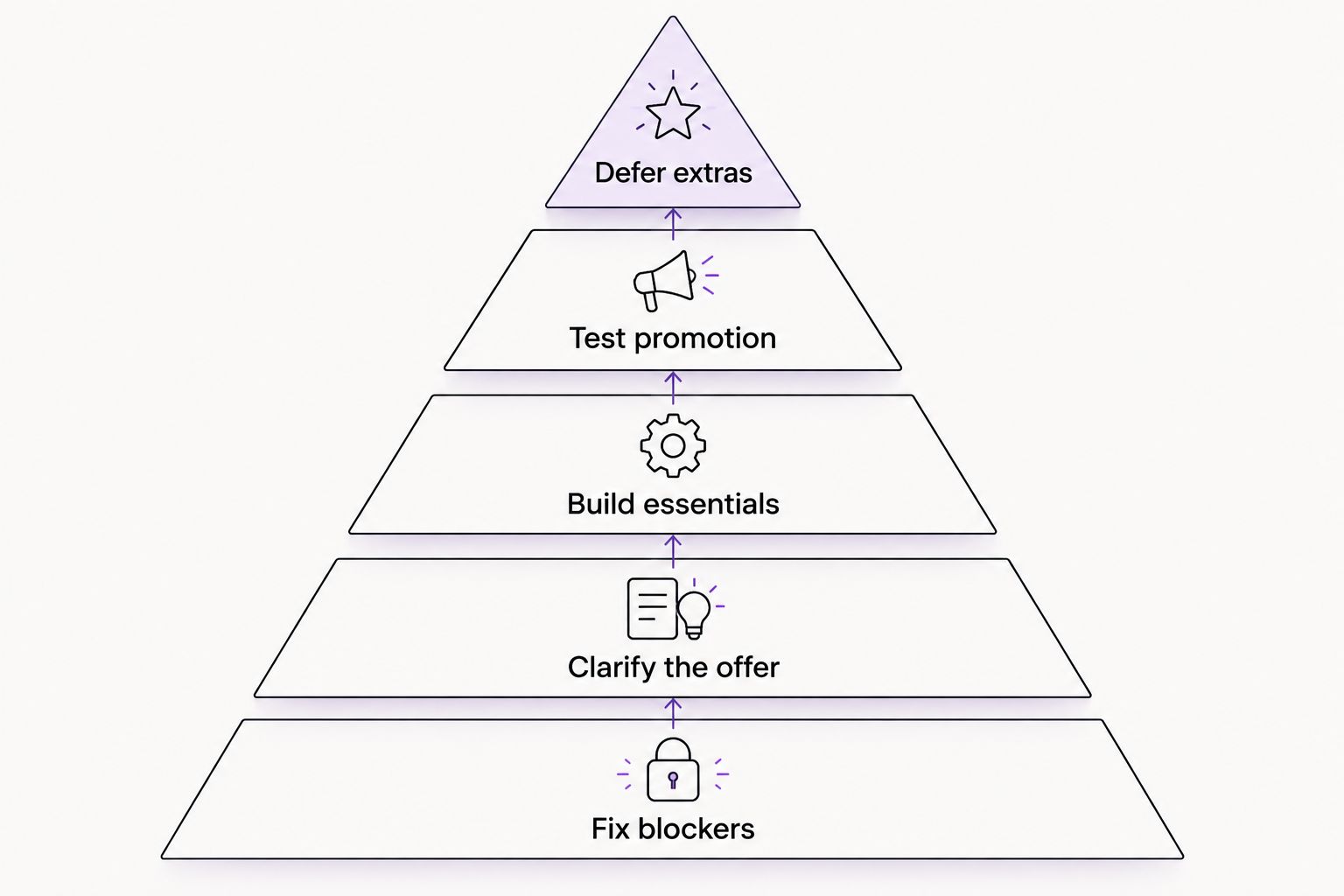
Use a priority ladder for your 2026 plan. This keeps urgent customer-facing problems separate from optional additions.
- Fix blockers: Repair broken contact paths, inaccurate business details, or confusing service information.
- Clarify the offer: Make the audience, service, and next step understandable.
- Build essentials: Create the branding or website materials needed to support that offer.
- Test promotion: Choose a focused marketing activity after the destination and inquiry path are ready.
- Defer extras: Hold work that has no clear connection to the current goal.
A written scope should name the deliverable, the person responsible, the review process, and the acceptance condition. For a contact form, acceptance means more than seeing the form on the page: the submission must reach the correct destination.
Record exclusions too. If photography, ongoing content, or account management is outside the agreement, make that explicit before work begins. Otherwise, different expectations remain hidden until a deadline approaches.
Week 4: Review completed work and decide what comes next
End the first month with a decision meeting, not a collection of unfinished suggestions. Compare the completed work with the agreed scope and identify anything still waiting on access, content, or approval.
Your 2026 review should distinguish delivery from business results. A published service page is a deliverable; a qualified inquiry is a business result. Report both without pretending they mean the same thing.
Ask for a useful handoff
You should receive a clear account of what changed and what requires attention. Depending on the scope, that includes:
- Completed deliverables and their status.
- Instructions for maintaining the work.
- Confirmation of account ownership and access.
- Available performance observations, with reporting dates.
- Recommended next work and the reason for its priority.
Do not approve another month merely because tasks remain available. Continue when the next scope addresses a real need and fits your capacity to supply information, approve work, and handle inquiries.
Why first-month priorities vary
There is no single correct package for every small business. Your first-month scope should reflect the business you have, not a standard bundle of activities.
- Launch or refresh: A new business needs foundational decisions; an established business needs a review of what already exists.
- Offer clarity: Unclear services require messaging decisions before promotional work.
- Website condition: A working website presents a different starting point from one with broken forms or outdated information.
- Available evidence: Existing inquiry records support different decisions from a business starting without tracking.
- Owner capacity: Your time for content, feedback, and approvals affects the work you can reasonably take on.
- Budget and timeline: Agree on priorities and exclusions rather than assuming every service fits the engagement.
Should you hire a consultant or use another kind of help?
Match the help to the problem. A consultant is appropriate when you need priorities and direction. A defined design or website task can call for a different arrangement.
These are selection criteria, not guarantees about any provider. Ask each person or agency what their actual scope includes.
| Option | Best for | Advantage | Limitation to check |
|---|---|---|---|
| DIY website builder | Owners with a clear offer who want to build themselves | You control edits and the working schedule | You remain responsible for content, structure, and testing |
| Freelance designer | Owners with a defined design brief | You can commission a specific deliverable | Marketing planning and implementation need explicit inclusion |
| Marketing consultant | Owners unsure which problem to address first | The engagement can focus on diagnosis and priorities | Advice does not include implementation unless agreed |
| Small branding or web agency | Owners seeking a coordinated project scope | Related work can sit within one agreement | Confirm who performs each task and handles approvals |
MORSE LLC is a fit for solo owners who want direct work with Julian Cesar Hernandez on branding and websites. Its one-person structure gives you a named working relationship; confirm how the proposed workload and your approval schedule fit together. Discuss scope around your budget and timeline rather than assuming an all-inclusive service.
Discuss your branding and website priorities
Talk through your business needs, budget, and timeline with Julian.
Should a marketing consultant redesign your website first?
A website redesign belongs first when the agreed review identifies problems that require rebuilding rather than smaller corrections. Do not approve a redesign solely because the current site looks dated.
Ask which customer task the redesign will improve and what content or functionality must change. If the issue is an unclear service description or a broken form, discuss whether a focused correction addresses it.
What results should you expect after the first month?
Expect the agreed deliverables, documented findings, and a clear next decision. Do not treat the first month as a guaranteed deadline for sales, rankings, or a steady inquiry flow.
For your 2026 reporting, agree on what is being measured and when measurement starts. If tracking begins during the engagement, distinguish the new reporting period from earlier activity rather than presenting an unsupported before-and-after claim.
How do you know whether the consultant's plan is useful?
A useful plan tells you what happens next, who does it, and why it matters. You should be able to approve or reject each proposed task without needing to translate marketing language.
Ask the consultant to explain the consequence of delaying a task. If the explanation never connects to your offer, customer experience, inquiry process, or agreed goal, ask why that task belongs in the scope.
FAQ
What should I bring to my first meeting with a small business marketing consultant?
Bring your service descriptions, customer information, existing brand materials, website details, and available inquiry records. Also explain your budget boundaries, deadlines, and capacity to approve work.
Should I hire a marketing consultant before launching my business?
Hire a consultant before launch when you need help clarifying your audience, offer, or marketing priorities. If those decisions are settled, a defined branding or website project can be the more direct next step.
Will a marketing consultant build my website?
Website development is included only when the agreement explicitly includes it. Confirm who writes the content, builds the pages, tests the inquiry process, and handles the handoff.
Should my consultant start posting on social media immediately?
Social posting should start when it supports an agreed goal and points people toward a clear offer. First confirm what you will publish, who approves it, and how interested customers should contact you.
What does MORSE LLC help small business owners with?
MORSE LLC provides branding, website development, marketing, and automation services, plus a document-generation tool. Julian Cesar Hernandez leads the one-person agency and works directly with clients.
How should I evaluate my consultant at the end of the month?
Compare completed work with the written scope, acceptance conditions, and reporting agreement. Review unresolved issues and approve further work only when the next priority is clear.
One last thing
Before adding another channel to your 2026 plan, submit your own inquiry form. Check the confirmation message, the receiving inbox, and the reply process. This simple exercise gives you a concrete customer path to discuss—and a clear problem to fix if any part fails.