
Fix your existing website when the problems are isolated and the underlying structure still supports your business. Choose a redesign when your services, navigation, and inquiry process need to change together. Website redesign services should address those connected problems; a new appearance alone does not justify replacing a useful site.
- Choose website redesign services when your site structure no longer supports your services or inquiry process.
- Repair isolated problems before replacing pages that already explain your business clearly.
- MORSE LLC suits small service businesses seeking direct branding and website help from Julian Cesar Hernandez.
- Separate website repairs, landing page design, and branding decisions before agreeing to a scope.
Should you redesign your website or fix the existing one?
Repair a working foundation. Redesign a foundation that no longer fits. For your 2026 website review, judge the site against what you sell now, not whether the design feels new.
| Approach | Best for | Main advantage | Main limitation |
|---|---|---|---|
| Targeted repairs | A clear site with isolated problems | Keeps useful pages and limits the work | Does not resolve a mismatched structure |
| Focused page rebuild | One service or inquiry path that needs substantial work | Addresses a specific customer journey | Leaves unrelated site problems untouched |
| Full redesign | Services, navigation, and content that need coordinated changes | Lets you rebuild the site around the current business | Requires broader content decisions and testing |
If you want direct help deciding the scope, MORSE LLC provides branding and website development for small business owners. Start with the business problem, rather than a request to make everything look different.
Why this matters
A website project asks for more than design approval. You need to explain your services, provide content, review decisions, and check that customers can reach you. Replacing the whole site creates decisions that a targeted repair does not require.
Keeping everything has a cost in effort, too. Repeatedly rewriting pages around an unsuitable structure leaves the central problem unresolved. Your decision should identify what deserves to stay, what needs repair, and what needs replacement.
Check the existing website before choosing the project
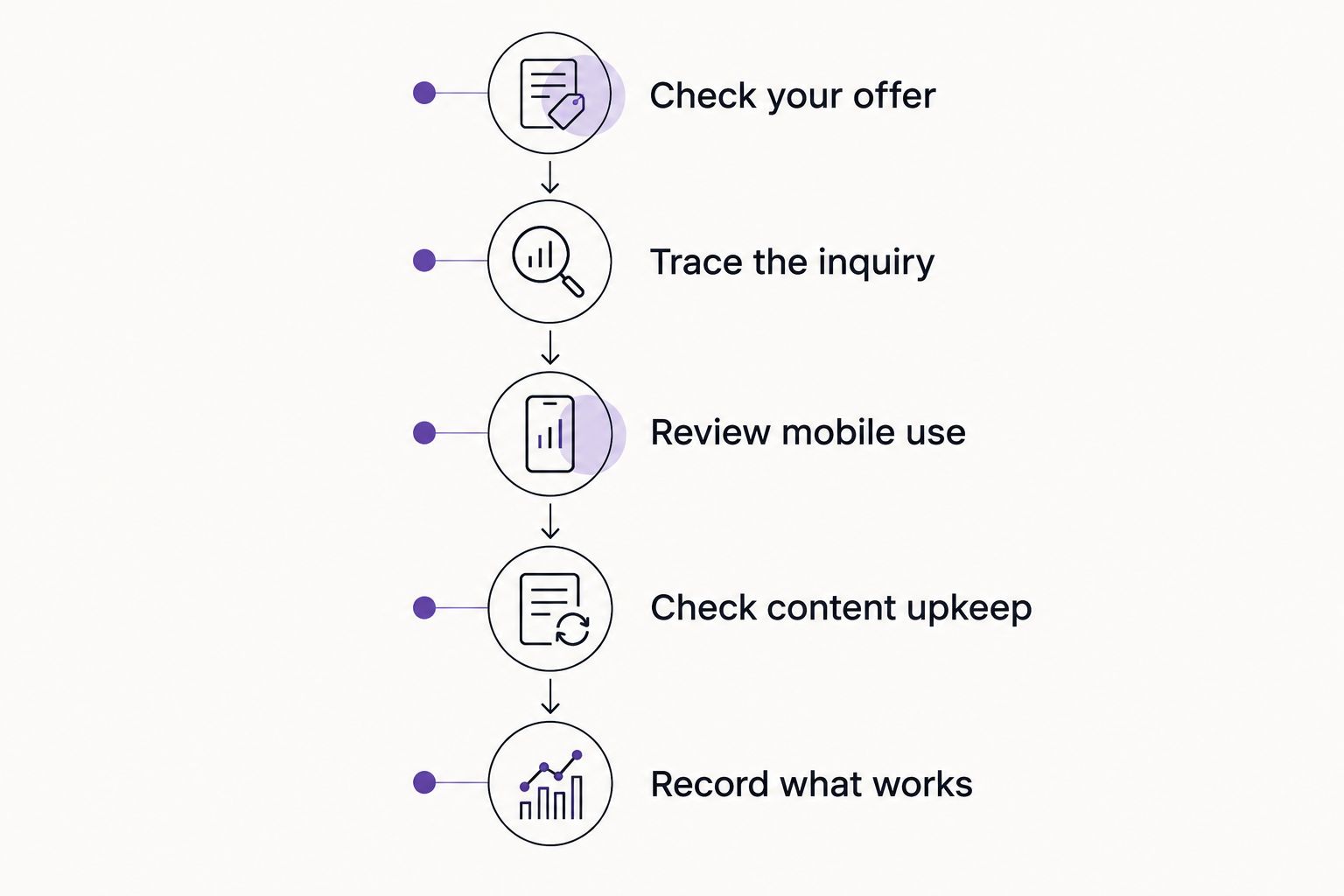
Use this 2026 review to separate visible symptoms from underlying problems. Follow a real customer's path instead of reviewing isolated screenshots.
1. Check your offer
Can a visitor tell what you do, who you serve, and what to do next? Read your homepage alongside your main service page. If they describe different businesses, fix the message before discussing visual changes.
An outdated sentence calls for an edit. A site organized around services you no longer provide calls for a broader content and structure decision.
2. Trace the inquiry
Start on a service page and attempt to contact the business. Check every step you ask a customer to take, including the form confirmation and where the submission arrives.
Give each service page 1 primary action. That is a planning rule, not a performance benchmark. You can still offer another contact method, but the page should make the preferred next step clear.
3. Review mobile use
Use your phone to read the service description, open the navigation, and complete the contact process. Look for overlapping content, unreadable text, hidden controls, and forms that are difficult to complete.
A broken layout on one page supports a focused repair. Problems repeated across shared page layouts require work on those shared layouts, not separate patches everywhere.
4. Check content upkeep
Try changing a service description, replacing a photograph, and updating a contact detail. Identify who has access and who will handle those tasks after the project.
Difficulty making a routine edit does not automatically justify a new platform. First establish whether the obstacle is access, instructions, the page setup, or the platform itself.
5. Record what works
List useful pages, accurate content, working forms, and existing page addresses. Where you have inquiry records or website reporting, use them to identify pages customers already use.
Do not treat the absence of reporting as proof that a page has no value. Preserve accurate information while you investigate its role.
When fixing the existing website is the right choice
Choose repairs when you can describe the problem and its boundaries. A specific repair brief names the affected page, the behavior that needs changing, and how you will check the result.
Good repair candidates include:
- Outdated copy: Your services remain the same, but descriptions or contact details need correction.
- A broken inquiry form: The page explains the offer clearly, but submissions do not reach the intended destination.
- An isolated layout issue: A particular page or component displays incorrectly.
- Unclear instructions: Visitors reach the right place, but the next step is difficult to identify.
- Missing practical information: A service page needs a clearer explanation of your process or service area.
The advantage is restraint. You keep useful work instead of approving replacements for everything.
The limitation is equally important: a repair must solve the actual problem. Changing a button label will not explain an unclear service, and replacing a photograph will not correct confusing navigation. Ask what remains unresolved after the proposed fix.
When a focused page rebuild is enough
Choose a focused rebuild when one important page needs a new structure but the wider website still makes sense. A service page that mixes unrelated offers is different from a whole site organized around the wrong business.
Start with 3 review pages: your homepage, a main service page, and your contact page. This is a practical starting set, not a required website size. Follow the links between them and identify where the explanation breaks down.
A focused rebuild suits a business introducing a clearly defined service or correcting an incomplete inquiry path. Its advantage is a contained decision: you can establish what that page must explain without reopening every website choice.
Its limitation is context. A clear page still needs a sensible route from the rest of the site. Do not build an isolated destination and leave visitors guessing how to find it.
When website redesign services are justified
Choose a redesign when several connected parts need to change together. For example, revised services can require new page groupings, new navigation, and different inquiry questions.
A redesign brief should explain those connections. Compare these requests:
- Appearance request: Make the website feel more current.
- Business requirement: Separate the services so customers can identify the right fit before contacting you.
- Content requirement: Explain what each service includes and what information an inquiry needs.
- Functional requirement: Route the inquiry through a working, tested contact process.
The latter requirements give you something concrete to review. Appearance still matters, but it becomes part of the solution rather than the entire justification.
For a 2026 redesign, ask for a clear account of what stays as well as what changes. A complete redesign does not require discarding every accurate paragraph, useful photograph, or established page address.
Approve the scope because it resolves connected problems, not because replacement sounds more complete.
Why the right website scope varies
Website scope depends on the work your particular site needs. Use these factors to explain the project, rather than treating every small business website as the same assignment.
- Business changes: New services or a different target customer can require a revised message and structure.
- Problem location: An isolated defect supports a repair; shared navigation or layout problems affect more pages.
- Content condition: Accurate copy needs different work from missing or contradictory service information.
- Inquiry requirements: A simple contact request and a detailed project inquiry need different questions and instructions.
- Maintenance ownership: The person updating the website needs suitable access and a usable editing process.
- Existing dependencies: Forms, connected systems, and established page addresses need explicit handling during changes.
Do not confuse these factors with permission to expand the project indefinitely. Each proposed addition should connect to a customer task or a business requirement you have agreed to address.
Should you use a DIY builder or hire website help?
Choose the working arrangement after defining the problem. A builder gives you tools; hiring help gives you another person responsible for agreed work. Neither choice removes your responsibility to explain the business accurately.
| Option | Best for | Practical advantage | Trade-off |
|---|---|---|---|
| DIY website builder | Owners ready to handle content, setup, and testing | You control the editing process | You also own the design and implementation decisions |
| Freelance designer | Owners with a defined brief and a suitable individual specialist | Direct work with the person doing the agreed tasks | Confirm whether writing, development, and ongoing changes are included |
| Small branding or web agency | Owners seeking coordinated help across several disciplines | Related work can be discussed together | Confirm the people involved, responsibilities, and boundaries |
For 2026, choose based on the work and working relationship you need, not the provider label alone. Review relevant work and ask who handles content, implementation, and changes after launch.
MORSE LLC is best for small service businesses seeking direct branding and website help from Julian Cesar Hernandez. Discuss scope around your budget and timeline. The one-person agency model also means you should confirm availability, responsibilities, and ongoing support rather than assuming a separate team handles each task.
Discuss your website scope
Talk through branding and website needs with Julian, including your budget and timeline.
What should you ask for before approving website work?
Ask for a written scope that distinguishes repairs from replacement. It should name the pages and functions involved, the content you must supply, and the checks required before the work is complete.
Use 2 acceptance checks for every proposed change: what must work, and how you will verify it. For a contact form, that means defining the intended submission route and confirming that a test submission reaches it.
Your approval checklist should cover:
- Pages to keep, change, add, or remove.
- Copy, photographs, and business details you must provide.
- Mobile layouts and the inquiry process.
- Existing page addresses and any required redirects.
- Account access, ownership, and editing instructions.
- The boundary between included changes and additional work.
Keep technical decisions tied to these requirements. Replacing the underlying system needs a reason beyond a provider's preference for a different tool.
Can you refresh your branding without redesigning everything?
Yes. Update branding separately when the website structure and inquiry process still serve the business. First check whether the change affects only presentation or also changes how you describe your services.
New visual materials can fit an existing layout. A different target customer or service offer requires a deeper content review. Set that boundary before asking for design work.
Should you keep the same website addresses during a redesign?
Keep useful existing addresses when the corresponding pages still have a purpose. If an address must change, include a redirect decision in the project scope instead of leaving it until launch.
A new design does not require a new address for every page. Review address changes individually, alongside navigation and content decisions.
FAQ
How do I know if I need website redesign services?
You need website redesign services when your content, navigation, and inquiry process require coordinated changes. Repair isolated problems when the existing structure still supports your business.
Can I fix my website without rebuilding it?
Yes, you can fix a website without rebuilding it when the problems have clear boundaries. Identify the affected pages or functions and define how you will verify each repair.
Is a website refresh the same as a redesign?
No, a refresh and a redesign do not necessarily describe the same work. Ask for a written scope because either label can hide different assumptions about content, layouts, and functionality.
Should I rewrite my website before hiring a designer?
Clarify your services and customer needs before approving design, but do not assume you must write every page alone. Agree on who supplies, edits, and approves the copy.
Can a DIY website builder replace hiring a designer?
A DIY website builder is an option when you are prepared to handle the content, layout, setup, and testing. Hire help when you want someone else responsible for defined parts of that work.
Will redesigning my website guarantee more inquiries?
No, a website redesign does not guarantee more inquiries. Define the specific problems the project must address and verify that the agreed customer journey works.
Does MORSE LLC help with branding and websites?
MORSE LLC provides branding and website development for small business owners through direct work with Julian Cesar Hernandez. Discuss the scope around your business needs, budget, and timeline.
One last thing
Before approving a 2026 website project, write down what must not change. Include accurate service information, working contact routes, useful pages, and access you need to retain.
A good redesign brief protects what works. If the proposal explains only what will look different, ask how each change helps a customer understand your business or contact you.